.NET
Microsoft Technologies based on the .NET software framework.

3,367 questions
This browser is no longer supported.
Upgrade to Microsoft Edge to take advantage of the latest features, security updates, and technical support.
' cx='32' cy='32' r='32' /%3E%3Ctext x='50%25' y='55%25' dominant-baseline='middle' text-anchor='middle' fill='%23FFF' %3ESQ%3C/text%3E%3C/svg%3E)
I have a WCF Web Services in Azure App Service , this WCF use a dll with RSA objects, WCF and dll were build in .NET Framework and C#. I tried use:
RSACryptoServiceProvider rsaCryptoServiceProviderPrivateKey = (RSACryptoServiceProvider)p_x509Certificate2.PrivateKey;
and:
RSA rsaPrivateKey = p_x509Certificate2.GetRSAPrivateKey();
but I have this error:
System.Security.Cryptography.CryptographicException: Invalid provider type specified.
at System.Security.Cryptography.Utils.CreateProvHandle(CspParameters parameters, Boolean randomKeyContainer)
at System.Security.Cryptography.Utils.GetKeyPairHelper(CspAlgorithmType keyType, CspParameters parameters, Boolean randomKeyContainer, Int32 dwKeySize, SafeProvHandle& safeProvHandle, SafeKeyHandle& safeKeyHandle)
at System.Security.Cryptography.RSACryptoServiceProvider.GetKeyPair()
at System.Security.Cryptography.RSACryptoServiceProvider..ctor(Int32 dwKeySize, CspParameters parameters, Boolean useDefaultKeySize)
at System.Security.Cryptography.X509Certificates.X509Certificate2.get_PrivateKey()
The Azure App Service configuration:
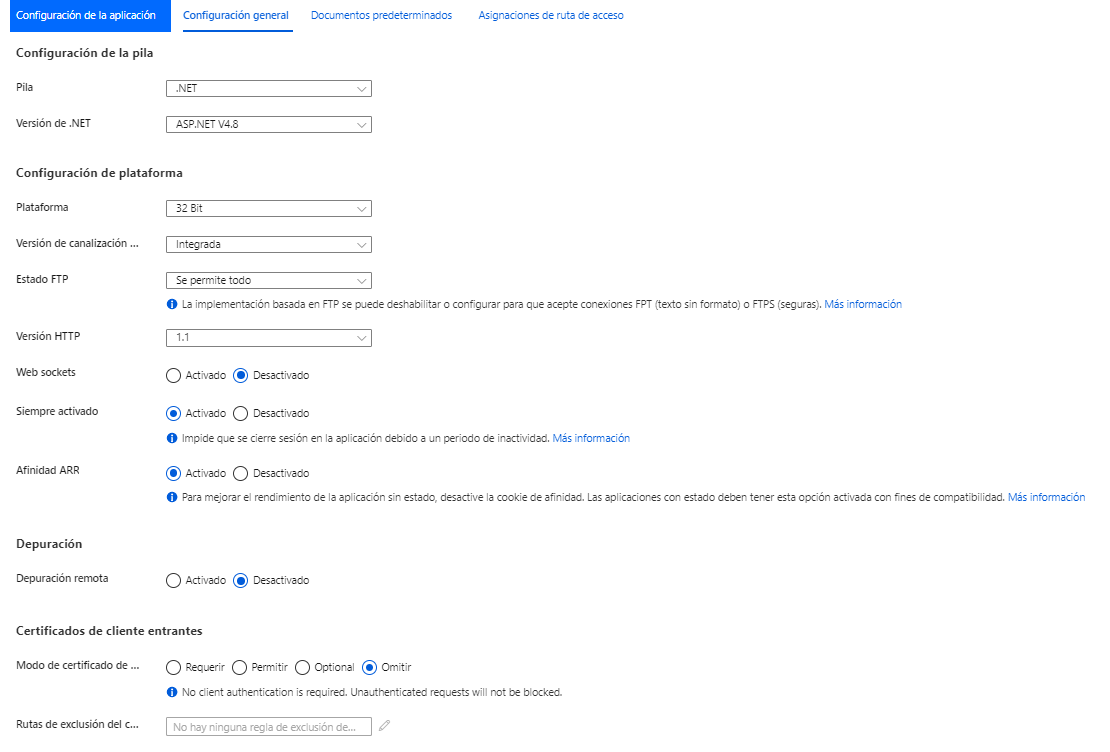
How I can fix this problem?
Note: I only use X509Certificate2 file content, I do not have a file .pfx or .p12 in a physically store.
Thanks.

' cx='32' cy='32' r='32' /%3E%3Ctext x='50%25' y='55%25' dominant-baseline='middle' text-anchor='middle' fill='%23FFF' %3ELH%3C/text%3E%3C/svg%3E)
Hi @Sicoy Quito ,
You can try the following code to instantiate X509Certificate, used with GetRSAPrivateKey().
You can also try changing the permissions of the folder
x509Certificate = new X509Certificate2(rawData, password, X509KeyStorageFlags.MachineKeySet | X509KeyStorageFlags.PersistKeySet | X509KeyStorageFlags.Exportable);
Best regards,
Lan Huang
Thank you very much, that flags in X509Certificate2 resolved the problem.
' cx='32' cy='32' r='32' /%3E%3Ctext x='50%25' y='55%25' dominant-baseline='middle' text-anchor='middle' fill='%23FFF' %3EDN%3C/text%3E%3C/svg%3E)
I also had the same problem - I was able to solve only by importing the PFX into the local machine certificate store then re-exporting (with private key). But then I had to change my code to use UserKeySet instead of MachineKeySet (or it would throw an "Access denied" error just trying to create the X509Certificate, vs the previous error that occurred only when accessing the PrivateKey member).