Σημείωμα
Η πρόσβαση σε αυτήν τη σελίδα απαιτεί εξουσιοδότηση. Μπορείτε να δοκιμάσετε να εισέλθετε ή να αλλάξετε καταλόγους.
Η πρόσβαση σε αυτήν τη σελίδα απαιτεί εξουσιοδότηση. Μπορείτε να δοκιμάσετε να αλλάξετε καταλόγους.
Databricks understands the importance of your data and the trust you place in us when you use our platform and Databricks AI assistive features. Databricks is committed to the highest standards of data protection, and has implemented rigorous measures to ensure information you submit to Databricks AI assistive features is protected.
- Your data remains confidential.
- Databricks does not use data, prompts, or responses submitted to or output from these features to train generative foundation models that Databricks makes available for use by third parties.
- Our model partners do not retain data you submit through these features, even for abuse monitoring. Our partner-powered AI assistive features use zero data retention endpoints from our model partners.
- Protection from harmful output. When using Azure OpenAI, Databricks also uses Azure OpenAI content filtering to protect users from harmful content. When using Anthropic models, Databricks relies on Anthropic’s built-in safety mechanisms and additional hardening against harmful outputs as described in Anthropic’s safety documentation. In addition, Databricks has performed an extensive evaluation with thousands of simulated user interactions to ensure that the protections put in place to protect against harmful content, jailbreaks, insecure code generation, and use of third-party copyright content are effective.
- Databricks uses only the data necessary to provide the service. Data is sent only when you interact with Databricks AI assistive features, or as needed to provide the features. Databricks sends your prompt, relevant table metadata and values, errors, as well as input code or queries to help return more relevant results.
- Data is protected in transit and at rest. All traffic between Databricks and model partners is encrypted in transit with industry standard TLS encryption. Any data stored within an Azure Databricks workspace is AES-256 bit encrypted.
- Databricks offers data residency controls. Databricks AI assistive features are Designated Services and comply with data residency boundaries. For more details, see Databricks Geos: Data residency and Databricks Designated Services.
For more detail on how specific features handle your data, see the privacy and security FAQs.
Data sent to the models
What services and models do partner-powered AI assistive features use?
If the partner-powered AI features setting is enabled, Databricks AI assistive features use models hosted by Azure OpenAI service or Anthropic on Databricks.
Some features, such as Genie Code Autocomplete, use a Databricks-hosted model even when the setting is enabled. If you disable the partner-powered AI features setting, some AI assistive features may use a Databricks-hosted model. For more information, see Partner-powered AI features.
What data is sent to the models?
Databricks sends only the data needed to provide the service. In general, this includes your prompt (for example, your question, code, or query) and relevant metadata such as table and column names and descriptions, sample values, errors, and previous questions. The exact data differs by feature:
- Genie Code sends code and queries in the current notebook cell or SQL editor tab, table and column names and descriptions, previous questions, and favorite tables. In Agent mode, Genie Code can also analyze cell outputs and read data samples from tables, similar to other coding agents in the industry.
- Genie Agents use the natural language prompt, table names and descriptions, relevant values, general instructions, example SQL queries, and SQL functions.
- Genie Ontology is a map of your data and business that Genie automatically builds and maintains by extracting knowledge from sources such as tables, queries, dashboards, notebooks, documents, and connected apps. Extracted ontology snippets respect the permissions of the source assets and documents.
- AI-generated comments send metadata for the object being documented and its parent objects, including catalog, schema, table, function, model, and volume names, their current comments, and column details (name, type, whether it's a primary key, and current column comment).
Does the data sent to the models respect the user's Unity Catalog permissions?
Yes, all data sent to AI assistive feature models respect Unity Catalog permissions, so no data users do not have access to is sent to such models.
Do partner model providers store my data?
No. When using partner models through Databricks, partner model providers do not store prompts or responses.
Storage and access
Where are responses from AI assistive features stored?
Genie Agent responses and approved AI-generated comments are stored in the Databricks control plane database. The control plane database is AES-256 bit encrypted.
Genie Code chat history is stored in the same place as other notebook content.
Who can see my chat history with Genie Code or Genie Agents?
You can view your own Genie Code chats. Admins can view the chat thread if they have a direct link. When you share a chat thread, recipients can view it. See Share a chat thread.
Genie Agent managers can see other users’ messages, but not their query results. Conversations with Genie Agents follow conversation sharing settings.
Code execution and accuracy
Do Genie Agents or Genie Code execute code?
Genie Agents are designed with read-only access to customer data, so they can only generate and run read-only SQL queries.
With Agent mode, Genie Code can run code in the notebook and SQL editor. At first, Genie Code will ask you for confirmation to proceed with execution. You can choose to confirm, always allow execution in the current Genie Code thread, or always allow execution. Other Genie Code modes do not automatically run code on your behalf.
AI models can make mistakes, misunderstand intent, and hallucinate or give incorrect answers. Review and test AI-generated code before you run it.
Has Databricks done any assessment to evaluate the accuracy and appropriateness of the responses from AI assistive features?
Yes, Databricks has done extensive testing of all of our AI assistive features based on their expected use cases and using simulated user inputs to increase the accuracy and appropriateness of responses. That said, generative AI is an emerging technology, and AI assistive features may provide inaccurate or inappropriate responses.
Data residency and compliance
How is my traffic routed through Geos?
Databricks AI assistive features are designated services that use Databricks Geos to manage data residency when processing customer content. Traffic routing depends on your region and whether cross-Geo processing is enabled (the Enforce data processing within workspace Geography for Designated Services is disabled).
Can I use AI assistive features with tables that process regulated data (PHI, PCI, IRAP, FedRAMP)?
Yes. To do so, you must comply with requirements, such as enabling the compliance security profile, and add the relevant compliance standard as part of the compliance security profile configuration.
Databricks-hosted models
How do AI assistive features work with Databricks-hosted models?
When partner-powered AI features are disabled, AI assistive features use Databricks-hosted models, which are entirely Databricks-selected and Databricks-managed. Databricks uses open-source models that are available for commercial use, such as OpenAI GPT OSS.
The following diagram provides an overview of how a Databricks-hosted model powers Databricks AI-powered features such as Quick Fix.
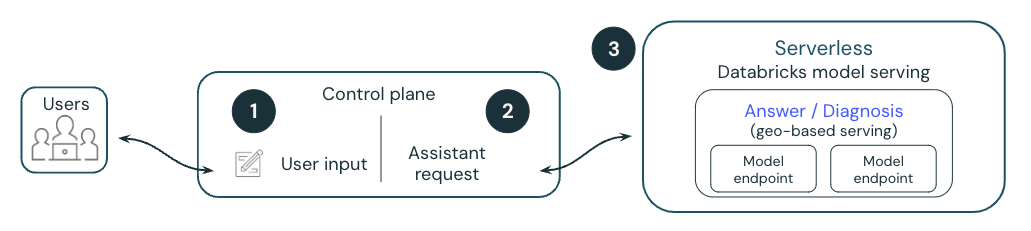
- A user executes a notebook cell, which results in an error.
- Databricks attaches metadata to a request and sends it to a Databricks-hosted large-language model (LLM). All data is encrypted at rest. Customers can use a customer-managed key (CMK).
- The Databricks-hosted model responds with the suggested code edits to fix the error, which is displayed to the user.