Note
Access to this page requires authorization. You can try signing in or changing directories.
Access to this page requires authorization. You can try changing directories.
Memory lets AI agents remember information from earlier in a conversation or from previous conversations. With memory, agents provide context-aware responses and build personalized experiences over time.
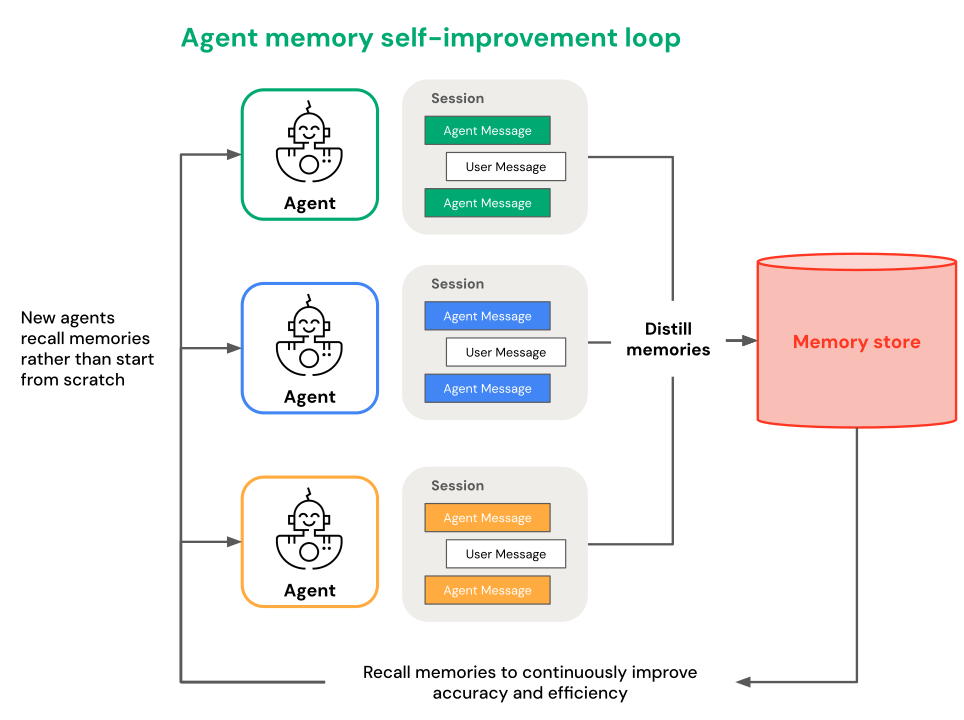
Use agent memory when you want your agent to:
- Remember user preferences, past decisions, or accumulated context across sessions.
- Share knowledge and preferences between multiple agents and projects.
- Improve in accuracy and efficiency over time.
Choose a memory option
Azure Databricks has two approaches to agent memory.
| Memory option | Best for |
|---|---|
| Managed agent memory (Beta) | Databricks manages memory infrastructure secured with Unity Catalog governance. Supports agents built with any framework that need per-user, cross-session memory. |
| Self-managed agent memory (Lakebase) | You manage the underlying memory store using Lakebase. Supports custom agents built with LangGraph or the OpenAI Agents SDK that need direct SQL access to short-term and long-term conversation state. |
Memory scaling for agents
Memory comes in different forms. Episodic memory captures raw interactions, such as conversation logs and user feedback, whereas semantic memory distills those interactions into reusable facts and rules. You can also scope memory to an individual user or share it as organizational knowledge across a team.
As an agent accumulates more of this context, its accuracy and efficiency can improve. Databricks research calls this pattern memory scaling. For these findings, see Memory scaling for AI agents from Databricks research.