Note
Access to this page requires authorization. You can try signing in or changing directories.
Access to this page requires authorization. You can try changing directories.
Azure Databricks released these features and improvements in October 2026.
Note
Releases are staged. Your Azure Databricks account might not be updated until a week or more after the initial release date.
Workspace-level package repositories for Databricks Apps are generally available
October 14, 2026
Workspace admins can now configure default Python and npm package repositories for Databricks Apps. Apps inherit the workspace configuration while still allowing app-level overrides.
See Configure default package repositories.
On-demand state repartitioning is now generally available
October 13, 2026
On-demand state repartitioning is now generally available. You can resize the number of shuffle partitions for a stateful Structured Streaming query or Lakeflow pipeline without losing checkpoint state. See On-demand state repartitioning for stateful streaming queries.
Google Gemini 4 Argon is now available on Unity Gateway
October 13, 2026
Google Gemini 4 Argon is now available on Unity Gateway. You can access this model using Foundation Model APIs.
Customers are responsible for ensuring their compliance with applicable terms.
External access to views through the Unity REST API is generally available
October 13, 2026
External engines can now query Unity Catalog views over Delta Lake tables through the Unity REST API. See External access to views.
Databricks AI Runtime SDK replaces serverless_gpu
October 13, 2026
Starting in GPU environment version 6, the Databricks AI Runtime SDK (databricks-sdk-air) replaces the deprecated serverless_gpu package. It provides the @distributed and ray_init APIs and the databricks.air.data utilities under the databricks.air namespace. The gpus and gpu_type arguments are renamed to num_accelerators and accelerator_type. The old names still work in databricks.air but emit a FutureWarning, and support will end in version 7.
Serverless GPU environment version 6 includes both packages. Version 6 is the last version that includes serverless_gpu. Versions 5 and below continue to use it. See Migrate from serverless_gpu.
Unity Gateway Skills API and developer tools are available in Beta
October 12, 2026
The Unity Gateway Skills REST API is now available in Beta, with create, read, update, list, delete, and finalize support across Azure Databricks developer tools:
- Databricks CLI
- Python SDK
- Go SDK
- Go Modular SDK
- Java SDK
- JavaScript SDK
See the Skills API and SDK reference.
Governed tag propagation is in Beta
October 12, 2026
Tag propagation in Unity Catalog is in Beta. When you enable tag propagation for a governed tag, Unity Catalog uses lineage to automatically apply that tag to derived tables and views whenever a supported operation runs, such as CREATE TABLE AS SELECT, CREATE VIEW, INSERT INTO ... SELECT, or MERGE. This keeps classification and ABAC enforcement consistent at both the table and column levels as data moves downstream.
See Tag propagation.
Parameters for Lakeflow pipelines are now generally available
October 12, 2026
Pipeline parameters are now generally available. Parameterize Lakeflow pipeline SQL source code with key-value pairs so a single pipeline can run against different catalogs, schemas, or tables without editing the source. Define parameter defaults in pipeline settings, override them when you start an update, and reference them in SQL with named parameter syntax. See Use parameters with pipelines.
Agent memory pipelines are in Beta
October 12, 2026
Agent memory pipelines are in Beta. A memory pipeline connects a session store to a memory store. Each run uses an LLM to distill durable facts, preferences, and decisions from stored conversations into memory entries that your agent recalls in later conversations. You can run a pipeline on demand or about every 24 hours. See Agent memory pipelines.
Knowledge Assistant and Supervisor Agent are now legacy
October 12, 2026
Knowledge Assistant and Supervisor Agent are now legacy offerings. For new agents written in code, Databricks recommends the Agent Bricks CLI. To build agents without code, use Genie Agents. See Legacy agent offerings.
Feature Views are now generally available
October 12, 2026
Feature Views are now generally available for batch, streaming, and request-time data. They will be enabled for compliance security profile workspaces in mid-November 2026. See Feature Views.
Use request tags in Unity Gateway service policies (Beta)
October 9, 2026
Custom service policies in Unity Gateway can now check caller-supplied request tags, such as requiring a tag before a model request or MCP tool call proceeds. See Request tags.
Use OpenJev as the evaluator for LLM-as-a-judge service policies (Beta)
October 9, 2026
You can now select OpenJev (Qwen3.5 4B) as the evaluator model service of a custom LLM-as-a-judge service policy. OpenJev classifies content without generating output tokens, so it typically responds faster than a chat evaluator. See Use OpenJev as the evaluator.
Google Workspace connector is available in Beta
October 9, 2026
The managed Google Workspace connector is now available in Beta in Databricks Lakeflow Connect.
Use the connector to ingest audit activity from Google Workspace applications and services into Azure Databricks. The connector uses OAuth user authorization and supports incremental ingestion.
Unity Gateway supports Amazon Bedrock Mantle
October 9, 2026
You can now access Amazon Bedrock Mantle models through Unity Gateway model provider services, with Unity Catalog permissions, rate limits, budgets, and inference tables. See Model providers external to Databricks.
Productboard connector is available in Beta
October 8, 2026
The managed Productboard connector is now available in Lakeflow Connect in Beta. Workspace admins can control access to this feature from the Previews page.
Use the connector to ingest product hierarchy, roadmap, objectives, customer feedback notes, and workspace member data from Productboard into Azure Databricks. The connector uses Server-to-Server OAuth authentication and supports incremental ingestion for notes, UI-based pipeline authoring, Declarative Automation Bundles, and API-based pipeline authoring.
The Discover page and domains are now GA
October 8, 2026
The Discover page and domains are now generally available. Discover is a curated browsing experience that helps users find assets across Azure Databricks without requiring deep knowledge of catalog hierarchies. Use domains and subdomains to organize assets such as tables, dashboards, notebooks, and Genie Agents by business area, highlight key assets with custom curation, and explore AI-recommended assets.
Azure Standard HDD OS disk retirement
October 8, 2026
Azure will retire Standard HDD OS disks on September 8, 2028. Before this date, Azure Databricks will migrate the affected classic compute resources. A future release note will confirm when the migration is complete and when to restart your compute.
Enforce partner guardrails with external service policies (Beta)
October 7, 2026
You can now enforce a third-party guardrail on Unity Gateway traffic. An external service policy sends request and response content to your guardrail vendor and blocks the call when the vendor denies it, with no changes to your applications. See Enforce a partner guardrail with an external service policy.
DeepSeek V4.1 Flash supports priority pay-per-token and reserved provisioned throughput
October 7, 2026
You can now use DeepSeek V4.1 Flash with priority pay-per-token for latency-sensitive traffic or reserved provisioned throughput for dedicated capacity.
Dataset materialization for AI/BI dashboards is now in Beta
October 7, 2026
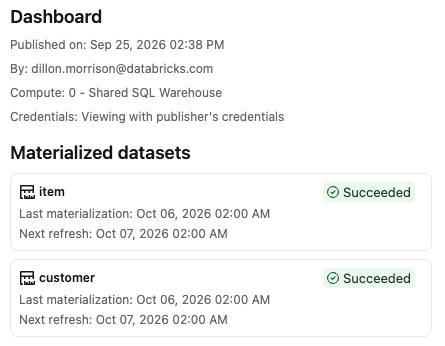
You can now pre-compute and store dashboard dataset results on a schedule to make dashboard interactivity much faster. Published dashboards render from stored results instead of rerunning expensive queries on every load or interaction. See Dataset materialization in AI/BI dashboards.
Azure Databricks integration for Microsoft Copilot Studio is now generally available
October 7, 2026
Using Azure Databricks data in Microsoft Copilot Studio is now generally available. Connect Genie Agents as tools or use your Azure Databricks data as a knowledge source to build custom agents. See Use Azure Databricks data in Microsoft Copilot Studio.
Anthropic Claude Haiku 5.5 is now available on Unity Gateway
October 7, 2026
Anthropic Claude Haiku 5.5 is now available on Unity Gateway. You can access this model using Foundation Model APIs.
Customers are responsible for ensuring their compliance with applicable terms.
Metric view window measures are generally available
October 6, 2026
Window measures in metric views are now generally available. Window measures define rolling window, cumulative, or semiadditive aggregations, such as moving averages, period-over-period changes, and running totals. See Window measures.
Zhipu AI GLM 5.2 is now a legacy model
October 6, 2026
GLM 5.2 is now a legacy model. Databricks recommends migrating to GLM 5.3 or GLM 5.3 Flash.
Genie Code CLI is in Beta
October 6, 2026
Genie Code CLI is a coding agent that runs in your terminal, tuned for data and AI work on Azure Databricks. It works with your local files and uses the Databricks CLI to discover data, answer questions, and build and deploy assets such as pipelines, models, and apps. Model access is provided and governed through Unity Gateway. See Genie Code CLI.
DeepSeek V4 Flash (0731) is scheduled for retirement
October 6, 2026
DeepSeek V4 Flash (0731) will be retired on November 5, 2026. DeepSeek V4.1 Flash is the recommended replacement. See Deprecated and retired models for migration guidance.
Use multiple triggers for Lakeflow Jobs (Beta)
October 5, 2026
Lakeflow Jobs can now use up to five triggers. You can combine trigger types, add multiple triggers of the same type, and pause each trigger independently. See Add multiple triggers to a job.
Run Lakeflow pipelines as a group
October 5, 2026
You can now set a pipeline's run-as identity to an account group, in addition to a user or a service principal. Pipeline updates run with the group's permissions, so a team can own an automated pipeline without tying it to one person's account. See Set the run-as identity to a group.
Genie Code scheduled tasks are now available by default for workspaces with the compliance security profile enabled
October 5, 2026
Genie Code scheduled tasks are now available by default for workspaces with the compliance security profile enabled.
See Genie Code scheduled tasks.
ai_parse_document now extracts chart data as JSON
October 5, 2026
ai_parse_document now extracts chart values as structured JSON and describes their series, legends, and axes. Search and agents can use these values in answers. See ai_parse_document function.
Agent Bricks documentation for code-first agent development
October 5, 2026
The Agent Bricks documentation now centers on building, deploying, and running custom agents in code. See Develop agents on Azure Databricks:
- Agent compute stack: New pages describe how a deployed agent's framework or harness, agent server, and agent runtime fit together. See Deploy agents on Azure Databricks.
DurableAgentServerand Agent Runtime:DurableAgentServerserves agents through the invocation API, with synchronous, streaming, and background runs, persistent run state, and crash recovery. Agent Runtime runs it on Databricks Apps. See Agent Server and Agent Runtime.- Querying agents: The query guide is organized by agent server, starting with the invocation API. See Query agents deployed on Azure Databricks.
- Legacy offerings: Offerings that are no longer recommended for new agents, including the MLflow
AgentServer,LongRunningAgentServer, and agents deployed to Model Serving, are now in a Legacy section that maps each one to its replacement. See Legacy agent offerings.
OpenJev (Qwen3.5 4B) is now available on Unity Gateway
October 2, 2026
OpenJev (Qwen3.5 4B) is available as a pay-per-token model service. Use the TypeSafe System One API to evaluate yes or no, choice, and scoring questions and get structured answers and probabilities. See model availability by region.
Customers are responsible for ensuring their compliance with applicable model terms.
JDBC Unity Catalog connections are now generally available
October 2, 2026
JDBC Unity Catalog connections are now generally available on serverless compute, Databricks Runtime 19 and above, and SQL warehouses 2025.40 and above, including support for SSL certificates. OAuth M2M authentication remains in Beta. See JDBC connection.
Save reusable query templates in Google Sheets
October 2, 2026
The Databricks Connector for Google Sheets now lets you save imports as a reusable template that you and your team can run in one step, each with your own Unity Catalog permissions. See Templates in Google Sheets and Query Azure Databricks data in Google Sheets.
Google Gemini 2.5 Pro is retired
October 2, 2026
Google Gemini 2.5 Pro is no longer available. The recommended replacement models are Gemini 3.1 Pro or Gemini 3.5 Flash. See Deprecated and retired models for migration guidance.
Google Gemini 2.5 Flash is retired
October 2, 2026
Google Gemini 2.5 Flash is no longer available. The recommended replacement models are Gemini 3.1 Pro or Gemini 3.5 Flash. See Deprecated and retired models for migration guidance.
Customer-managed keys for query history are now generally available
October 2, 2026
You can now use a customer-managed key on the system catalog to decrypt statement_text and error_message in the query history system table. See Reading encrypted fields.
Standard ai_extract now delivers higher-quality extraction
October 2, 2026
The standard (default) mode for ai_extract now uses a new model checkpoint that is 2.3x faster while improving overall quality at no additional cost. See the ai_extract documentation.
GitLab connector is available in Beta
October 1, 2026
The managed GitLab connector is now available in Lakeflow Connect in Beta. Workspace admins can control access to this feature from the Previews page.
Use the connector to ingest repository, project, group, CI/CD, and security data from GitLab into Azure Databricks. The connector uses OAuth U2M authentication and supports incremental ingestion, UI-based pipeline authoring, Declarative Automation Bundles, and API-based pipeline authoring.
Schedule automatic data refresh in the Azure Databricks Excel Add-in (Public Preview)
October 1, 2026
You can now schedule automatic refreshes of Azure Databricks data imported into Microsoft Excel. Choose an interval or calendar schedule and the SQL warehouse that runs each refresh, then review recent runs from the Azure Databricks Excel Add-in. See Schedule automatic data refresh in the Azure Databricks Excel Add-in.
Cross-engine attribute-based access controls (ABAC) is now generally available
October 1, 2026
Cross-engine attribute-based access controls (ABAC) is now generally available. Supported external engines can read Unity Catalog managed tables with ABAC policies, row filters, and column masks enforced by Azure Databricks serverless compute.
See Cross-engine attribute-based access controls (ABAC) for requirements, supported clients, and serverless compute costs.