Note
Access to this page requires authorization. You can try signing in or changing directories.
Access to this page requires authorization. You can try changing directories.
In Microsoft Dataverse, activities are tasks that you or your teams perform when they contact customers, such as sending letters or making telephone calls. You can create activities for yourself, assign them to someone else, or share them with other users or teams. An activity is any action that you can enter on a calendar and has time dimensions (start time, stop time, due date, and duration) that help determine when the action occurred or is to occur. Activities have basic properties that help determine what action the activity represents, such as subject and description. An activity state can be opened, canceled, or completed. The completed status of an activity has several substatus values associated with it to clarify the way that the activity was completed.
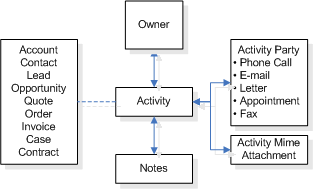
Activities involve one or more participants, called activity parties in Dataverse. For a meeting activity, the participants are the contacts or users attending the meeting. For a telephone call or fax activity, the parties are the caller and the person who is called. The following diagram shows the entity relationships for activities.
To support the communication needs of the modern-day business, such as instant messaging (IM) and SMS, you can create custom activities in Dataverse.
Note
Activities security is inherited through the Activity (ActivityPointer) table. Each activity record is represented by a single row in the ActivityPointer table, which helps manage permissions and security roles for all activities uniformly. Learn more about Activities data model and storage
See also
Activities data model and storage
Custom activities
E-mail activity table
Activity tables for tasks, faxes, phone calls, and letters
Activity Party table
Activity Pointer (Activity) table