Note
Access to this page requires authorization. You can try signing in or changing directories.
Access to this page requires authorization. You can try changing directories.
This article helps decision makers prepare their organization for AI agent adoption.

Organizational readiness is the ability of your organization to support AI agents throughout their lifecycle. Agents fail more often from unclear ownership than from technical problems. This guidance helps you establish the organizational foundation for sustainable AI agent adoption.
Outcome: By the end of organizational readiness, your organization should have a defined operating model and an investment strategy that supports responsible AI agent adoption.
AI agent decision tree and architecture

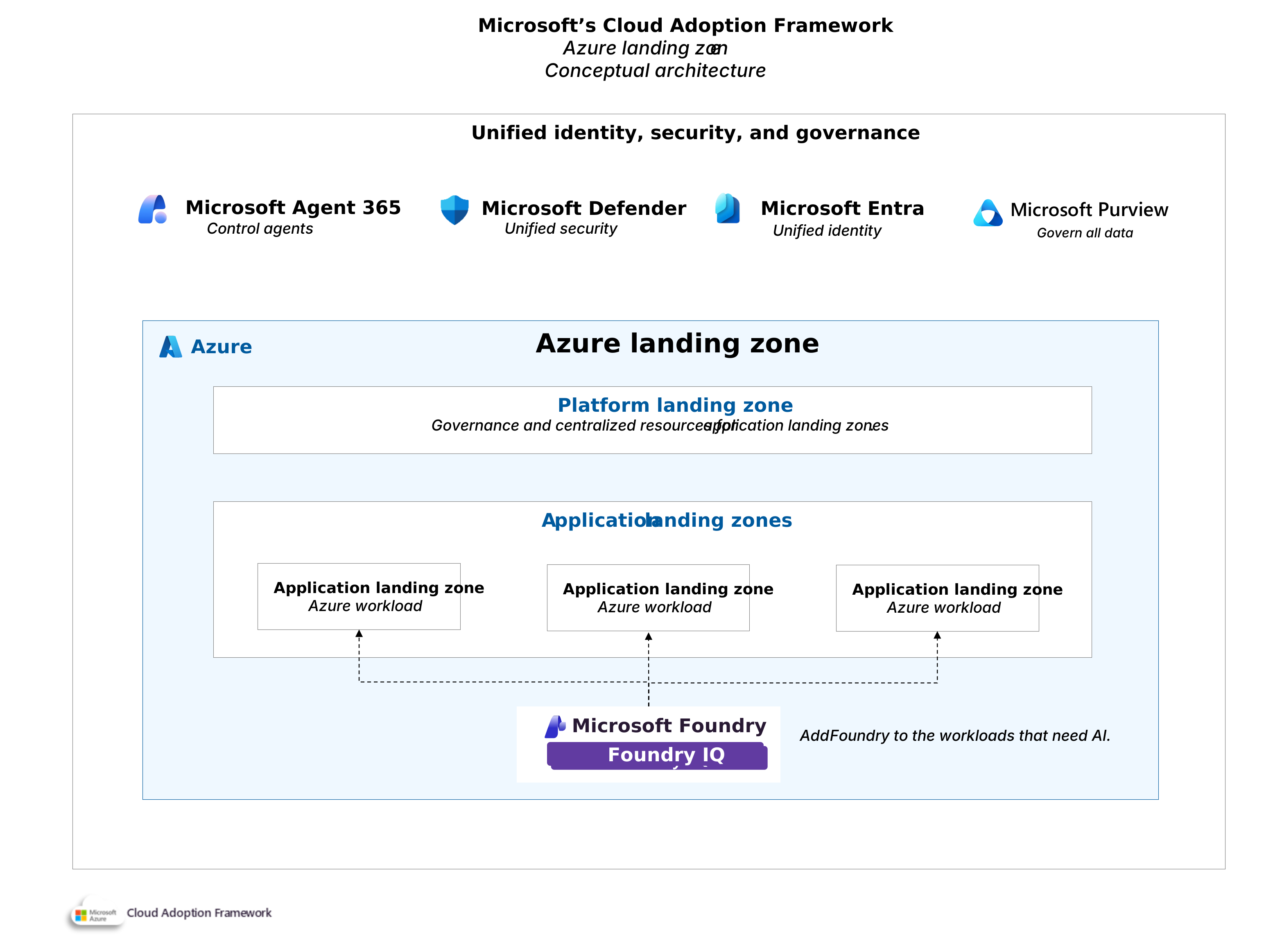
1. Operating model
What operating model should we use? An AI agent operating model defines how your organization assigns responsibility for agent adoption and ongoing management. Most organizations can extend their existing business and technology responsibilities to support AI agents. Larger adoption programs might require dedicated teams to coordinate governance and enablement. The operating model should establish clear accountability regardless of the technology used to create an agent.
Business ownership: The business function that relies on an agent owns its outcomes. It also accepts the agent's residual risk. A claims department owns its claims triage agent, for example. Existing process owners usually take on this responsibility. Critical or cross-functional agents can warrant a dedicated owner.
Risk and compliance: This function sets security and compliance requirements for agents. It defines risk criteria and reviews higher-risk use cases. Existing governance functions can extend their scope to agents. Business leaders still accept residual risk within their established authority.
SaaS platform management: Platform functions configure and secure the platforms that host agents. SaaS platforms such as Microsoft 365 Copilot and Copilot Studio need tenant settings and builder policies. They also establish policies that govern agent creation and use. SaaS platform teams manage shared platform capabilities rather than assume ownership of every agent created on those platforms.
Azure platform management: Azure platform teams should extend existing platform capabilities and governance controls to support agents built with Microsoft Foundry or custom AI infrastructure on Azure.
Workload development: Dedicated workload teams should develop and operate agents as managed solutions using technologies such as Microsoft Copilot Studio, Microsoft Foundry, or custom AI infrastructure on Azure. They should develop within approved environments and follow the governance controls established by the teams managing those platforms. They follow the organization's Operational standards.
Individual builders: Employees can create agents for personal productivity or business processes by using approved tools such as Agent Builder in Microsoft 365 Copilot and Microsoft Copilot Studio. Individual creators should maintain their agents and ensure they comply with organizational policies. An employee-created agent that becomes business-critical requires formal ownership and operational accountability.
AI enablement: Enablement functions help employees adopt AI agents and apply organizational standards. Organizations can extend existing technology enablement functions or establish a dedicated AI enablement team. Existing functions are generally sufficient for limited adoption. Dedicated teams might provide greater coordination when adoption spans multiple business units or requires specialized expertise. The tradeoff is additional organizational cost and management overhead. See AI CoE.
For foundational cloud operating model guidance, see Operating model.
2. Prioritization
How should we prioritize AI agent opportunities? Agent ideas usually outnumber the capacity to build and support them. Teams can benchmark ideas against the Microsoft Scenario Library and the AI Use Cases catalog.
Prioritization decides which use cases receive funding first and which ones wait. Funding the wrong candidates wastes budget and erodes executive confidence. A consistent approach lets leaders compare proposals from different business units on equal terms. Business impact, user desirability, and technical feasibility should guide prioritization.
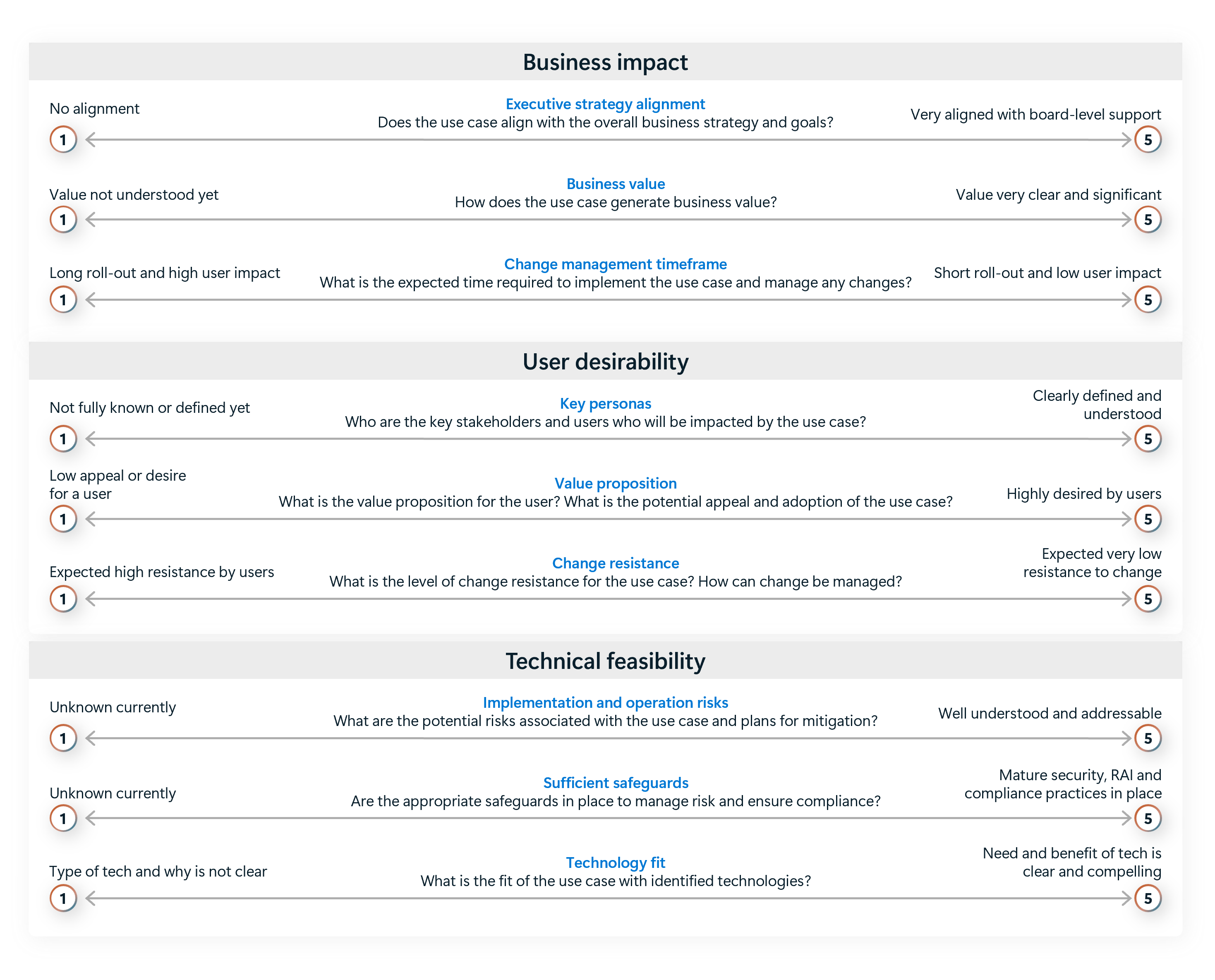
2.1 Business impact
Business impact shows how strongly a use case supports business priorities and how quickly it delivers measurable value.
Executive strategy alignment: Strong candidates directly support strategic priorities and have an executive sponsor. Weak candidates have little connection to business objectives.
Business value: Strong candidates show clear and measurable benefits, such as lower cost per transaction or faster case resolution. Weak candidates have benefits that nobody quantified.
Change management timeframe: Strong candidates have short rollout timelines and limited disruption to how people work. Weak candidates require lengthy rollouts or significant process redesign.
2.2 User desirability
User desirability shows whether the intended users understand the benefits and are likely to adopt the agent. An agent that people avoid delivers no value regardless of its technical quality.
Key personas: Strong candidates have clearly defined users with well-understood needs. Weak candidates lack clarity about who benefits.
Value proposition: Strong candidates remove a pain point that users feel every day. Weak candidates offer limited appeal or unclear benefits.
Change resistance: Strong candidates face little resistance because the agent removes unwanted work. Weak candidates threaten established roles or habits. Their adoption stalls without a deliberate change plan.
2.3 Technical feasibility
Technical feasibility shows whether teams can deliver and operate the agent with acceptable risk. For agents, risk depends heavily on what happens when the agent acts incorrectly.
Implementation and operation risks: Strong candidates have well-understood risks and practical mitigation plans. The consequences of an incorrect action are reversible or contained. Weak candidates carry unknown risks or actions that are difficult to undo, such as payments or customer commitments.
Sufficient safeguards: Strong candidates operate in areas where security and responsible AI practices are already mature. Weak candidates depend on safeguards that don't exist yet.
Technology fit: Strong candidates need an agent's ability to reason over variable inputs and choose among actions. Weak candidates follow fixed and predictable steps. Conventional workflow automation handles those steps at lower cost and risk.
3. Return on investment (ROI)
How should the organization evaluate AI agent return on investment? Return on investment (ROI) shows whether an agent's value justifies its total cost. It separates agents worth scaling from agents worth stopping. Many organizations run dozens of pilots and scale none of them. Pilots without stop criteria rarely end. They also consume capacity that proven agents need. Four elements make an ROI assessment credible.
Business baseline: The business owner measures the current process before an agent enters it. Average handling time per case is a typical measure. Claims of improvement lack credibility without a baseline.
Total cost: Total cost includes implementation and ongoing operations. Licensing and consumption charges form part of it. Integration work and the effort to govern and monitor the agent form the rest. Prebuilt agents usually cost less to implement but offer less flexibility.
Net business value: Productivity gains don't automatically become financial savings. An agent that saves each employee an hour a week creates capacity. Financial value depends on whether the organization uses that capacity to reduce cost or increase output. Business cases that count estimated time savings as cash often lose credibility at the first budget review.
Investment decisions: Gates make scale and stop decisions explicit. A pilot gate tests whether the agent meets its acceptance criteria with real users. A scale gate tests whether measured value exceeds total cost at acceptable risk. Leaders agree on stop criteria at funding time, such as a target reduction in handling time within 90 days. Owners fix or retire agents that miss their criteria.
4. Financial management and FinOps
How should the organization manage AI agent finances? AI agent financial management establishes how your organization estimates costs and assigns funding responsibility. It also defines how teams monitor consumption and control spending. Organizations should extend existing financial management and FinOps practices to account for AI agent pricing models and variable consumption.
Pricing and cost estimation: AI agent costs depend on the services and consumption models involved. Prebuilt agents might use per-user licensing or consumption-based pricing. Custom agents might incur costs for model inference and supporting services. Organizations should estimate costs by using expected adoption and usage patterns. Consumption-based pricing offers flexibility but creates uncertainty when usage increases. Fixed licensing can improve predictability but might result in unused capacity or licenses. For major cost factors, see What AI should we use?.
Funding responsibility: Central funding simplifies investment in shared capabilities such as a common model deployment. Business-unit funding creates clearer accountability when benefits stay within one function. A combined approach funds shared platforms centrally and business-specific agents locally. Most organizations use this combination.
Showback and chargeback: Each business unit should have an accountable budget owner for its agent consumption. Shared agents need an agreed allocation method. Showback is appropriate when business units need visibility without direct cost recovery. Chargeback is appropriate when consumption costs need to affect individual business-unit budgets.
Consumption controls: Finance and platform functions agree on budgets and review actual consumption as adoption grows. Budgets in Microsoft Cost Management alert owners before Azure spending exceeds plan. Copilot Studio billing management provides similar controls for Copilot Studio agents. The Cost management standards cover ongoing cost control.
5. Skilling and sourcing
What AI agent skills should the organization develop? The adoption approach determines which skills the organization needs. Prebuilt agent adoption mainly needs user training and governance skills. Custom development also needs engineering and operations expertise. Leaders decide which capabilities to build internally and which to source from partners.
Role-based training: Training reflects each function's responsibilities. Leaders need to understand agent capabilities and investment risk. Builders need to understand appropriate use and organizational policy. Engineering teams need the expertise to develop and operate agents. Uniform training for every employee spends budget on skills that many people won't use. Microsoft training, AI Skills Navigator, and Microsoft training partners offer starting points.
Practical learning: Hackathons and workshops let employees practice finding good agent use cases. They also let employees practice human oversight. A community of practice, such as a Teams channel for agent builders, spreads lessons across teams.
Partner expertise: Specialist partners can accelerate adoption when internal capabilities are insufficient or the required expertise is temporary. Partner support is particularly useful for complex custom agent initiatives or initial platform enablement. Your organization should retain business accountability and develop enough internal capability to govern externally delivered solutions.