Explore Apache Spark structured streaming
Tip
See the Text and images tab for more details!
Apache Spark is a powerful data processing engine designed to handle very large amounts of data quickly. Rather than processing data on a single computer, Spark splits the work across many machines (a cluster) so everything runs in parallel. You can use Spark on Microsoft Azure in the following services:
- Microsoft Fabric
- Azure Databricks
Spark supports code written in Python, Scala, or Java, and can handle both batch processing and stream processing.
Spark Structured Streaming
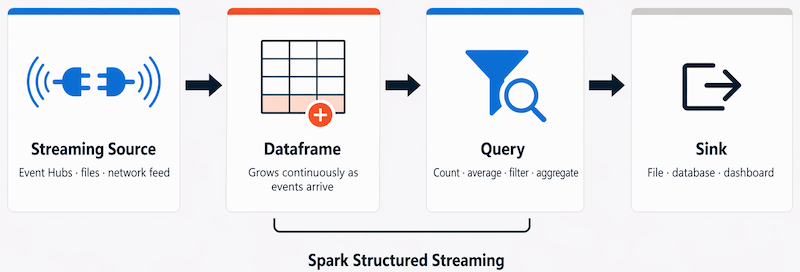
Spark Structured Streaming is a library built into Spark that makes it straightforward to work with streaming data. Think of it as a way to treat a live data stream the same way you'd work with a table in a spreadsheet—except the table keeps growing in real time as new data arrives.
Here's how it works in practice:
- You connect to a streaming source—for example, a message queue like Azure Event Hubs, a folder of files, or a network feed.
- Spark reads incoming data into a dataframe—essentially a table of rows and columns that continuously fills with new data as events arrive.
- You write a query on that dataframe—for example, to count events per minute or calculate a running average.
- The query results are written to an output (a sink), such as a file, a database, or a dashboard.
Spark Structured Streaming is a good choice when you're already using Spark for data processing and want to extend that work to include real-time data streams.
Note
For more information about Spark Structured Streaming, see the Spark Structured Streaming programming guide.
Delta Lake
Delta Lake is an open-source storage format that improves how data is stored in a data lake. By default, a data lake is just a collection of files—there's no built-in way to ensure that data is complete, consistent, or correctly structured. Delta Lake adds those guarantees, making data lake storage behave more like a traditional database.
Key benefits of Delta Lake include:
- Reliability: Changes to data are tracked, so partial or failed writes don't corrupt your data.
- Schema enforcement: Data must match a defined structure before it's accepted, preventing messy or incompatible records from slipping in.
- Unified batch and streaming: The same Delta table can serve as both a streaming sink (data written to it in real time) and a source for batch queries—so you don't need separate storage for historical and live data.
The Spark runtimes in Microsoft Fabric and Azure Databricks include built-in support for Delta Lake.
Delta Lake combined with Spark Structured Streaming is a good solution when you want a single, consistent data store that works for both real-time ingestion and historical analysis.
Note
For more information about Delta Lake, see Lakehouse and Delta Lake tables.