Tournament formatting
Consider ways to apply your knowledge of structured build challenges to a tournament format. There are a variety of ways that tournaments can be formatted and these can vary based on scale and time. Let's look at just a few examples and then consider alternatives and how these can be adapted.
Small-scale elimination tournament
This example illustrates how a classroom or club can format a tournament.
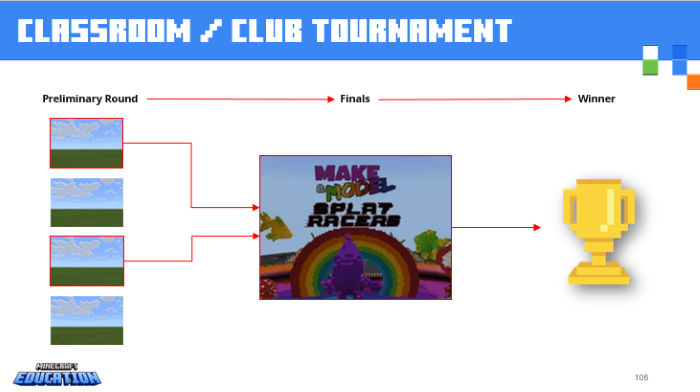
Students are divided into teams to work collaboratively. For example, a class or club of 20 students builds in individual blocks of grass worlds as four teams of five students, five teams of four students, or ten teams of two students.
- Preliminary round: Teams are given a specific theme or prompt and a set amount of time (for example, one class period) to create their build in Minecraft. The teacher or a panel of student judges the builds based on creativity, adherence to the theme, and overall aesthetics.
- Final round: The top two teams from the preliminary round are given a new prompt and compete in a head-to-head challenge in a Make & Model world. The winner is chosen based on the same criteria as the preliminary round.
Large-scale elimination tournament
For a larger scale, such as a district-wide tournament, the format needs to be scaled appropriately to accommodate more teams. Some considerations include:
- Logistics - size of the venue, number of devices, timeframe
- Support - having enough staff to adequately support the number of participants
- Communication - ensuring all participating parties understand their responsibilities and the ruleset
This tournnament is an example of a format that can be used on a schoolwide or districtwide level.
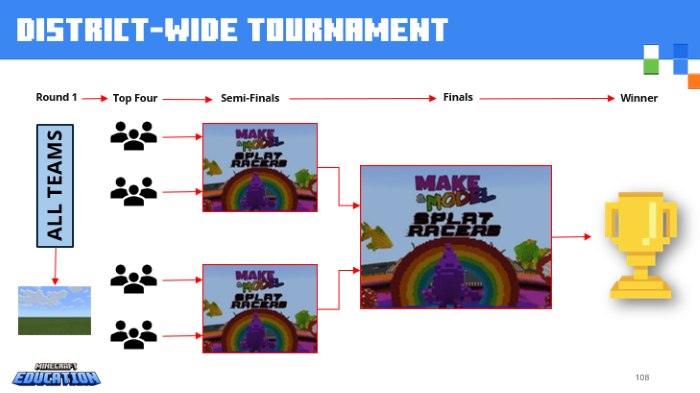
- Round 1: All teams from all schools are invited to participate in a Build Challenge with a prompt that has a set deadline for submission. A panel of judges selected by the district judges the submissions and the top four teams advance to round two.
- Semi finals: In the semi-finals, each team faces off against another in a head-to-head Build Challenge using a new prompt and a Make & Model world. The winners, selected by the judges using the rubric criteria, for each of the two games advance to the finals.
- Finals: The remaining two teams compete in a head-to-head challenge using one final prompt to determine the tournament champion.