Note
Access to this page requires authorization. You can try signing in or changing directories.
Access to this page requires authorization. You can try changing directories.
Metric views are the core implementation of Unity Catalog business semantics in Unity Catalog. They provide a centralized way to define and manage business metrics by separating measure definitions from the fields (also called dimensions) used to group, filter, and aggregate them, so you can define metrics once and query them at runtime.
Standard views lock in aggregations and groupings at creation time. With a metric view, you define the metric once, for example sum of revenue divided by distinct customer count, and users can group by any available field. The query engine generates the correct computation.
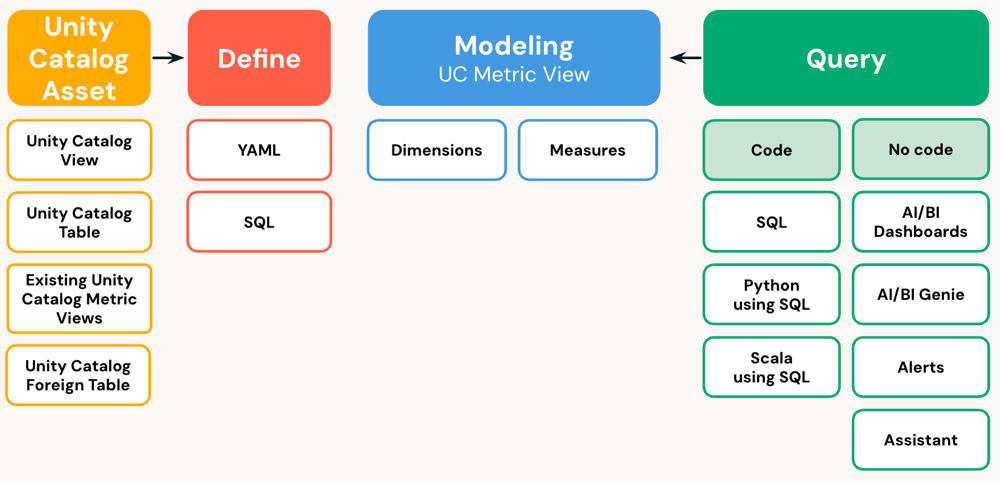
Get started
Use the following pages to create, query, and manage metric views.
| Page | Description |
|---|---|
| Create a metric view | Define metric views using SQL DDL or the Catalog Explorer UI, with built-in YAML validation. |
| Query metric views | Query metric views from SQL editors, notebooks, dashboards, Genie Agents, and alerts. |
| Use metric views with external BI tools | Query metric views from Power BI, Tableau, Sigma, and other external BI tools. |
| Manage metric views | Control access, enable collaborative editing, and manage the metric view lifecycle. |
| Tutorial: build a metric view with joins and data modeling | Walk through a complete sales analytics metric view with joins, measures, and agent metadata. |
Core features
Use the following pages to learn about modeling, materialization, and agent metadata.
| Page | Description |
|---|---|
| Model metric views | Define sources, fields, measures, and filters. Model relationships using star and snowflake schemas with multi-level joins. |
| Advanced techniques for metric views | Build complex metrics using composability and window measures for trailing averages, period-over-period changes, and cumulative totals. |
| Use parameters with metric views | Bind values at query time with parameters to serve many query variants from a single metric view. |
| Materialization for metric views | Pre-compute and incrementally refresh aggregations. The query engine automatically rewrites queries to use materialized views when appropriate. |
| Agent metadata in metric views | Add synonyms, display names, and formatting rules to improve AI agent accuracy and display consistent formats across tools. |
| Metric view YAML syntax reference | Complete reference for the metric view YAML specification, including all fields, types, and formatting examples. |