Note
Access to this page requires authorization. You can try signing in or changing directories.
Access to this page requires authorization. You can try changing directories.
Important
AKS preview features are available on a self-service, opt-in basis. Previews are provided "as is" and "as available," and they're excluded from the service-level agreements and limited warranty. AKS previews are partially covered by customer support on a best-effort basis. As such, these features aren't meant for production use. For more information, see the following support articles:
Azure Kubernetes Application Network secures communication between services in connected Azure Kubernetes Service (AKS) clusters through automatic mutual TLS (mTLS) and identity-based authorization. It issues workload identities and manages certificate issuance, rotation, and validation to enable encrypted, authenticated, and explicitly authorized service-to-service communication without manual configuration, with FIPS-compliant encryption in transit.
This article provides an overview of the security features in Azure Kubernetes Application Network, including mTLS, workload identities, certificate management, and authorization policies. It also outlines limitations and next steps for implementing secure communication in your Azure Kubernetes Application Network environment.
Limitations
- Certificates are currently issued by an Azure Kubernetes Application Network-managed certificate authority (CA) and aren't chained to a public CA.
mTLS
Application Network uses mTLS to provide identity-based, encrypted communication between workloads. Each service in an Application Network connected cluster automatically receives a certificate that allows it to prove its identity and establish trusted, encrypted connections with other services in the same Application Network. Encryption in transit uses FIPS-compliant cryptography.
mTLS migration strategy
Application Network currently allows both encrypted and unencrypted traffic. This approach ensures that existing workloads continue to operate normally while new or updated workloads automatically use mTLS for secure communication. This means you can adopt mTLS for secure communication across your workloads without downtime. After the migration is complete, you can change to strict mode so that authentication is enforced.
Benefits of mTLS in Azure Kubernetes Application Network
mTLS in Azure Kubernetes Application Network helps you:
- Protect data in transit: All service-to-service traffic can be encrypted automatically (FIPS-compliant).
- Verify service identity: Each workload has a unique Application Network-managed root and intermediate certificate.
- Simplify operations: Application Network handles certificate issuance, rotation, and revocation for users.
Certificate management
Azure Kubernetes Application Network provides certificate management backed by Azure Key Vault that issues and maintains the certificates used for mTLS. This service establishes a shared trust boundary across all AKS clusters connected to the same Application Network resource.
Application Network automatically manages the entire certificate lifecycle for root and intermediate certificates including provisioning, renewal, and rotation. This ensures that workload identities remain valid, and communication stays secure over time. You don't need to create, store, or rotate certificates manually.
The following diagram illustrates the certificate hierarchy in Application Network, showing how the root CA, intermediate CAs, and workload certificates are structured to establish trust across connected clusters:
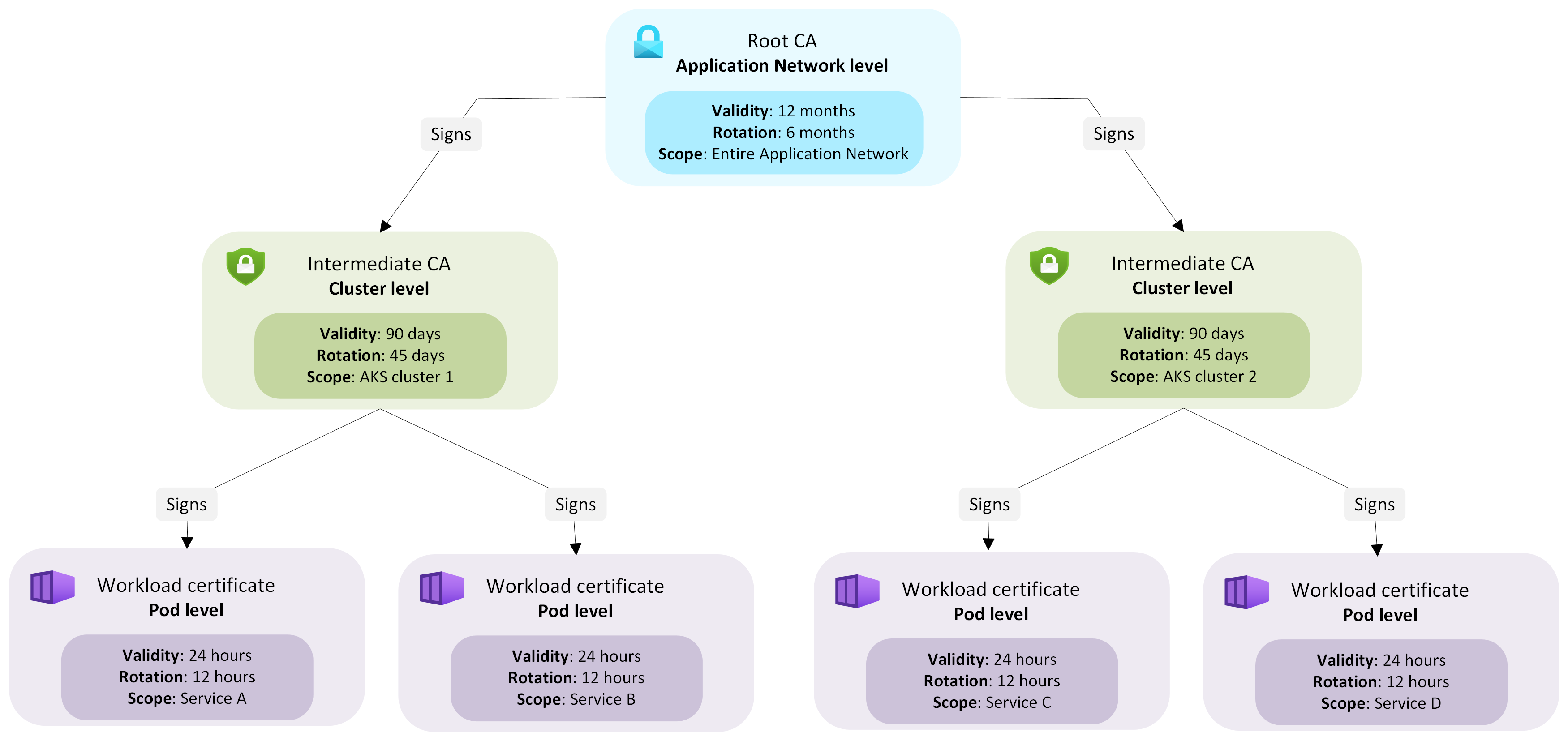
Certificate hierarchy and lifecycle
When an Application Network resource is created, a root CA is provisioned to serve as the trust anchor for the Application Network. When an AKS cluster joins the Application Network as a member, Application Network issues an intermediate certificate for that member signed by the Application Network root CA. Each connected AKS cluster uses its Application Network-managed intermediate certificate to issue short-lived workload certificates to workloads in that cluster.
All workload certificates inherit trust from the Application Network root CA, maintaining a unified trust boundary across the resource. The rotation of root and intermediate certificates is handled transparently for users without causing any downtime or traffic disruptions. This managed hierarchy ensures consistent, verifiable trust across all clusters in an Application Network while automatically maintaining the validity of each certificate.
From any member cluster, you can get the root CA certificate from config map istio-root-cert under namespace applink-system.
Certificate types and rotation periods
| Certificate type | Scope | Validity period | Rotation period | Purpose |
|---|---|---|---|---|
| Root CA | Azure Kubernetes Application Network | 12 months | 6 months | Establishes the trust boundary for all clusters connected to the Azure Kubernetes Application Network |
| Intermediate CA | Cluster | 90 days | 45 days | Issues workload certificates for workloads within that cluster |
| Workload certificate | Workload | 24 hours | 12 hours | Authenticates workloads and secures service-to-service communication |
Workload identity and authorization
As applications grow, services often need to communicate securely across different namespaces and environments within the same deployment. Managing certificates and ensuring that each service can verify who it’s talking to can quickly become complex and error-prone. Azure Kubernetes Application Network eliminates this overhead by automatically assigning and managing workload identities.
Within an Application Network-connected environment, workloads communicate securely inside and across namespaces. To ensure each service can be trusted and authenticated, Application Network assigns every workload a verifiable identity that represents its namespace and service account.
Each Application Network workload automatically receives a unique identity in the SPIFFE format, which includes its namespace and service account. The identity is formatted as follows:
spiffe://cluster.local/ns/<namespace>/sa/<service-account>
This identity is embedded in the workload certificate and is used to prove the service’s identity when communicating with other workloads. Azure Kubernetes Application Network uses this SPIFFE-based identity model with Istio authorization policies so you can define clear, consistent rules for which services are allowed to communicate.
Define access policies
You can use Istio AuthorizationPolicies to control which workloads are allowed to communicate within your environment. These policies let you define access based on verified workload identities rather than network locations or IP addresses. This approach helps you enforce consistent access controls even as services scale and move across nodes. For example, you might allow only specific gateways or workloads from trusted namespaces to call a service by referencing their SPIFFE identities in the policy’s principals list as shown in the following example:
apiVersion: security.istio.io/v1
kind: AuthorizationPolicy
metadata:
  name: allow-gateway-to-app
  namespace: default
spec:
  selector:
    matchLabels:
      app: myApp
  action: ALLOW
  rules:
  - from:
    - source:
        principals:
        - cluster.local/ns/default/sa/myApp-gateway // see SPIFFE format above
Policy design guidance
When designing authorization policies, keep the following best practices in mind:
- Always specify both namespace and service account to prevent unintended cross-namespace access.
- Use principals to define explicit workload identities for fine-grained access.
- Use namespaces to define broader trust boundaries when appropriate.
- Avoid rules that match only service account names without namespaces, as this might grant access across clusters or environments.
- Combine
AuthorizationPolicieswith KubernetesNetworkPoliciesto enforce both identity-based and network-based isolation.
Note
Azure Kubernetes Application Network authorization is based on verified workload identity rather than IP address. This ensures consistent enforcement even as workloads scale or move across nodes.
By combining Azure Kubernetes Application Network-managed identities, certificates, and policy controls, you can implement identity-based, least-privilege service communication, ensuring authenticated, encrypted, and explicitly authorized traffic between workloads across clusters.
Related content
To learn more about Azure Kubernetes Application Network, see the following articles: