Note
Access to this page requires authorization. You can try signing in or changing directories.
Access to this page requires authorization. You can try changing directories.
Slash commands help users discover and use named command functionality in Teams agents and apps.
If your agent or app has functionality that users should be able to invoke with named commands, you can add configuration that makes those commands quickly discoverable and accessible from the message compose box in Teams. Named slash commands can help users access guidance, create personal follow-up tasks, or manage personalization options.
User experience
Slash commands in Teams are text-based shortcuts that let users perform actions from the compose box in conversations. When a user enters a / in an empty compose box, Teams displays an autocomplete menu containing built-in commands for common tasks exposed by agents or apps in the current context.
The slash commands feature enables apps and agents to add their own commands to this list to help users discover and use them.
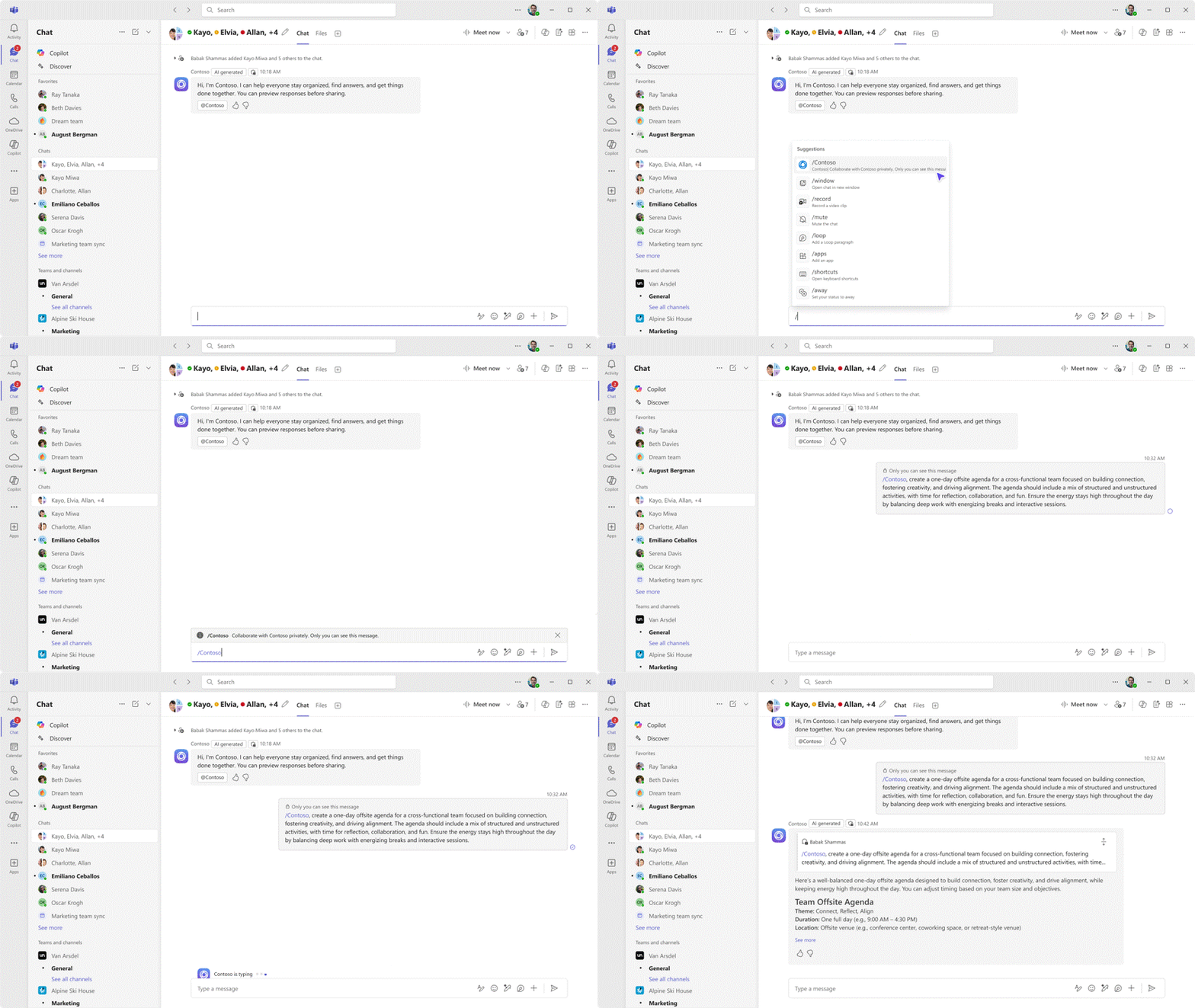
Slash commands
Apps and agents can expose slash-command experiences through app or agent configuration in two primary ways:
- Agent slash commands: Surface named commands to users in the slash command autocomplete menu.
- Message extension slash commands: Enable users to activate your app or agent's message extensions with a slash command.
These types of slash commands are supported across all client platforms, including mobile.
Important
Targeted messaging and agent slash commands are fundamental to agent design for group conversations and require careful handling of user privacy expectations. Selecting an agent command switches the compose box to targeted message mode. A user-initiated targeted message is delivered only to the selected agent, and the agent can respond privately to the user.
For more information, see best practices and design guidance.
Agent slash commands
Agent slash commands enable agents to surface named commands that users can privately invoke in channels, group chats, and meeting chats. Slash commands are useful for functionality that users need to access quickly and privately in group conversations.
In channels, group chats, and meeting chats, the slash command autocomplete menu includes all commands registered by agents in the current conversation. Each command is displayed with its description and its agent's name and icon, making them discoverable and distinguishing between commands with the same name.
Invoking a command from the menu switches the compose box to targeted messaging mode for the agent and inserts the name of the command as the message text. Selecting Send sends the targeted message to the agent. For example, a project management agent or bot app might expose commands such as /create-task to turn the current conversation into a tracked task based on context, or /status-check command that can be given a work item number and returns information about it.
Slash commands for action-type message extensions
Apps that implement action-type message extensions can expose those actions as slash commands. When a user selects one from the autocomplete menu, Teams opens the associated task module or dialog. Activating a message extension slash command opens the module or dialog only; it does not send a message. Search-type message extensions cannot be exposed as slash commands.
Message extension slash commands can be configured to appear as autocomplete entries in both the compose box and the Teams command box.
Mention commands in agents
Use @mention commands in your agents and apps when users need to address a specific agent or bot directly. The message is delivered to the mentioned agent, and the agent responds according to the conversation context. For example, a user can @mention a project management agent in a channel and enter assign to create a follow-up task from the conversation context.
For more information about @mention commands, see @Mention.
Add commands
Slash commands and targeted messaging are configured in the app or agent manifest. Declaring commands in the manifest makes commands visible in Teams, while the app or agent implementation determines how each command is handled after the user sends it.
Slash and @mention commands for agents
Slash and @mention commands require an agent to opt in to receive targeted messages, For more information, see receive targeted messages.
Triggers: slash and @mention
The triggers property defines where a command appears and how users can invoke it from the Teams compose experience. For agent command lists, use mention when the command should appear in the traditional @mention command menu, use slash when the command should appear in the slash command picker, or include both values when the same command should be available from both entry points.
Declare commands and their triggers by configuring the bots[].commandLists[] section of the manifest. The following manifest example shows an agent that supports targeted messages and exposes three commands through slash, mention, and combined triggers:
{
  "bots": [
    {
      "botId": "{{BOT_ID}}",
      "scopes": ["personal", "team", "groupChat"],
      "supportsTargetedMessages": true,
      "commandLists": [
        {
          "scopes": ["personal", "team", "groupChat"],
          "triggers": ["slash"],
          "commands": [
            {
              "title": "summarize",
              "description": "Summarize the conversation"
            }
          ]
        },
        {
          "scopes": ["personal", "team", "groupChat"],
          "triggers": ["mention"],
          "commands": [
            {
              "title": "assign",
              "description": "Assign a follow-up task"
            }
          ]
        },
        {
          "scopes": ["personal", "team", "groupChat"],
          "triggers": ["slash", "mention"],
          "commands": [
            {
              "title": "review",
              "description": "Review a document"
            }
          ]
        }
      ]
    }
  ]
}
• As is required for slash commands, this example code snippet:
supportsTargetedMessagesis set totrueto allow the agent to receive targeted messages in group conversations.summarizeis configured as a slash command.assignis configured as an @mention command.reviewis configured as both a slash command and an @mention command.
Slash commands for action-type message extensions
Use the triggers property of composeExtensions[].commands[] to expose message extensions as slash commands.
{
    "composeExtensions": [
        {
            "botId": "{{BOT_ID}}",
            "commands": [
                {
                    "id": "summarizeCommand",
                    "type": "action",
                    "title": "Summarize",
                    "description": "Summarize a document",
                    "context": ["compose", "commandBox"]
                },
                {
                    "id": "draftCommand",
                    "type": "action",
                    "title": "Draft",
                    "description": "Draft a document",
                    "context": ["compose", "commandBox"],
                    "triggers": ["slash"]
                },
                {
                    "id": "reviewCommand",
                    "type": "action",
                    "title": "Review",
                    "description": "Review a document",
                    "context": ["compose", "commandBox"],
                    "triggers": ["slash"]
                }
            ]
        }
    ]
}
In this example, summarizeCommand is available in the configured compose and command box contexts but is not exposed as a slash command. The draftCommand and reviewCommand actions declare the slash trigger, so they appear as slash commands in supported entry points.
Implement agent named command handling
Configuring agent slash commands only surfaces them to users in the Teams client, it doesn't assist with their implementation.
When a user activates an agent slash command, Teams switches the compose box to targeted message mode and inserts the command name, then returns control to the user to allow them to enter more text and send the message. The agent's message handler is responsible for using the contents of the message to determine whether it should be interpreted as a command invocation and handling it appropriately.
See best practices and design guidance for other message handling guidance.
Best practices and design guidance
Choose the trigger that matches how users will invoke the command. Offer slash commands for common actions that users need to access quickly, repeatedly, and privately. They work best for user-specific actions such as viewing settings, creating follow-up tasks, or checking personal status, especially when users benefit from discovering and reusing the action from the compose box. Use an @mention command when users must address a specific agent or rely on conversation context. Offer both only when each is a natural entry point to the same behavior.
As with all message-based activity, the design of slash command behaviors should carefully consider whether the user expects a public or private message as a response in group conversations. For general guidance about agent response visibility, see targeted messaging best practices and design guidance.
Keep the command set small and focused. Support natural-language prompts when users need a more conversational experience, but reserve slash commands for the most repeatable actions.
Keep slash command names short and action-oriented. Use aliases for high-frequency commands when they improve discoverability, and use prompt starters for longer or more open-ended prompts.
Provide clear command descriptions to improve discoverability, including any expected input beyond the command name.
Related content
Collaborate with us on GitHub
The source for this content can be found on GitHub, where you can also create and review issues and pull requests. For more information, see our contributor guide.
Platform Docs