Explain the agent lifecycle - plan, act, evaluate
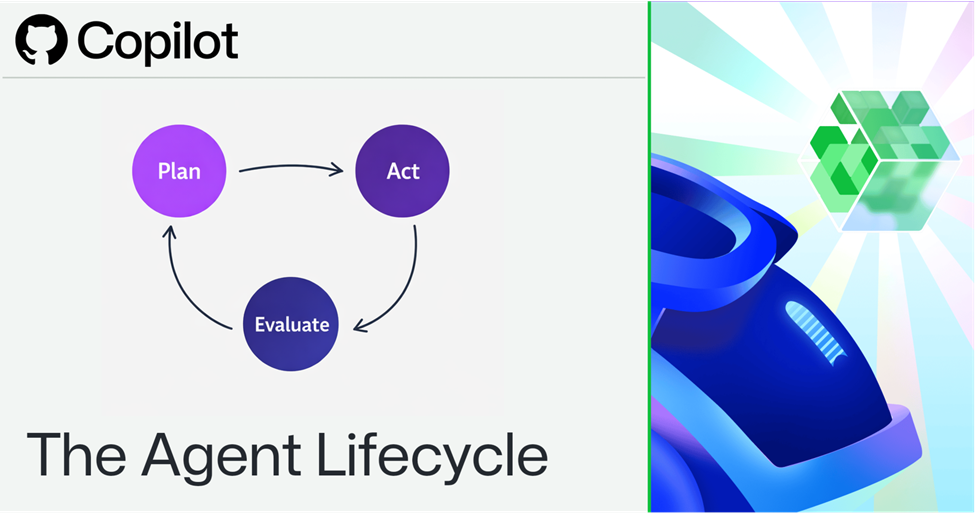
Agentic systems don't make one decision and stop. They operate through cycles. A foundational model is the lifecycle of plan → act → evaluate. This lifecycle isn't a one-time sequence. It's a loop: agents repeatedly plan, act, and evaluate until the task meets defined success criteria.
In this unit, you'll learn
How the plan → act → evaluate lifecycle works in practice
How planning, action, and evaluation are implemented in GitHub workflows
How feedback signals drive iteration and completion
Plan
In the planning phase, the agent interprets the goal and determines what steps are needed to complete it. In high-quality systems, plans aren't hidden internal states. They're structured, reviewable artifacts that make the approach understandable and assessable.
Examples of planning artifacts in GitHub include:
A structured plan in the pull request description
A linked issue or checklist outlining scope and success criteria
Tip
Plans become more reviewable when they include scope (what will change), success criteria (how you'll know it worked), and a rollback or escalation path.
Act
In the action phase, the agent executes the plan in the repository. This can include:
Creating a branch
Changing files and pushing commits
Opening or updating a pull request
Responding to review feedback with revisions
This matters because it keeps execution bounded: actions occur in a specific repository, on a branch, and through pull request workflows rather than through uncontrolled direct changes to the default branch.
Evaluate
In the evaluation phase, the agent and the humans supervising it use signals from the development system to assess results. In GitHub, common evaluation signals include:
Workflow runs and status checks (build/test/lint)
Code review feedback (requested changes, approvals)
Security signals (code scanning results, secret scanning alerts, dependency alerts)
When configured by repository or organization policy, protections such as rulesets and branch protection can require checks to pass before changes merge-turning evaluation into an enforceable gate rather than an informal suggestion.
For security-oriented work, evaluation often includes:
Code scanning (including SARIF upload workflows)
Secret scanning alerts
Push protection to prevent supported secrets from being committed
These capabilities reinforce a key lesson: agent evaluation must be grounded in system signals, not in the agent's confidence.
Evaluation isn't the final step. If checks fail, risks remain, or requirements aren't met, the lifecycle continues: the agent must revise the plan, adjust its actions, and reevaluate until the outcome is acceptable or handed off to a human.
For example, when an agent proposes a dependency update in a pull request, the plan defines which package changes, the action updates the files, and evaluation occurs through CI checks and security signals.
If workflows fail or the vulnerability remains unresolved, the work isn't complete. The lifecycle must loop: revise the plan, adjust the change, or escalate to a human.
A high-quality agent system makes every phase visible
The plan is inspectable.
Action is bounded to repository workflows.
Evaluation uses objective signals.
When any piece is missing, trust degrades: plans become opaque, actions become risky, and outcomes become difficult to validate.
The lifecycle of planning, acting, and evaluating is the operational core of agentic systems. It explains how agents move from intent to execution -and how GitHub's checks, workflows, reviews, and security signals provide feedback that enables safe iteration.
Once you understand how an agent behaves, the next question becomes where that behavior is controlled. In the next unit, you'll examine GitHub as the system of record and control plane for agent workflows.
I would recommend mentioning this earlier, either in the Evaluate section or in the intro, to make it immediately clear that plan/act/evaluate is a loop and not a linear sequence. It would help learners to know this from the start instead of discovering it in the scenario.