What makes startups succeed?
Successful startups share a number of important attributes. In this unit, you learn about some of the most common shared attributes of successful startups, and you can score your startup against them.
By understanding what makes startups succeed, you're able to bake some of these attributes into your startup from the very beginning.
Non-obvious idea
Every startup needs to be based on a good idea. Unfortunately for many founders, the idea they decide to work on is self-evidently good. This means that many other people are likely to have had the same idea, and the company will therefore most likely be competing with other startups, or even large enterprises, doing something similar.
Some of the best startup ideas sound wild at first but are actually a good idea. This makes them a great startup idea, because not many people are working on the same thing.
Consider the following Venn diagram:
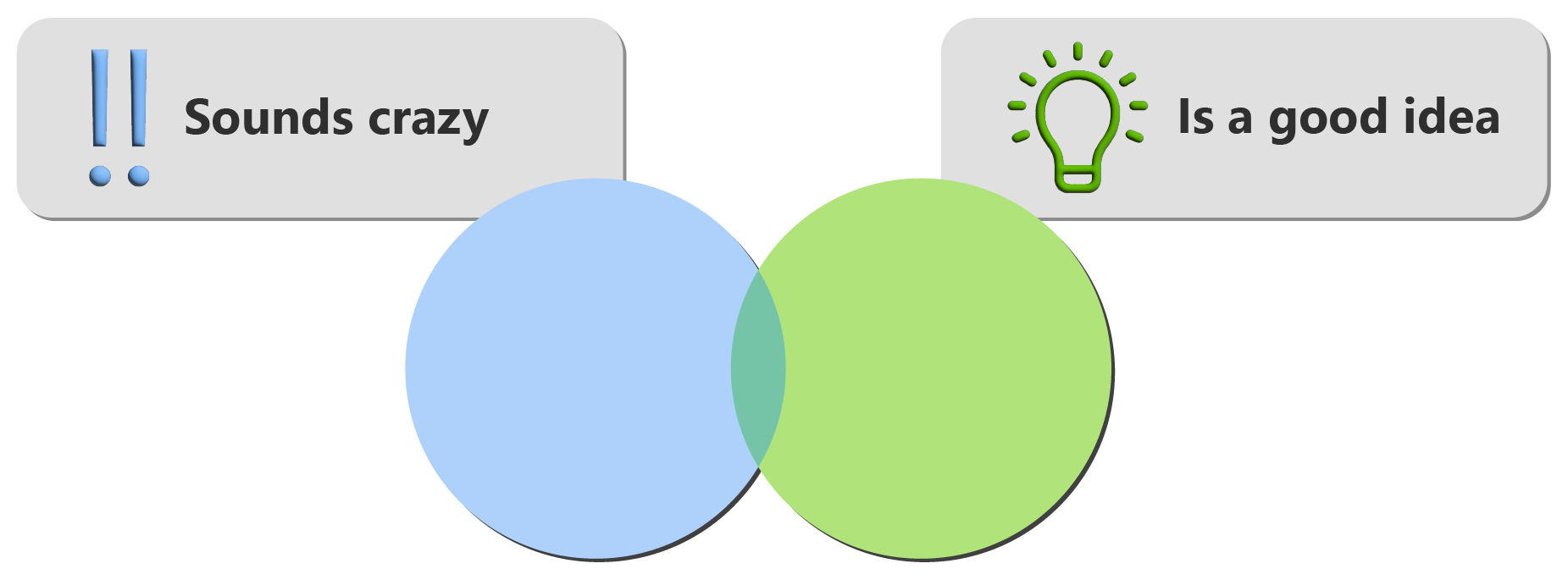
The blue set on the left represents all ideas that sound absurd. When you first describe these ideas to people, their most common reaction is: "That wouldn't work."
The green set on the right represents all ideas that are in fact a good idea (that is, they could be the basis for a product that customers want and would pay for).
Not many people start off with ideas that sound absurd and are in fact absurd (the blue set on the left, excluding the intersect). That's good news, because the world doesn't need any more perpetual-motion-machine inventors.
However, many people tend to come up with ideas that are perfectly good, but are very obvious (the green set on the right, excluding the intersect). There's a good chance that many startups are working on a similar idea.
Keep in mind that it's fine to have some competitors, because this validates that the opportunity exists and that there are customers who are looking for this solution. However, having many direct competitors is a tough starting point for any startup, particularly if those competitors are further along in their product development and have significant capital to maintain their market lead.
Some of the best startup ideas exist in the intersection between these two sets. They're both a good idea (the green set) and non-obvious (the blue set). These startup ideas are counterintuitive to most people. Generally, these ideas are only visible to those with deep insights into the problem space, often acquired over long periods of time.
If most people think your startup idea won't work, but you have some unique insight that convinces you that they're wrong and you're right, then you could be onto something.
Case study: Airbnb
When Airbnb started, many smart people looked at the idea and said: "There's no way people will give their house keys to a stranger and let them stay in their house just to make a few extra bucks. It won't work, at least not at scale."
Of course, today we know that Airbnb is a wildly successful tech company. The founders' unique insights gave them the ability to see past this objection and pursue a business model that most people thought wouldn't be viable.
Task: Research your competitors
Imagine you're trying to raise money from a venture capital fund and you send them your pitch deck. One of the first things they'll do is consider the competitive landscape and make an assessment as to whether your startup is doing anything new, or at least different than existing competitors.
Now, put yourself in the shoes of the analyst at that fund. Spend half an hour doing some online research on your company's problem space and see how many competitors you can find. Don't just look for direct competitors that are doing the same thing, but also indirect competitors that might provide an alternative solution to the same problem.
Does your startup stand out as doing something new and innovative, or does it appear to be one of a large number of undifferentiated competitors?
The right team
It's fine to be a sole founder at the outset, but before long most founders realize that having a team is critical to the success of their company.
The amount of work needed to build and launch a startup is massive, and it's been shown that sole founders struggle to cope with the workload.
Furthermore, startups also need a range of skill sets and perspectives, and just about every founder benefits from the moral support of being part of a team. Having people you trust as thought-leadership partners within the team can help you to weather the inevitable emotional ups and downs of establishing a startup. The team helps you build the resiliency necessary to get through the most challenging periods. Moreover, these individuals can provide different approaches to problem solving that will ultimately contribute to faster progress.
Task: Complete a startup skills checklist
Complete the following startup skills checklist to see how your team stacks up. There's no absolutely right mix of skills, but if you find there's an obvious gap, now is a good time to start working on filling it.
☐ More than one founder
☐ Diverse backgrounds and perspectives
☐ Domain expertise relevant to the target market
☐ Tech skills suited to building the product
☐ Design skills
☐ Sales skills
☐ Communication skills
☐ Leadership skills
Intense customer pain
You might have heard of "painkiller" companies versus "vitamin" companies. Painkillers are the ones that are solving a significant pain for customers, whereas vitamin companies are making products that might be useful but are more of a "nice to have" than a "need to have."
The benefit of being a painkiller company is that your target customers are probably looking for a solution to whatever problem is causing them the pain. Maybe they've tried other products, or even invested time and money trying to create their own solution.
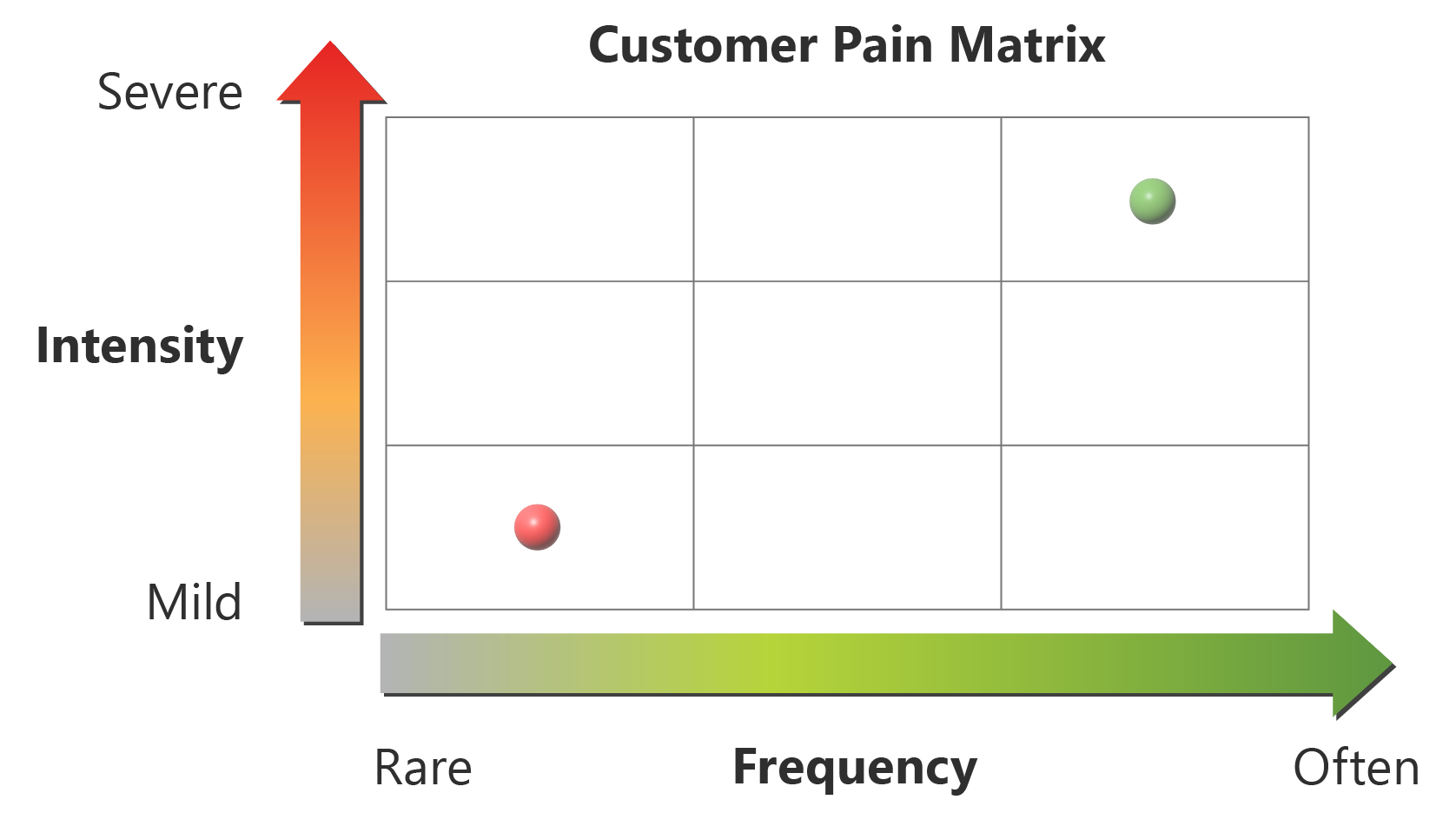
A useful way to think of customer pain is with reference to intensity versus frequency. Problems that are intense are more likely to cause customers to actively seek new possible solutions than problems that are mild. Similarly, problems that occur frequently are better motivators than problems that only occur very occasionally.
If you're looking at a number of customer pain points that you could address, try plotting them on a chart with intensity and frequency on the axes. The problems in the top right quadrant (high intensity, high frequency) are likely to be the best ones to go after.
Scalable business model
Successful startups tend to be highly scalable, meaning that they can grow rapidly. Scalable startups can become increasingly efficient in terms of resource requirements as they deliver their product to an expanding customer base.
If your business model relies on having to perform repetitive, non-scalable tasks (even doing in-person sales calls), you might face major barriers to scalability and growth. That's because these constraints might place an upper limit on the number of customers you can serve.
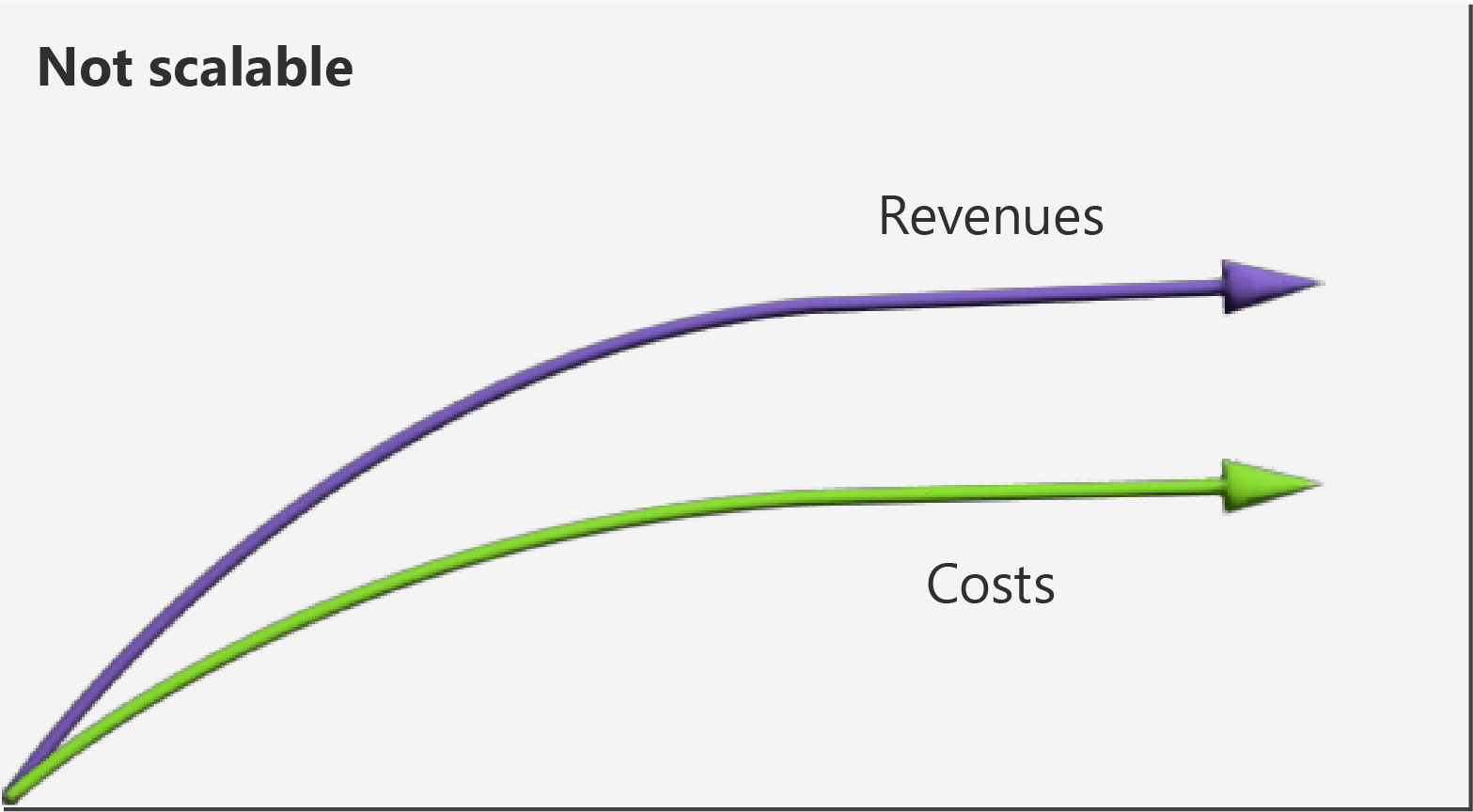
The following simple graph illustrates a non-scalable company that's delivering services to customers. Let's say it's a graphic-design business. As the company gets more customers, it does more graphic design work and generates more revenue. At the same time, however, it needs to employ more graphic designers, so its costs increase proportionally. At some point, it stops growing and its revenues and costs plateau. As long as revenues exceed costs the business is making a profit, which is of course a good thing. However, this isn't what scalability looks like.
Now let's look at a scalable business model.
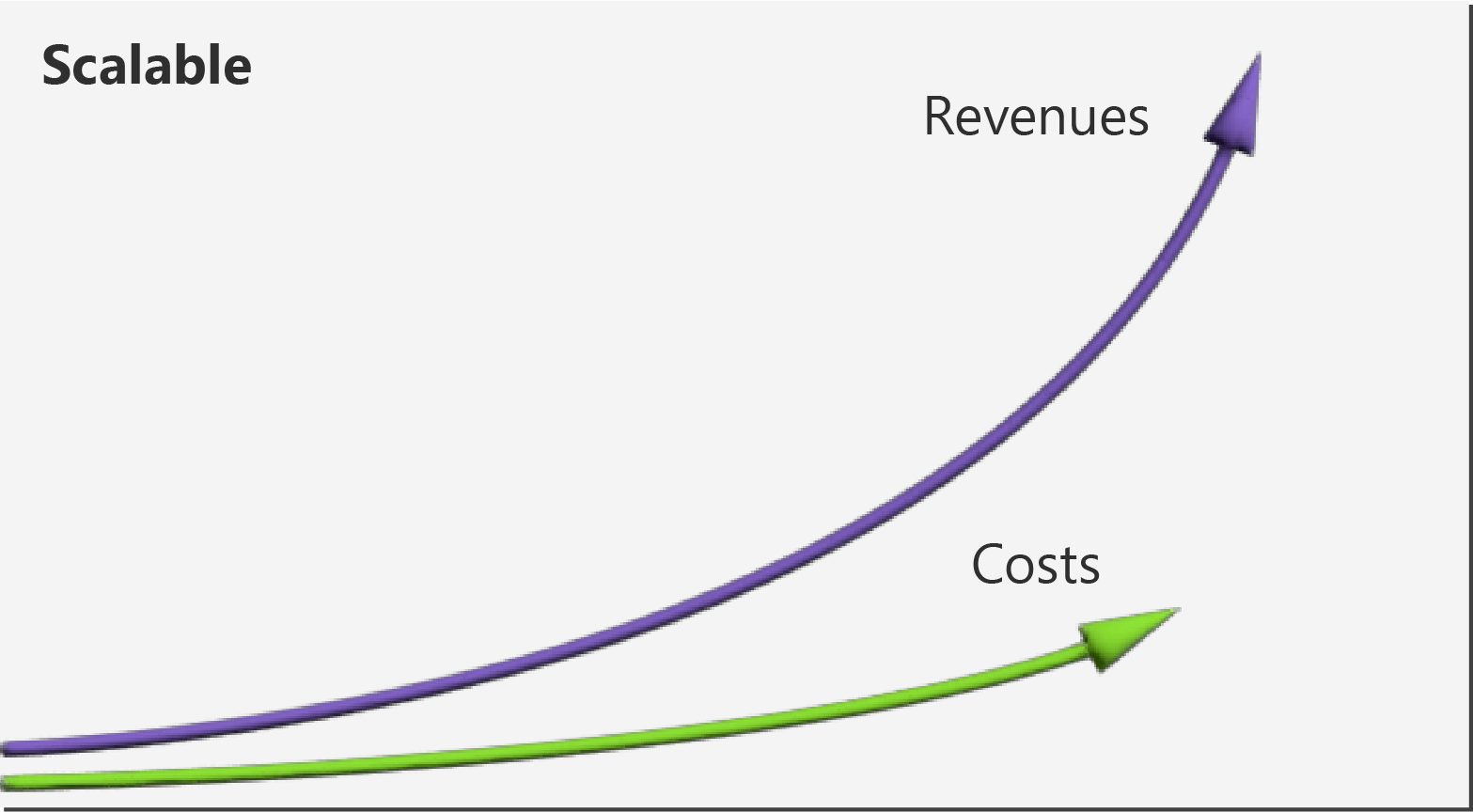
In a scalable company, at some point revenues become decoupled from costs. For many companies, this is because they're taking advantage of the inherent scalability of the internet.
If your product is software or something that can be achieved through software, after your product is built, the incremental cost of digitally delivering your product to each additional customer is very close to zero.
After you've built the product and invested in developing and launching it, a scalable business model enables your company to grow rapidly.
Large opportunity
The success of a startup is a function of volume and value; volume being the number of customers it can serve, and value represented by what those customers are willing to pay for the startup's product or service. Volume and value in turn dictate the economic rent the company is able to capture, and the overarching size of the market the startup could potentially address.
Startup founders should aim to serve as large a market as possible and ensure that their product creates meaningful value for customers.
As noted by Marc Andreessen, founder of Netscape and cofounder of the venture capital firm Andreessen Horowitz, "software is eating the world." Every industry is being disrupted by software companies, resulting in massive shifts of economic value from old, legacy companies to new, digitally enabled ones. There are countless opportunities to build companies capable of disrupting multibillion-dollar markets, so why create a company that's serving a narrow niche or focused just on a small market?
Tip
Ask yourself: Am I focused on a large and growing market? Are there enough people who will rely on my product every day to make this an opportunity worth pursuing? Is this a market that's dominated by large, inefficient incumbents who could be disrupted by my solution?
Remember that you could be devoting the next 10 years of your life to this company, so the prize had better be worth the effort!
Timing
There's an optimal time for every startup idea. Make sure that you're not launching your startup too far ahead of the opportunity, or too far behind.
An example of launching too far ahead of the opportunity would be a marketplace for sharing quantum computing capability. Quantum computing is going to be a huge opportunity at some point, but it might not be wise to set up a marketplace for sharing that capability today; you'd be some years ahead of the curve.
Conversely, you'd be a brave person to start an online bookstore company today. The optimal time for starting that business has passed.
Task: Identify timing factors
Make a note of any factors you can think of that affect the timing of your company. Is now a good time for this idea? Why?
Tailwinds
On a related note, the best ideas often benefit from tailwinds that help push them along. These are shifts in technology, consumer behavior, or regulations that make it easier to get your startup started (or that make it possible, if it would've previously been impossible).
Uber benefited from tailwinds when it launched in 2009. The founders had identified a growing acceptance of the sharing economy by consumers, as well as the emergence of ubiquitous GPS and high-quality maps on smartphones (noting that the first iPhone was released in 2007).
Had someone tried to launch a ridesharing app like Uber five years earlier, it wouldn't have made sense. Similarly, if someone were to start another rideshare company today, it would face stiff competition from existing ridesharing apps that have already established traction, market share, and a strong brand.
Task: Identify tailwinds
Make a note of all of the tailwinds you can think of that might benefit your company. What can you do now to capitalize on them?
Inherently shareable
The cheapest way to acquire a new customer is by having an existing customer refer someone else to your product.
A large proportion of successful startups deliberately built features that make it easy for users to share their product, and this shareability contributed to their massive growth.
Hotmail is a great example. The company started in 1996, and at that time was just about the first browser-based email service. Browser-based email is ubiquitous and free today, but in 1996, in the early days of the internet, nearly everyone's email address was tied to their ISP. That was inconvenient because if you changed your ISP, you had to change your email address.
Hotmail decided to make their product shareable by putting a footer at the bottom of every email that read "Sent from Hotmail. Get your free email here." The result of this shareability was that many people got a Hotmail address.
Over the course of a year and a half after launching, Hotmail grew from zero users to 9 million users, and was subsequently acquired in late 1997 by Microsoft for a reported $450 million. (For more information, check out Microsoft Acquires Hotmail, List of mergers and acquisitions by Microsoft, and How Hotmail changed Microsoft (and email) forever.) Today, 9 million users doesn't seem like much, because there are billions of people on the internet; but in 1997, this represented around one out of every eight internet users.
Task: Find ways to share your product
Make a note of the five software products that you use most often. See if you can find a way that each of them has been deliberately designed to be shareable. Does the company give existing users an incentive to share the product with new users? Do you think this has contributed to the company's growth?
Think about what features can you build into your product from the beginning that will make it easy to share. How can you provide users an incentive to share it?
Recurring revenues
Unlike one-off sales, recurring revenues occur on a regular, ongoing basis. For example, software-as-a-service businesses that bill customers through a subscription agreement generate recurring revenues. With this type of business model, as long as the customer continues using your product and paying for it, you'll continue making money.
Recurring revenues are highly attractive because:
- They can lead to a high customer lifetime value (LTV).
- The cost to retain an existing customer is almost always lower than the cost to acquire a new customer.
- Revenues are predictable as long as you have a high level of customer retention.
- Predictable revenues enable more confidence in investing in product development, often leading to better products over time.
- Companies that generate recurring revenues can scale much more rapidly.
- Investors are usually more interested in businesses that generate recurring revenues than those that make one-off sales, because each new customer is building cumulatively on an existing revenue base.
- Customers often prefer to spread the cost of your product over a monthly billing cycle rather than having to pay for it up front.
- You can make money while you sleep!
Task: Find ways to make revenue recurring
Open your smartphone or your laptop. Make a note of all the products to which you've subscribed and that you're continuing to pay for on an ongoing basis.
Tip
Ask yourself: Why do I continue to pay for this product? Look at the communications you've received from the company to see what they've done to ensure they retain you as a paying customer.
Are there any lessons that you can apply in your own startup?
Worksheet
In this unit, we've discussed nine shared attributes of successful companies. You can score your company based on the presence or absence of those attributes.
Don't be concerned if you don't get all nine. By completing the remaining modules in the Microsoft for Startups Founders Hub, you'll have an opportunity to address any areas where your startup is currently lacking.
☐ Based on a non-obvious idea
☐ Founded by the right team
☐ Addresses intense customer pain
☐ Has a scalable business model
☐ Represents a large market opportunity
☐ Benefits from advantageous timing
☐ Takes advantage of market tailwinds
☐ Has an inherently shareable product
☐ Has a business model based on recurring revenues
Score: __ / 9