Note
Access to this page requires authorization. You can try signing in or changing directories.
Access to this page requires authorization. You can try changing directories.
Data transfer and connectivity refer to moving data into and out of Databricks environments. Networking charges for serverless products only apply to customers using Azure Databricks serverless compute. Customers using classic compute manage and pay related networking costs directly to Azure. Networking charges for performance-intensive products apply to all customers, regardless of compute type. Serverless charges apply when serverless compute communicates with your resources and are billed directly by Azure.
Important
Starting April 7, 2026, configuring service endpoints requires Azure Network Security Perimeter. See Configure an Azure network security perimeter (NSP) for Azure resources.
Note
When you add Azure storage accounts to a Network Security Perimeter (NSP) and configure an inbound rule that allows the AzureDatabricksServerless service tag, Azure Databricks sends traffic over service endpoints. This doesn't incur charges. For the complete list of supported Azure services, see Configure an Azure network security perimeter (NSP) for Azure resources. For cross-region storage access, data transfer charges still apply.
Identify billable connections
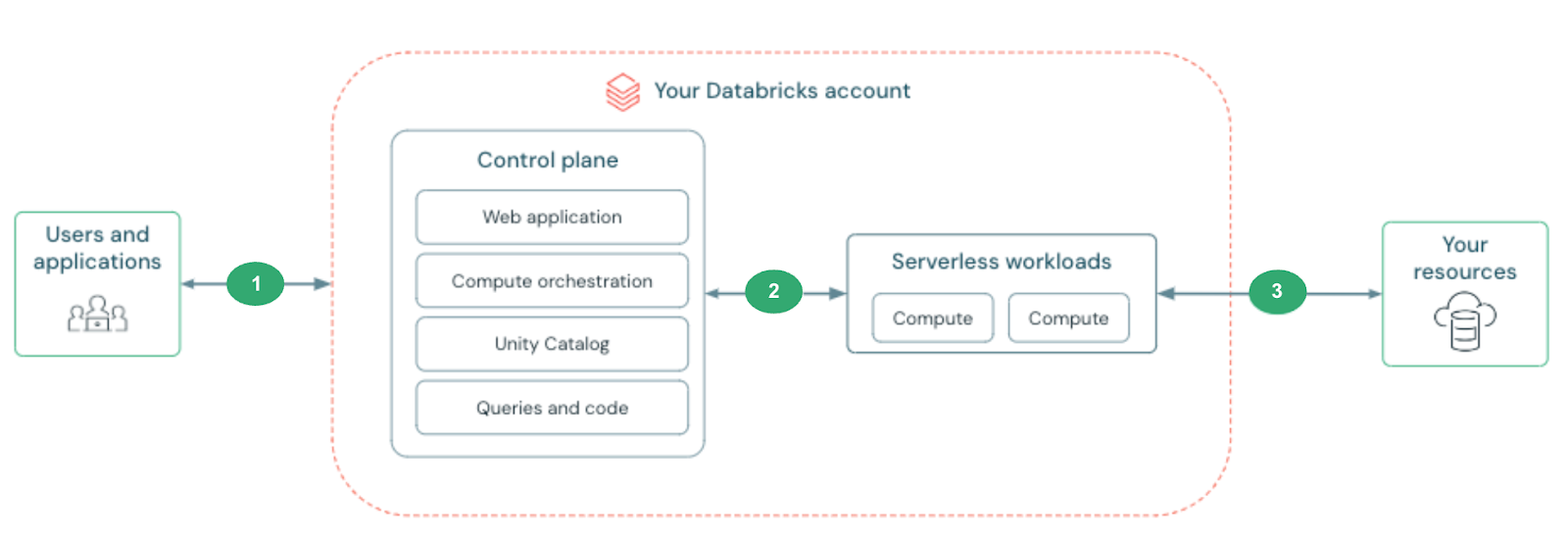
Connection 3 in the diagram below shows Databricks serverless workloads, which run in the Databricks-managed cloud account and access your data or services. You are charged for the associated data transfer and connectivity costs.
Connection 1 in the diagram shows inbound client connections (users and applications). For performance-intensive products (Lakebase, OpenSharing SecureConnect, Zerobus, and Files API), Databricks charges for cross-region and public-internet egress back to the client. Client ingress and same-region egress are not charged. All other client access to Databricks, such as UI and API requests, is not charged. This charge is separate from any serverless networking charges and applies regardless of whether you use serverless or classic compute.
To understand your usage, see Billable usage system table reference.
Types of connectivity charges
Databricks charges for the following types of connectivity:
| Connection type | Description | Billed | Timeline |
|---|---|---|---|
| Private Connectivity (/GB) | See Azure Private Link pricing. | Waived until further notice | N/A |
| Private Connectivity (/hour) | See Azure Private Link pricing. | Yes | Billing |
| Public Connectivity (/GB) | See Azure NAT Gateway pricing. | Yes | Billing |
| Data Transfer (/GB) | See Bandwith pricing. | Yes | Billing |
For detailed pricing information, see Data transfer and connectivity.
Cost management best practices
For practical guidance on optimizing Databricks costs while maintaining performance, see Best practices for cost optimization.