Developer technologies | Transact-SQL
A Microsoft extension to the ANSI SQL language that includes procedural programming, local variables, and various support functions.
This browser is no longer supported.
Upgrade to Microsoft Edge to take advantage of the latest features, security updates, and technical support.
' cx='32' cy='32' r='32' /%3E%3Ctext x='50%25' y='55%25' dominant-baseline='middle' text-anchor='middle' fill='%23FFF' %3ESB%3C/text%3E%3C/svg%3E)
Lock mode considers various lock types that can be applied to a resource that has to be locked:
Exclusive (X)
Shared (S)
Update (U)
Intent (I)
Schema (Sch)
Bulk update (BU)
when i execute this query then i saw IX on request_mode column for Emp1 table. what IX means ?
IX means intent lock or different ?
BEGIN TRANSACTION
UPDATE Emp1 WITH (ROWLOCK,UPDLOCK)
SET   name = 'James'
WHERE ID=1

SELECT resource_type, request_mode, resource_associated_entity_id,
       object_name(try_convert(int, resource_associated_entity_id)),
       COUNT(*) AS [Count]
FROM   sys.dm_tran_locks
WHERE  request_session_id = @@spid
GROUP  BY resource_type, request_mode, resource_associated_entity_id,
          object_name(try_convert(int, resource_associated_entity_id))
go
select * from Emp1
ROLLBACK TRANSACTION
screen shot attached
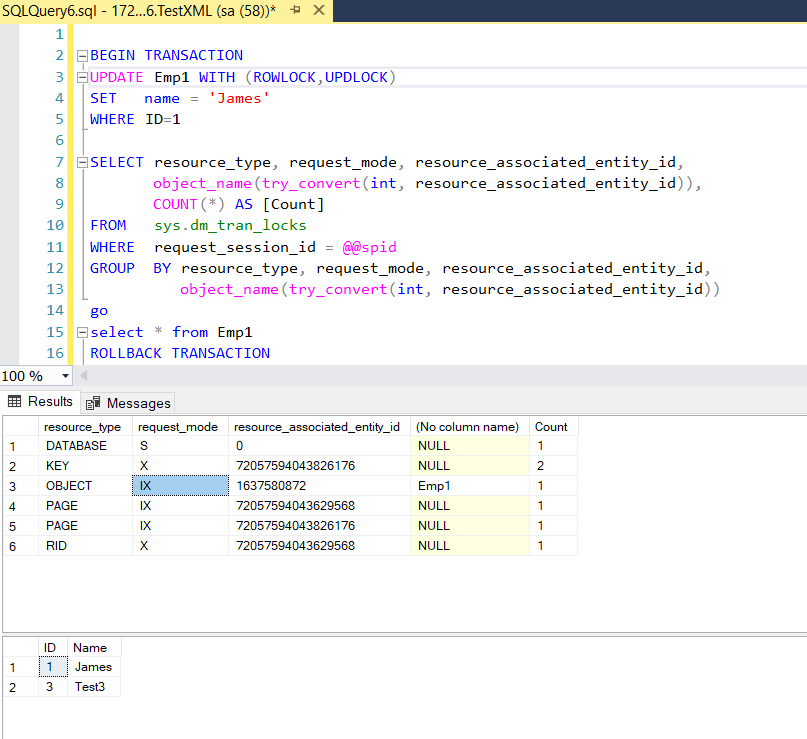
a) UPDATE LOCK place lock on Intent or Rows ?
b) what is difference between row lock and intent lock ?
i used WITH (ROWLOCK,UPDLOCK) row lock and update lock hint but still lock is not placed on row....why?
A Microsoft extension to the ANSI SQL language that includes procedural programming, local variables, and various support functions.
' cx='32' cy='32' r='32' /%3E%3Ctext x='50%25' y='55%25' dominant-baseline='middle' text-anchor='middle' fill='%23FFF' %3EEM%3C/text%3E%3C/svg%3E)
Hi @Sudip Bhatt ,

This means there is an IX lock on the column.IX refers to intent exclusive lock.

1.Use of ROWLOCK
The ROWLOCK row-level lock ensures that when the user obtains the updated row, it will not be modified by other users during this time. Therefore, row-level locks can ensure data consistency and improve the concurrency of data operations.
ROWLOCK tells SQL Server to only use row-level locks, ROWLOCK syntax can be used in SELECT, UPDATE and DELETE statements.
2.In order to obtain a lock on a specific resource type, the transaction must first obtain the same mode of intent lock at a higher granularity level. For example, in order to obtain an exclusive lock on a row, the transaction must first obtain an intent exclusive lock on the page containing that row, and also obtain an intent exclusive lock on the data object containing that page. The purpose of the intention lock is to effectively detect incompatible lock requests at a higher granularity level and prevent the granting of incompatible locks.
Regards
Echo
If the answer is helpful, please click "Accept Answer" and upvote it.
Note: Please follow the steps in our documentation to enable e-mail notifications if you want to receive the related email notification for this thread.
I have mention RowLock nd update Lock WITH (ROWLOCK,UPDLOCK) but intent exclusive lock is taken.... why ?
why Row lock not taken for my hint ?
please clearly mention difference between row lock and intent lock. Thanks
a) UPDATE LOCK place lock on Intent or Rows ?
Intent Lock : request mode of the lock
Row : lock-granularity-and-hierarchie, resource type of the lock
They are different concepts
b) what is difference between row lock and intent lock ?
same reply as a)’s
i used WITH (ROWLOCK,UPDLOCK) row lock and update lock hint but still lock is not placed on row....why?
it is already lock the row

Means the lock has been placed on the row.

When the data is updated, an exclusive lock will be applied for on the row. When an exclusive lock is applied for the row, an exclusive lock will be applied for the table containing the row.

used WITH (ROWLOCK,UPDLOCK) row lock and update lock hint but still lock is not placed on row....why?
Lock is placed on row, and I think I have already explained this. You have locks on KEY and RID. They are row locks.
When you have a lock on a lower level than table, you will always get intent locks on higher level. That is, if you get a lock on row level, you will also get intent locks on page and table. They serve to block other processes who want to take locks on these higher levels.
In this particular example you have updated a row in heap, a table without a clustered index, but there is a non-clustered index. The locks are taken on row level, since you requested this. The row level locks appears as KEY (in an index) or RID (in a heap).
The intent locks are taken on higher level to say "I am here below", so that a process that wants to take a lock on the entire table will be blocked. Same goes for the IX lock on page.
Row locks and intention locks do not belong to the same type. Row lock is to lock the row.
Refer to an example to illustrate the intention lock. When trying to modify data, the transaction will request an exclusive lock for the data resource to be modified. This lock mode is called exclusive lock because for the same data resource, if other transactions have already acquired any type of lock on the resource, it can no longer acquire the exclusive lock on the resource; if any transaction has already acquired it With the exclusive lock on the resource, you can no longer obtain any type of lock on the resource. That is, when the data resource obtains an exclusive lock, requesting another lock will be rejected by the system, which means that these locks are not compatible. The concept of intent lock has been mentioned before, and its function is to detect incompatible lock requests at a higher level. For example, if a transaction holds a row lock, and other transactions want to request an incompatible lock on the entire page or table containing that row, SQL Server can easily identify it and reject the request.
The content of the lock is very complicated. After understanding the concepts of the two locks, you will understand the difference between them.
' cx='32' cy='32' r='32' /%3E%3Ctext x='50%25' y='55%25' dominant-baseline='middle' text-anchor='middle' fill='%23FFF' %3ETP%3C/text%3E%3C/svg%3E)