Evaluate warehouse capabilities
- 6 minutes
A warehouse in Microsoft Fabric is an enterprise-scale relational data store built on a data lake foundation. It provides a full T-SQL experience for creating, loading, and querying structured data with multi-table ACID transaction support. If your team works primarily with SQL and you need transactional write capabilities, the warehouse is designed for that workload.
In the retail scenario, the sales team wants structured reporting with complex joins and frequent dimension updates. The warehouse is the primary candidate for this use case. This unit examines the warehouse's capabilities so you can evaluate when it's the right choice.
Warehouse architecture and capabilities
The Fabric warehouse stores all data in Delta format on OneLake, just like the lakehouse. However, the warehouse provides a fundamentally different development experience. You interact with the warehouse through T-SQL, using familiar SQL Server patterns for table creation, data loading, and query optimization.
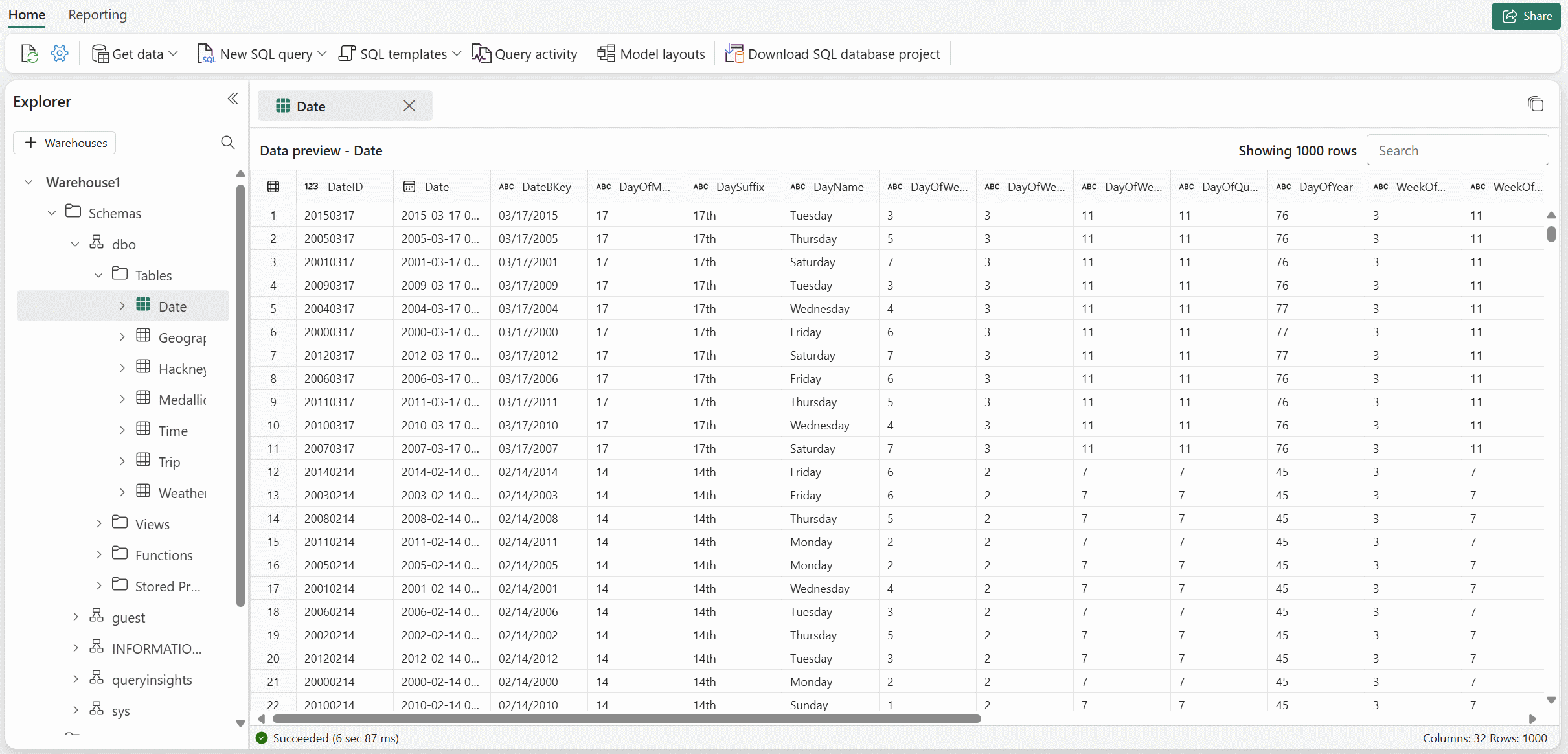
The warehouse supports:
- Full DML operations including INSERT, UPDATE, DELETE, and MERGE. You can modify data in place, which is essential for maintaining slowly changing dimensions and handling corrections.
- Full DDL operations including CREATE TABLE, ALTER TABLE, views, stored procedures, and functions. You define your schema with the same T-SQL statements you use in SQL Server.
- Multi-table ACID transactions. Changes across multiple tables commit or roll back together, which is critical for maintaining referential integrity in dimensional models.
- Cross-database queries. You can join data from multiple warehouses and lakehouse SQL analytics endpoints using three-part naming, without moving or copying data.
| Capability | Details |
|---|---|
| Data types | Structured |
| Primary development tool | T-SQL |
| Write support | T-SQL (INSERT, UPDATE, DELETE, MERGE, COPY INTO, CTAS), pipelines, dataflows |
| Read support | T-SQL (SELECT, views, stored procedures), Power BI Direct Lake |
| Storage format | Delta (Parquet with transaction log) |
| Schema management | Schema-on-write with enforced data types |
| Transaction support | Full multi-table ACID transactions |
When to choose a warehouse
The warehouse is the right choice when your scenario matches several of these characteristics:
- SQL-first teams. Your developers and analysts work primarily with T-SQL. They want to create tables, write stored procedures, and query data using the same tools and language they use with SQL Server or Azure SQL Database. The warehouse supports SQL Server Management Studio (SSMS), VS Code, and other SQL Server-compatible tools.
- Transactional write patterns. You need to update, delete, or merge records as part of your data pipeline. Dimensional models with slowly changing dimensions require UPDATE and DELETE capabilities that only the warehouse provides through T-SQL.
- Star schema and dimensional modeling. You're building curated data marts with fact and dimension tables for BI reporting. The warehouse's schema-on-write enforcement and full DDL support make it straightforward to define and maintain dimensional models.
- Strict schema governance. Regulatory or business requirements demand that data types and constraints are enforced from the moment data is loaded. The warehouse validates data on write, catching type mismatches and constraint violations early.
- Complex analytical queries. You need to run queries with multiple joins, aggregations, window functions, and subqueries. The warehouse's distributed query processing engine is optimized for complex analytical workloads.
Note
The warehouse doesn't require any capacity configuration or compute management. Fabric handles scaling automatically, with no knobs to turn for performance tuning.
When a warehouse isn't the best fit
The warehouse has trade-offs that make other stores better choices for certain scenarios:
- Spark-based workloads. If your team uses Python, Scala, or R in Spark notebooks for data engineering or data science, the lakehouse provides native Spark support. The warehouse is designed for T-SQL development, not notebook-based exploration.
- Unstructured or semi-structured data. If you need to store raw JSON files, images, or documents alongside your tables, the lakehouse's Files area handles those formats. The warehouse is designed for structured, tabular data.
- Streaming and real-time data. If your data arrives continuously and needs to be queryable within seconds, the eventhouse's streaming ingestion is purpose-built for that pattern. The warehouse handles batch and micro-batch loading.
- Highly flexible schemas. If your data model is evolving rapidly and you don't want to define the schema upfront, the lakehouse's schema-on-read approach gives you more flexibility. The warehouse's schema-on-write model enforces structure at load time.
Warehouse in the broader Fabric solution
In many Fabric solutions, the warehouse serves as the curated serving layer. Data flows from source systems through a lakehouse (where data engineers transform it with Spark), then into the warehouse (where it's organized into dimensional models for BI consumption).
The warehouse's full T-SQL support makes it the preferred foundation for semantic models in Power BI. Curated fact and dimension tables in the warehouse map directly to the tables and relationships that Power BI semantic models expose to report creators and end users.
The warehouse also plays a critical role in AI readiness. Its structured, well-governed data is the foundation that Copilot and data agents rely on when answering natural language questions:
- Copilot in Power BI generates DAX queries against semantic models that sit on top of warehouse star schemas. The clearer your dimensional model, the more accurate the AI-generated answers.
- Data agents translate natural language into T-SQL queries against warehouse tables. Consistent naming conventions, well-defined relationships, and descriptive column names directly improve agent accuracy.
- Semantic models built on warehouse data serve as the governed layer that multiple AI features consume. The work you invest in schema design, column descriptions, and referential integrity pays off across every AI tool that reads your data.
The schema enforcement and governance that the warehouse provides more than good data management practices—they're prerequisites for effective AI adoption.
You now understand when the warehouse is the right choice. Next, let's evaluate the eventhouse and see how it handles real-time and time-series workloads.
Check your understanding
Feedback
Was this page helpful?
No
Need help with this topic?
Want to try using Ask Learn to clarify or guide you through this topic?