Evaluate eventhouse capabilities
- 5 minutes
An eventhouse in Microsoft Fabric is designed for real-time analytics on streaming and time-series data. It efficiently handles large volumes of events arriving continuously, and it provides fast query performance on data with a natural time component. If your workload involves telemetry, logs, IoT data, or any event-based pattern, the eventhouse is purpose-built for that scenario.
In the retail scenario, the operations team monitors IoT sensor data from distribution centers in real time. They need dashboards that show temperature trends and anomaly alerts with minimal latency. The eventhouse is the right store for this workload. This unit examines the eventhouse's capabilities and helps you evaluate when to choose it.
Eventhouse architecture and capabilities
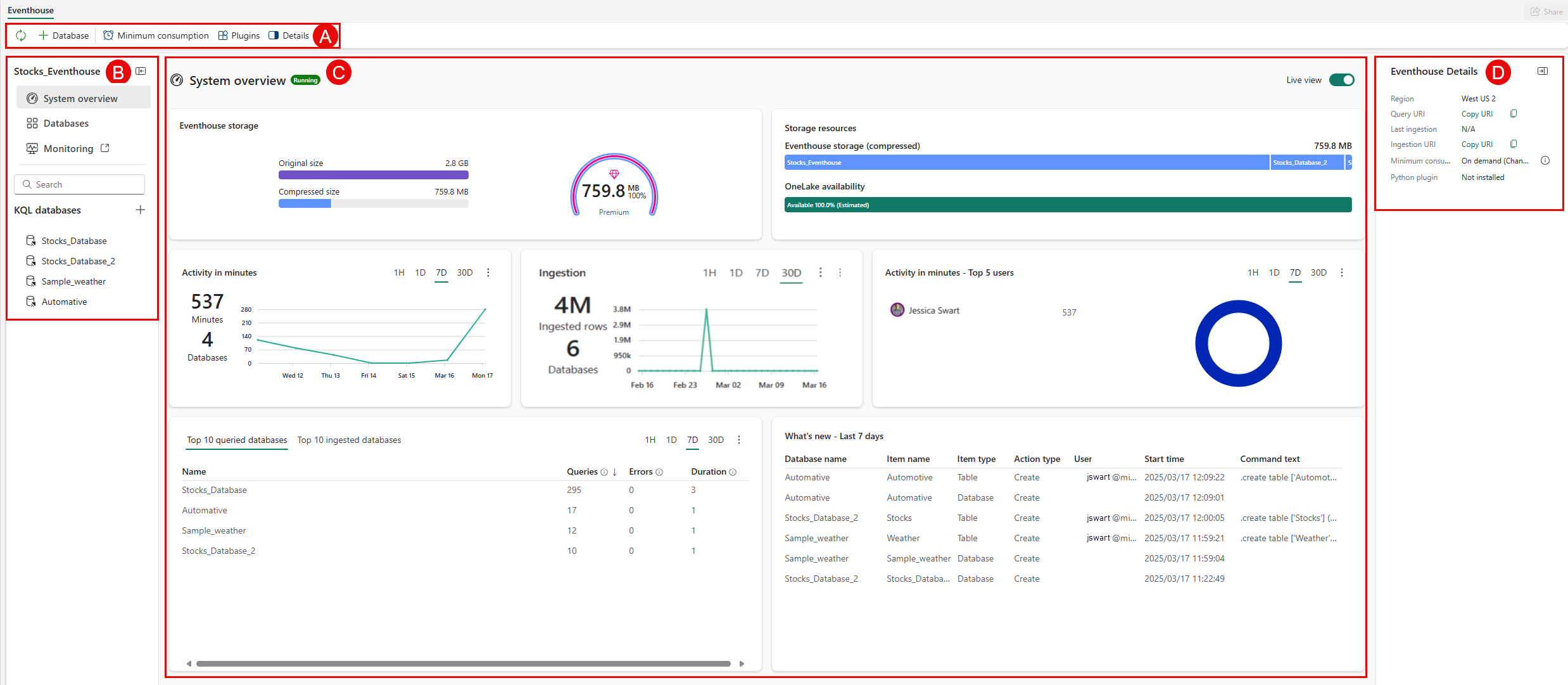
An eventhouse is a workspace of KQL databases that share capacity and resources. Each KQL database stores event-based data that's automatically indexed and partitioned by ingestion time. This time-based partitioning is fundamental to how the eventhouse achieves fast query performance on large volumes of event data.
The eventhouse accepts data from multiple sources and pipelines, including Eventstream, SDKs, Kafka, Logstash, dataflows, and more. Data arrives in various formats and is ingested in near real-time. Unlike the lakehouse and warehouse, the eventhouse is optimized for append-heavy workloads where new events stream in continuously and existing data is rarely modified.
The primary query language for the eventhouse is Kusto Query Language (KQL). KQL is designed specifically for time-series analysis and provides built-in operators for aggregations over time windows, anomaly detection, pattern matching, and geospatial analysis. The eventhouse also supports a subset of T-SQL for teams that prefer SQL syntax, though KQL provides the richest analytics experience.
| Capability | Details |
|---|---|
| Data types | Time-series, event-based, semistructured (JSON, text), structured |
| Primary development tool | KQL (Kusto Query Language) |
| Write support | Streaming ingestion, batch ingestion, Eventstream, SDKs, Kafka |
| Read support | KQL, T-SQL (subset), Power BI DirectQuery |
| Storage format | Columnar store with automatic indexing and compression |
| Schema management | Schema-on-write with dynamic fields for semistructured data |
| Transaction support | Append-optimized; not designed for UPDATE/DELETE operations |
When to choose an eventhouse
The eventhouse is the right choice when your scenario matches several of these characteristics:
- IoT telemetry and sensor data. You ingest data from equipment, sensors, or devices that generate continuous streams of measurements. The eventhouse's streaming ingestion and time-based partitioning handle this pattern efficiently.
- Log and event analytics. You collect application logs, security events, or system metrics that need to be searchable and analyzable in near real-time. KQL's full-text search and pattern-matching operators are designed for this type of data.
- Real-time dashboards and monitoring. You need dashboards that refresh frequently and show current state alongside historical trends. The eventhouse's fast query engine and Power BI integration support low-latency visualizations.
- Time-series analysis. You analyze trends, seasonality, or anomalies in data with a natural time dimension. KQL provides built-in time-series functions like
make-series,series_decompose, andseries_decompose_anomalies. - High-volume ingestion. You receive millions of events per day and need them to be queryable within seconds. The eventhouse is optimized for high-throughput ingestion with automatic scaling.
Tip
The eventhouse includes an Always-On option for time-sensitive systems that can't tolerate any startup latency. When enabled, the service stays available continuously and scales according to the autoscale mechanism.
When an eventhouse isn't the best fit
The eventhouse has characteristics that make other stores better choices for certain scenarios:
- Traditional dimensional modeling. If you're building star schemas with fact and dimension tables for structured BI reporting, the warehouse provides better support for that pattern. The eventhouse is optimized for flat, denormalized event data, not normalized relational models.
- Transactional updates. If you need to update or delete individual records frequently, the warehouse or lakehouse is a better fit. The eventhouse is designed for append-only workloads. While it supports some data management operations, it isn't built for heavy UPDATE/DELETE patterns.
- Batch-only workloads. If all your data arrives in scheduled batch loads and you don't need real-time query performance, a lakehouse or warehouse handles batch processing efficiently without the overhead of streaming infrastructure.
- Spark-based data engineering. If your team works primarily in Spark notebooks for data transformation and ML, the lakehouse is the right choice. The eventhouse doesn't provide a Spark execution environment.
Eventhouse in the broader Fabric solution
In many Fabric solutions, the eventhouse runs alongside a lakehouse or warehouse. The eventhouse handles hot data that arrives in real time and needs immediate analysis. When that data ages and becomes part of historical analysis, it can be made available in OneLake for access by other Fabric workloads.
The eventhouse supports real-time AI scenarios that the other stores can't handle at the same speed:
- Anomaly detection. KQL's
series_decompose_anomaliesfunction identifies outliers in time-series data as events arrive, enabling automated alerts for unusual patterns. - Time-series forecasting. Built-in functions like
series_decompose_forecastproject future values based on historical patterns without exporting data to a separate ML environment. - Streaming predictions. Events flowing through Eventstream can trigger real-time scoring pipelines, so you detect problems as they happen rather than discovering them hours or days later in a batch report.
When your AI use case requires acting on data within seconds of arrival, the eventhouse provides both the ingestion speed and the built-in analytics to make that possible.
You now understand the strengths and trade-offs of all three analytical data stores. In the next unit, you apply this knowledge to real-world business scenarios.
Check your understanding
Feedback
Was this page helpful?
No
Need help with this topic?
Want to try using Ask Learn to clarify or guide you through this topic?