Case study - Choose data stores for an integrated analytics solution
In this case study, you apply the decision framework from the previous units to a real-world scenario. Contoso Corporation is building an analytics platform with Microsoft Fabric, and you evaluate four workloads to recommend the right data store for each one.
Note
For each workload, read the scenario first and form your own recommendation. Then select the Recommendation tab to check your answer.
The business scenario
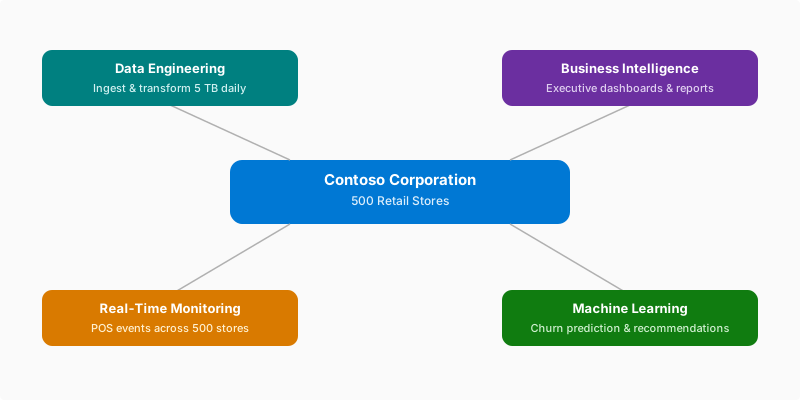
Contoso Corporation operates 500 retail stores across North America. They're modernizing their analytics platform with Microsoft Fabric to support four workloads: data engineering, business intelligence (BI), real-time inventory monitoring, and machine learning.
Workload 1: Data engineering
Contoso's data engineering team needs to build the analytics foundation. Here are their requirements:
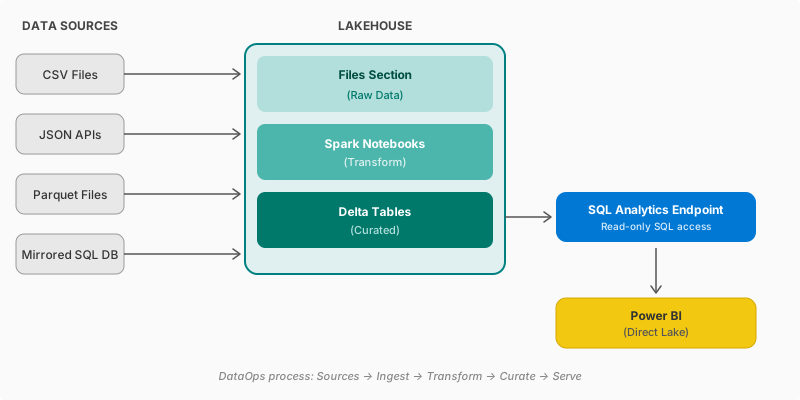
- Data sources: Mirrored SQL databases, supplier CSV files, partner JSON APIs, legacy Parquet exports
- Volume: 5 TB of new data daily
- Data formats: Structured, semi-structured, and unstructured
- Processing: Batch transformations that clean and validate raw data into curated tables
- Schema: Source schemas change frequently as upstream systems evolve
- Output: Clean, validated tables that downstream analysts and data scientists can trust
- Team skills: Python and PySpark
Consider the decision factors: data format, write pattern, workload type, and team skills. Which Fabric data store would you recommend?
Workload 2: Business intelligence
With curated data now available from the engineering lakehouse, Contoso's BI team needs to build executive dashboards and operational reports. Their requirements:
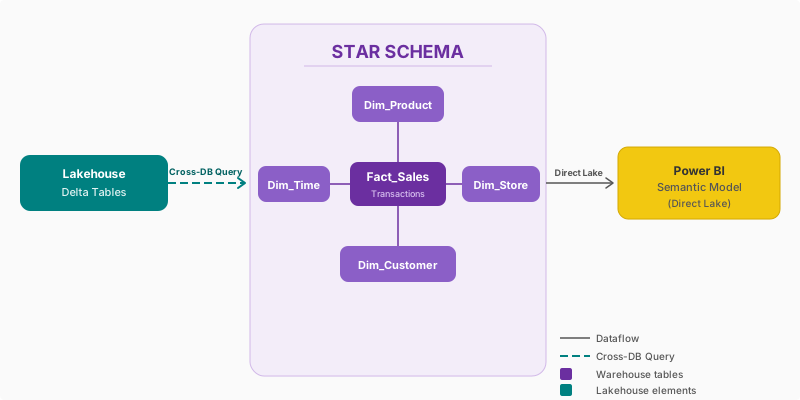
- Data modeling: Star schemas with fact and dimension tables
- Update pattern: Slowly changing dimensions that require daily in-place updates (price changes, address corrections)
- Write operations: Must support UPDATE, DELETE, and MERGE across multiple tables with transactional consistency
- Reporting: Subsecond Power BI dashboard performance for hundreds of business users
- Data access: Need to read curated tables from the engineering lakehouse without copying data
- Team skills: SQL Server experience using stored procedures, views, and complex joins
The engineering lakehouse's SQL analytics endpoint is read-only, so it can't support the write operations this team needs. Which Fabric data store would you recommend?
Workload 3: Real-time inventory monitoring
Contoso's operations team needs to monitor inventory across 500 stores in real time. Their requirements:
- Data source: Point-of-sale systems generating 50,000 events per second, continuously
- Data pattern: Append-only events with timestamps (transactions, inventory changes)
- Query pattern: Time-window analysis like "which stores sold more than 50 units of Product X in the last 15 minutes?"
- Latency: Stockout risks must be detected within seconds, not hours
- Visualization: Dashboards that auto-refresh every few seconds
- Historical data: Older events should be available for long-term trend analysis in another store
Neither the lakehouse (batch ingestion) nor the warehouse (not optimized for streaming time-series at this scale) fits these requirements. Which Fabric data store would you recommend?

Workload 4: Machine learning
Contoso's data science team needs to build predictive models for customer churn and product recommendations. Their requirements:
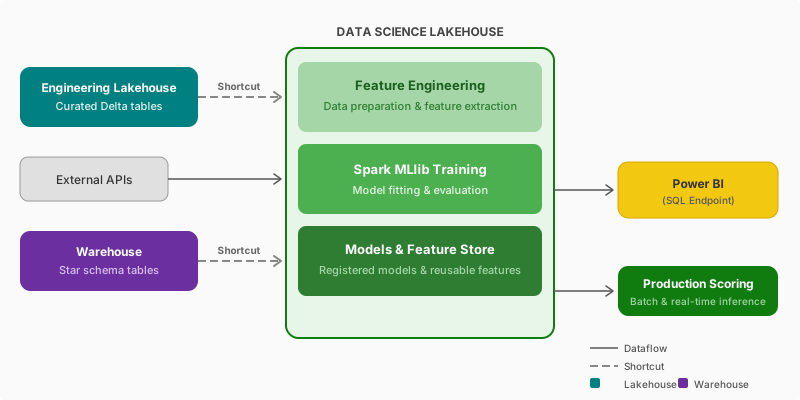
- Data sources: Transaction history from the warehouse, curated datasets from the engineering lakehouse, and external economic indicators
- Processing: Distributed feature engineering across 100+ GB datasets
- Tools: Python, scikit-learn, pandas, and Spark MLlib
- Isolation: Experiments involve frequent schema changes and failed runs that must not affect production data pipelines
- Output: Trained models and feature sets that other teams can access for reporting
The team needs the same Spark and Python capabilities as the engineering lakehouse, but can't risk disrupting production pipelines. What would you recommend?
How the complete solution fits together
Step back and look at what Contoso built. Four data stores, each chosen for specific workload characteristics, all integrated through OneLake.
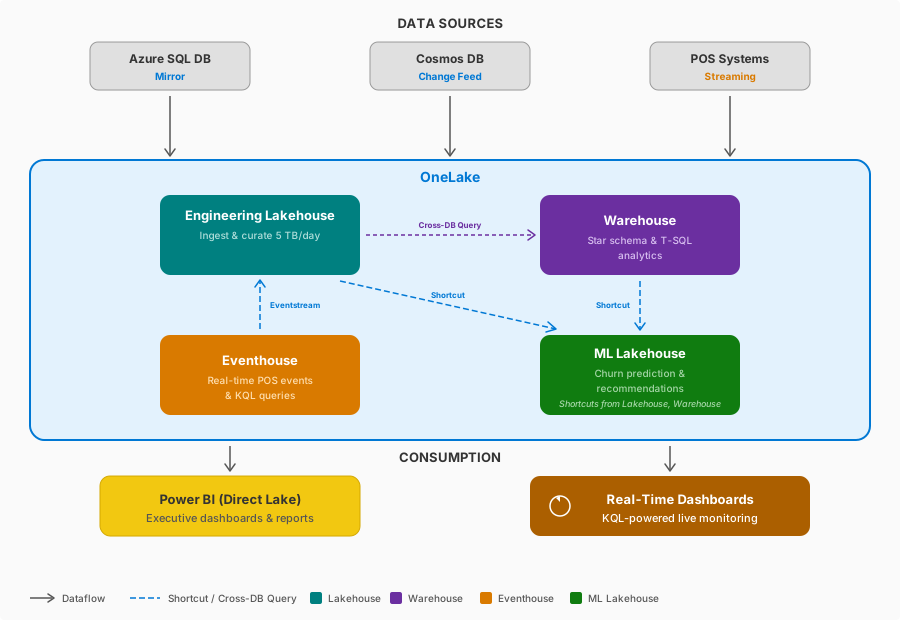
Data flows through the solution in a clear path:
- The engineering lakehouse ingests raw data from all sources and produces curated Delta tables.
- The warehouse builds star schemas on top of lakehouse data through cross-database queries, with no copying.
- An eventstream routes point-of-sale events to the eventhouse for real-time monitoring and to the lakehouse for historical analysis.
- The ML lakehouse reads from both the warehouse and engineering lakehouse via shortcuts to train models.
- Power BI connects to warehouse and lakehouses with Direct Lake. Real-Time Dashboards query eventhouse with KQL.
The key integration patterns:
| Pattern | What it does |
|---|---|
| OneLake shortcuts | ML lakehouse reads directly from engineering lakehouse and warehouse without duplicating data |
| Cross-database queries | Warehouse reads lakehouse data through three-part naming (lakehouse.schema.table) |
| Eventstreams | Route events from the same source to both eventhouse and lakehouse simultaneously |
| Direct Lake | Power BI reads data directly from OneLake with no import refresh |
The deeper lesson is that you rarely choose just one store. Build in layers: start with lakehouse for your data foundation, add warehouse for BI, eventhouse for real-time, and connect them through cross-database queries and OneLake shortcuts. Let each store do what it does best, and let integration handle the rest.
Note
Contoso's operational systems (Azure SQL Database for e-commerce, Azure Cosmos DB for the mobile app) aren't analytical data stores. They're optimized for writing individual records quickly. They integrate with Fabric through database mirroring, which continuously replicates data to OneLake without impacting operational performance. The engineering lakehouse reads this mirrored data as a source for transformation.