Developer technologies | Transact-SQL
A Microsoft extension to the ANSI SQL language that includes procedural programming, local variables, and various support functions.
This browser is no longer supported.
Upgrade to Microsoft Edge to take advantage of the latest features, security updates, and technical support.
' cx='32' cy='32' r='32' /%3E%3Ctext x='50%25' y='55%25' dominant-baseline='middle' text-anchor='middle' fill='%23FFF' %3ER%3C/text%3E%3C/svg%3E)
multiply all even place values by 2 (excluding zeros) and odd place values by 1.
0012345
0*2+0*1+1*2+2*1+3*2+4*1+5*2
0+0+2+2+6+4+10
0+0+2+2+6+4+(1+0)
15 = 1+5 = 6
The total of a given number is 6
A Microsoft extension to the ANSI SQL language that includes procedural programming, local variables, and various support functions.
Additional SQL Server features and topics not covered by specific categories
' cx='32' cy='32' r='32' /%3E%3Ctext x='50%25' y='55%25' dominant-baseline='middle' text-anchor='middle' fill='%23FFF' %3EYK%3C/text%3E%3C/svg%3E)
While asking a question you need to provide a minimal reproducible example:
(1) DDL and sample data population, i.e. CREATE table(s) plus INSERT, T-SQL statements.
(2) What you need to do, i.e. logic, and your attempt implementation of it in T-SQL.
(3) Desired output based on the sample data in the #1 above.
(4) Your SQL Server version (SELECT @@version;)
I need to create a function and pass a value to the function and get the output as 6 for the given example.
I am using SQL Server 2016
RajKumar-4323,
What values you are passing to a function?
What is the desired output for each input parameter?
Your SQL Server version (SELECT @@version;)

I don't Raj is passing any value to this function at all - looks very much as an assignment/interview question to me. I prefer not to be involved.
I am passing BIGINT to the function and I mentioned the desired output beginning of my post.
SQL Server 2016
' cx='32' cy='32' r='32' /%3E%3Ctext x='50%25' y='55%25' dominant-baseline='middle' text-anchor='middle' fill='%23FFF' %3EBZ%3C/text%3E%3C/svg%3E)
Hi,@RajKumar
Welcome to Microsoft T-SQL Q&A Forum!
You can refer to the answers of the following two writers, which implements your needs well!
Best regards,
Bert Zhou
Answer accepted by question author
' cx='32' cy='32' r='32' /%3E%3Ctext x='50%25' y='55%25' dominant-baseline='middle' text-anchor='middle' fill='%23FFF' %3EI1%3C/text%3E%3C/svg%3E)
Hi @RajKumar
please check this function :
create function [dbo].[TESTFUNC](@string VARCHAR(MAX))-- parameter
returns int --return type
AS
BEGIN
  DECLARE @LENGTH INT = (SELECT LEN(@string))
  declare @returnvalue int
  IF @LENGTH <3
    BEGIN
     DECLARE @stringint INT = CONVERT(INT,@string)
	 SET @returnvalue = (SELECT IIF(@stringint>=10,@stringint/10+@stringint%10,@stringint))
	END
  ELSE
    BEGIN
     DECLARE @I INT = 1
	 DECLARE @STR VARCHAR(10)
	 DECLARE @SUM INT = 0
	 WHILE @I <=@LENGTH
	 BEGIN

		SET @STR  = SUBSTRING(@string,@I,1)
		DECLARE @STRVALUE INT= CONVERT(INT,@STR)

		DECLARE @IFEVEN int =    IIF(@I%2=0,1,0)

		SET @STRVALUE = IIF(@IFEVEN =0,@STRVALUE*2,@STRVALUE *1)
		SET @STRVALUE =   IIF(@STRVALUE>=10,@STRVALUE/10+@STRVALUE%10,@STRVALUE)


		SET @I = @I+1
		SET @SUM = @SUM+@STRVALUE
	  END
	  declare @strtemp VARCHAR(MAX)= cast(@SUM AS VARCHAR(MAX))
	  SET @returnvalue  = dbo.TESTFUNC(@strtemp)
      END
   RETURN @returnvalue
END
and use it
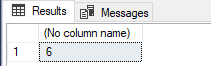
SELECT dbo.TESTFUNC('0012345')
result:
Best Regards,
Isabella
If the answer is the right solution, please click "Accept Answer" and upvote it. If you have extra questions about this answer, please click "Comment".
Note: Please follow the steps in our documentation to enable e-mail notifications if you want to receive the related email notification for this thread.
SELECT dbo.testfunc('000023459') is giving 11 as output but we need 1+1 = 2
Maybe you could explain what you are actually trying to do. If my guess is right, I don't think you want 2 here.
You are right. My answer always in 1 digit. For example if I get 16 the output to be 1+6 =7
But what is your actual business problem?
Hi @RajKumar ,
You cannot pass a BIGINT data type to the function. It is because of the leading zeros.
Please try the following solution. It will give you a good jumpstart for your function.
Hint: A UDF function could be called recursively.
SQL
DECLARE @inputValue VARCHAR(20) = '0012345';

DECLARE @tbl TABLE (Data VARCHAR(20));
INSERT INTO @tbl VALUES (@inputValue);

; WITH rs AS
(
 SELECT digit = SUBSTRING(@inputValue, number, 1)
 , seq = ROW_NUMBER() OVER (ORDER BY (SELECT NULL))
 FROM @tbl CROSS APPLY
 (
 SELECT DISTINCT
    number
 FROM master..spt_values
 WHERE number > 0
   AND number <= LEN(@inputValue)
 ) AS V
)
SELECT Result = SUM(IIF(seq % 2 = 1, digit*2, digit))
FROM rs;