Azure Data Factory
An Azure service for ingesting, preparing, and transforming data at scale.
This browser is no longer supported.
Upgrade to Microsoft Edge to take advantage of the latest features, security updates, and technical support.
' cx='32' cy='32' r='32' /%3E%3Ctext x='50%25' y='55%25' dominant-baseline='middle' text-anchor='middle' fill='%23FFF' %3EPM%3C/text%3E%3C/svg%3E)
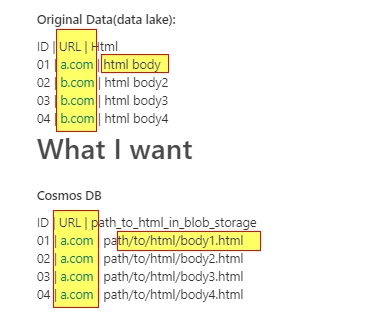
Original Data(data lake):
ID | URL | Html
01 | a.com | html body
02 | b.com | html body2
03 | b.com | html body3
04 | b.com | html body4
Cosmos DB
ID | URL | path_to_html_in_blob_storage
01 | a.com | path/to/html/body1.html
02 | a.com | path/to/html/body2.html
03 | a.com | path/to/html/body3.html
04 | a.com | path/to/html/body4.html
Blob files which contains the Html(blob storage):
path/to/html/body1.html
path/to/html/body2.html
path/to/html/body3.html
path/to/html/body4.html
Who could give some suggestions for implement this logic in ADF
' cx='32' cy='32' r='32' /%3E%3Ctext x='50%25' y='55%25' dominant-baseline='middle' text-anchor='middle' fill='%23FFF' %3EKM%3C/text%3E%3C/svg%3E)
Hi anonymous user-0048,
Thanks for using Microsoft Q&A forum and posting your query.
I'm not sure if I understood the requirement. Could you please elaborate a bit clear on the ask so that we can better assist on this. I am confused between source data and expected sink data.
Additional clarification (or a better sample/example) would be very helpful.
We look forward to your confirmation
Thanks
Sorry for the confusion, updated description!
ID | URL | Html(html content)
01 | a.com | <html>...</html> // --> this html content will be save to blob storage: path/to/html/body1.html
02 | b.com | <html>...</html> // --> this html content will be save to blob storage: path/to/html/body2.html
03 | b.com | <html>...</html> // --> this html content will be save to blob storage: path/to/html/body3.html
04 | b.com | <html>...</html> // --> this html content will be save to blob storage: path/to/html/body4.html
Cosmos DB
ID | URL | path_to_html_in_blob_storage
01 | a.com | path/to/html/body1.html
02 | a.com | path/to/html/body2.html
03 | a.com | path/to/html/body3.html
04 | a.com | path/to/html/body4.html
Blob files which contains the Html(blob storage):
path/to/html/body1.html
path/to/html/body2.html
path/to/html/body3.html
path/to/html/body4.html
Original Data(data lake):
ID | URL | Html(html content)
01 | a.com | <html>...</html> // --> this html content will be save to blob storage: path/to/html/body1.html
02 | b.com | <html>...</html> // --> this html content will be save to blob storage: path/to/html/body2.html
03 | b.com | <html>...</html> // --> this html content will be save to blob storage: path/to/html/body3.html
04 | b.com | <html>...</html> // --> this html content will be save to blob storage: path/to/html/body4.html
What I want
Cosmos DB
ID | URL | path_to_html_in_blob_storage
01 | a.com | path/to/html/body1.html
02 | a.com | path/to/html/body2.html
03 | a.com | path/to/html/body3.html
04 | a.com | path/to/html/body4.html
Blob files which contains the Html(blob storage):
path/to/html/body1.html
path/to/html/body2.html
path/to/html/body3.html
path/to/html/body4.html
Original Data(data lake):
ID | URL | Html(html content)
01 | a.com | <html>...</html> // --> this html content will be save to blob storage: path/to/html/body1.html
02 | b.com | <html>...</html> // --> this html content will be save to blob storage: path/to/html/body2.html
03 | b.com | <html>...</html> // --> this html content will be save to blob storage: path/to/html/body3.html
04 | b.com | <html>...</html> // --> this html content will be save to blob storage: path/to/html/body4.html
ID, URL, Html are only column names of original data. The html column data is very large and I want to put it to a file(each row has its own file) in blob storage and replace the column with a reference to blob storage.
What I want
Cosmos DB
ID | URL | path_to_html_in_blob_storage
01 | a.com | path/to/html/body1.html
02 | a.com | path/to/html/body2.html
03 | a.com | path/to/html/body3.html
04 | a.com | path/to/html/body4.html
Blob files which contains the Html(blob storage):
path/to/html/body1.html
path/to/html/body2.html
path/to/html/body3.html
path/to/html/body4.html
Hi anonymous user-0048 ,
Sorry for the delayed response and thanks for clarification.
One of the way to achieve your requirement is use the Derived column to dynamically created the folder path for the HTML content files and followed by 2 sink transformations.
Sample transformation flow looks like below:

Hope this helps. Do let us know if you have further query.
----------
Please don’t forget to Accept Answer and Up-Vote wherever the information provided helps you, this can be beneficial to other community members.