Note
Access to this page requires authorization. You can try signing in or changing directories.
Access to this page requires authorization. You can try changing directories.
Azure Event Grid supports event-driven architectures by routing events from sources to handlers. This article shows you how to configure Azure Service Bus queues and topics as event handlers for Event Grid events. You configure the queue or topic to process events in enterprise applications by using the Azure portal, Azure CLI, Azure PowerShell, or REST API.
Prerequisites
- An Azure account with an active subscription. Create an account for free.
- An Event Grid topic, system topic, custom topic, or partner topic to subscribe to. For more information, see Create an Event Grid topic or a domain.
- A Service Bus namespace with a queue or topic to receive the events. For more information, see Create a Service Bus namespace and a queue by using the Azure portal.
- Permission to create an event subscription on the source topic and to send messages to the target Service Bus queue or topic.
Service Bus queues
Route events in Event Grid directly to Service Bus queues for buffering or command and control scenarios in enterprise applications.
Configure a Service Bus queue by using the Azure portal
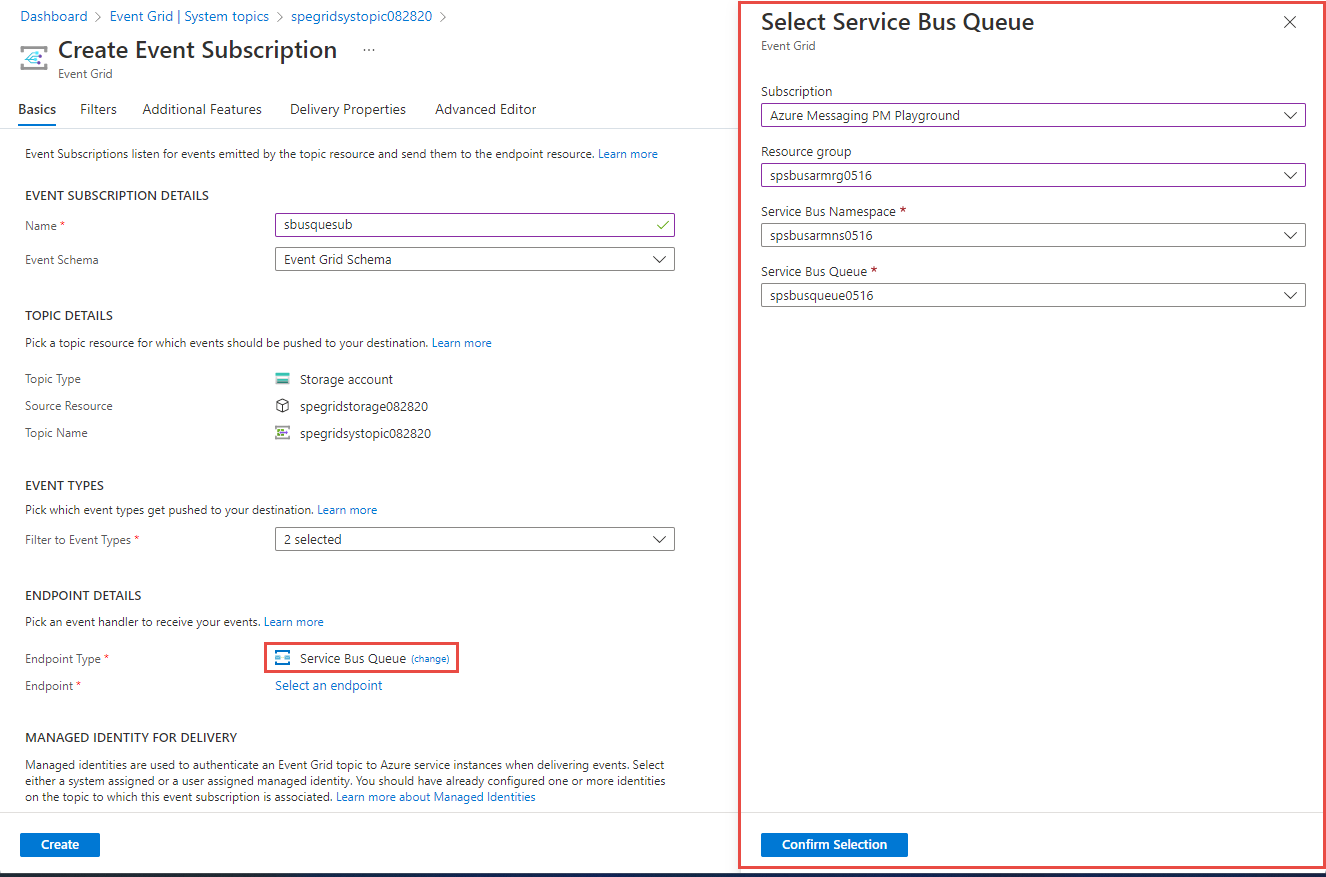
In the Azure portal, while creating an event subscription, select Service Bus Queue as the endpoint type, and then select Select an endpoint to choose a Service Bus queue.
Note
If you use a session-enabled queue or topic subscription as the destination, set the session property on the event by using a delivery property with the header name SessionId.
Configure a Service Bus queue by using the Azure CLI
Use the az eventgrid event-subscription create command with --endpoint-type set to servicebusqueue and --endpoint set to /subscriptions/{AZURE SUBSCRIPTION}/resourceGroups/<RESOURCE GROUP NAME>/providers/Microsoft.ServiceBus/namespaces/<NAMESPACE NAME>/queues/<QUEUE NAME>. Here's an example:
az eventgrid event-subscription create \
    --name <my-event-subscription> \
    --source-resource-id /subscriptions/{SubID}/resourceGroups/{RG}/providers/Microsoft.EventGrid/topics/topic1 \
    --endpoint-type servicebusqueue \
    --endpoint /subscriptions/{SubID}/resourceGroups/TestRG/providers/Microsoft.ServiceBus/namespaces/ns1/queues/queue1
You can also use the az eventgrid topic event-subscription command for custom topics, the az eventgrid system-topic event-subscription command for system topics, and the az eventgrid partner topic event-subscription create command for partner topics.
Configure a Service Bus queue by using Azure PowerShell
Use the New-AzEventGridSubscription command with -EndpointType set to servicebusqueue and -Endpoint set to /subscriptions/{AZURE SUBSCRIPTION}/resourceGroups/<RESOURCE GROUP NAME>/providers/Microsoft.ServiceBus/namespaces/<NAMESPACE NAME>/queues/<QUEUE NAME>. Here's an example:
New-AzEventGridSubscription -ResourceGroup MyResourceGroup `
            -TopicName Topic1 `
            -EndpointType servicebusqueue `
            -Endpoint /subscriptions/{SubID}/resourceGroups/TestRG/providers/Microsoft.ServiceBus/namespaces/ns1/queues/queue1 `
            -EventSubscriptionName EventSubscription1
You can also use the New-AzEventGridSystemTopicEventSubscription command for system topics, and the New-AzEventGridPartnerTopicEventSubscription command for partner topics.
Service Bus topics
Route events in Event Grid directly to Service Bus topics for command and control messaging scenarios.
Configure a Service Bus topic by using the Azure portal
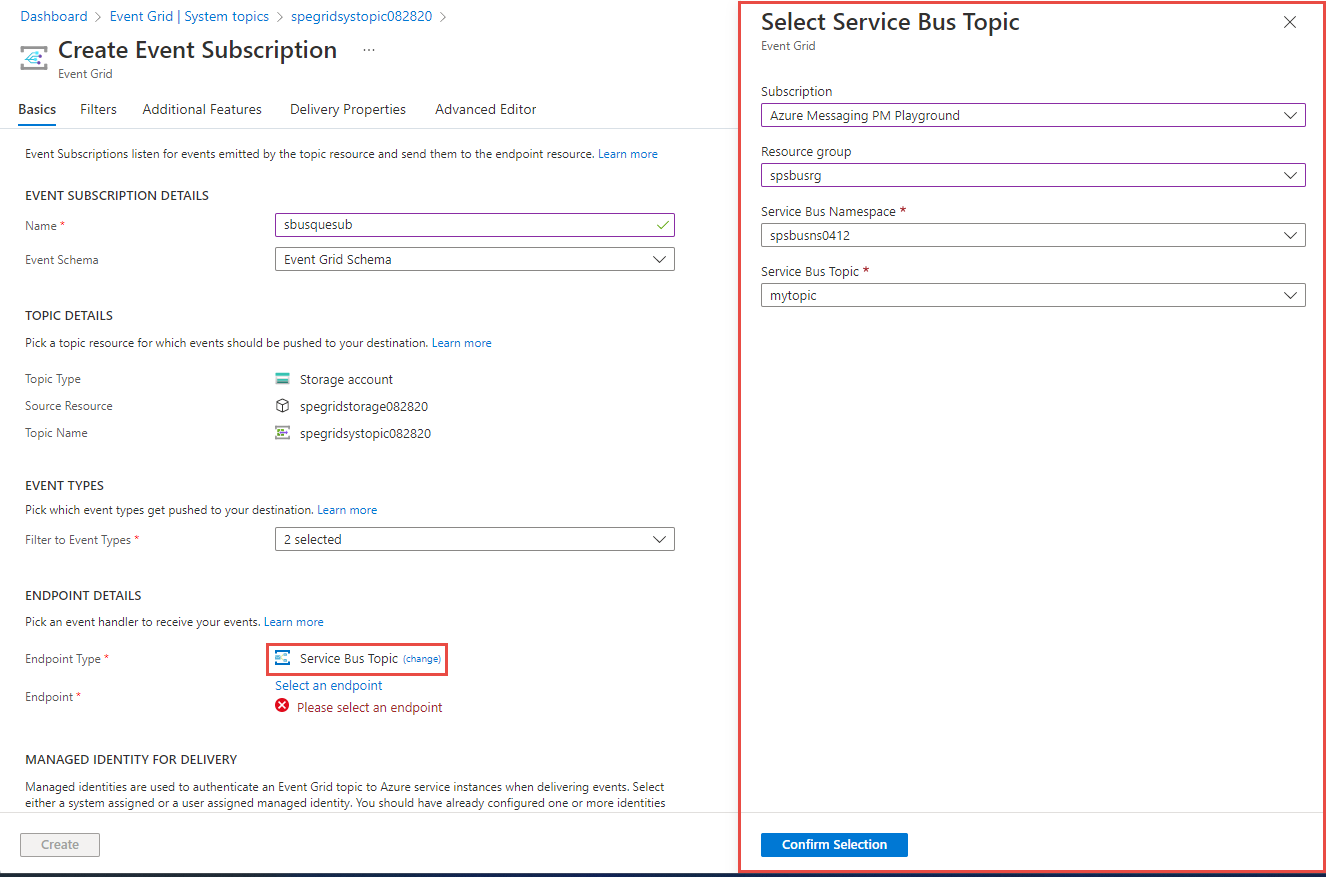
In the Azure portal, while creating an event subscription, select Service Bus Topic as the endpoint type, and then select Select an endpoint to choose a Service Bus topic.
Configure a Service Bus topic by using the Azure CLI
Use the az eventgrid event-subscription create command with --endpoint-type set to servicebustopic and --endpoint set to /subscriptions/{AZURE SUBSCRIPTION}/resourceGroups/<RESOURCE GROUP NAME>/providers/Microsoft.ServiceBus/namespaces/<NAMESPACE NAME>/topics/<TOPIC NAME>. Here's an example:
az eventgrid event-subscription create \
    --name <my-event-subscription> \
    --source-resource-id /subscriptions/{SubID}/resourceGroups/{RG}/providers/Microsoft.EventGrid/topics/topic1 \
    --endpoint-type servicebustopic \
    --endpoint /subscriptions/{SubID}/resourceGroups/TestRG/providers/Microsoft.ServiceBus/namespaces/ns1/topics/topic1
You can also use the az eventgrid topic event-subscription command for custom topics, the az eventgrid system-topic event-subscription command for system topics, and the az eventgrid partner topic event-subscription create command for partner topics.
Configure a Service Bus topic by using Azure PowerShell
Use the New-AzEventGridSubscription command with -EndpointType set to servicebustopic and -Endpoint set to /subscriptions/{AZURE SUBSCRIPTION}/resourceGroups/<RESOURCE GROUP NAME>/providers/Microsoft.ServiceBus/namespaces/<NAMESPACE NAME>/topics/<TOPIC NAME>. Here's an example:
New-AzEventGridSubscription -ResourceGroup MyResourceGroup `
            -TopicName Topic1 `
            -EndpointType servicebustopic `
            -Endpoint /subscriptions/{SubID}/resourceGroups/TestRG/providers/Microsoft.ServiceBus/namespaces/ns1/topics/topic1 `
            -EventSubscriptionName EventSubscription1
You can also use the New-AzEventGridSystemTopicEventSubscription command for system topics, and the New-AzEventGridPartnerTopicEventSubscription command for partner topics.
Message headers
These are the properties you receive in the message headers:
| Property name | Description |
|---|---|
| aeg-subscription-name | Name of the event subscription. |
| aeg-delivery-count | Number of attempts made for the event. |
| aeg-event-type | Type of the event. It can be one of the following values:
|
| aeg-metadata-version | Metadata version of the event. For Event Grid event schema, this property represents the metadata version and for cloud event schema, it represents the spec version. |
| aeg-data-version | Data version of the event. For Event Grid event schema, this property represents the data version and for cloud event schema, it doesn't apply. |
| aeg-output-event-id | ID of the Event Grid event. |
When you send an event to a Service Bus queue or topic as a brokered message, the messageid of the brokered message is an internal system ID.
The internal system ID for the message persists across redelivery of the event so that you can avoid duplicate deliveries by turning on duplicate detection on the Service Bus entity. Set the duplicate detection duration on the Service Bus entity to either the time-to-live (TTL) of the event or the maximum retry duration, whichever is longer.
Delivery properties
When you use event subscriptions, you can set up HTTP headers to include in delivered events. This capability supports setting custom headers that the destination requires. You can set custom headers on the events delivered to Azure Service Bus queues and topics.
Azure Service Bus supports the following message properties when you send single messages.
| Header name | Header type |
|---|---|
MessageId |
Dynamic |
PartitionKey |
Static or dynamic |
SessionId |
Static or dynamic |
CorrelationId |
Static or dynamic |
Label |
Static or dynamic |
ReplyTo |
Static or dynamic |
ReplyToSessionId |
Static or dynamic |
To |
Static or dynamic |
ViaPartitionKey |
Static or dynamic |
Note
- The default value of
MessageIdis the internal ID of the Event Grid event. You can override it. For example, usedata.field. - You can only set either
SessionIdorMessageId.
For more information, see Custom delivery properties.
REST examples (for PUT)
Service Bus queue
{
    "properties":
    {
        "destination":
        {
			"endpointType": "ServiceBusQueue",
            "properties":
            {
				"resourceId": "/subscriptions/<AZURE SUBSCRIPTION ID>/resourceGroups/<RESOURCE GROUP NAME>/providers/Microsoft.ServiceBus/namespaces/<SERVICE BUS NAMESPACE NAME>/queues/<SERVICE BUS QUEUE NAME>"
			}
		},
		"eventDeliverySchema": "EventGridSchema"
	}
}
Service Bus queue - delivery with managed identity
{
	"properties": {
        "deliveryWithResourceIdentity":
        {
            "identity":
            {
				"type": "SystemAssigned"
			},
            "destination":
            {
				"endpointType": "ServiceBusQueue",
                "properties":
                {
					"resourceId": "/subscriptions/<AZURE SUBSCRIPTION ID>/resourceGroups/<RESOURCE GROUP NAME>/providers/Microsoft.ServiceBus/namespaces/<SERVICE BUS NAMESPACE NAME>/queues/<SERVICE BUS QUEUE NAME>"
				}
			}
		},
		"eventDeliverySchema": "EventGridSchema"
	}
}
Service Bus topic
{
    "properties":
    {
        "destination":
        {
			"endpointType": "ServiceBusTopic",
            "properties":
            {
				"resourceId": "/subscriptions/<AZURE SUBSCRIPTION ID>/resourceGroups/<RESOURCE GROUP NAME>/providers/Microsoft.ServiceBus/namespaces/<SERVICE BUS NAMESPACE NAME>/topics/<SERVICE BUS TOPIC NAME>"
			}
		},
		"eventDeliverySchema": "EventGridSchema"
	}
}
Service Bus topic - delivery with managed identity
{
    "properties":
    {
        "deliveryWithResourceIdentity":
        {
            "identity":
            {
				"type": "SystemAssigned"
			},
            "destination":
            {
				"endpointType": "ServiceBusTopic",
                "properties":
                {
					"resourceId": "/subscriptions/<AZURE SUBSCRIPTION ID>/resourceGroups/<RESOURCE GROUP NAME>/providers/Microsoft.ServiceBus/namespaces/<SERVICE BUS NAMESPACE NAME>/topics/<SERVICE BUS TOPIC NAME>"
				}
			}
		},
		"eventDeliverySchema": "EventGridSchema"
	}
}
Note
When a failover occurs for a Service Bus namespace that's Geo-Disaster Recovery enabled, the secondary namespace doesn't emit events to Event Grid. You must manually add the Event Grid subscription for the secondary namespace.
Related content
For a list of supported event handlers, see the Event handlers article.