Azure Files provides two main types of endpoints for accessing Azure file shares:
This article focuses on how to configure a private endpoint for accessing the Azure file share directly. Much of this article also applies to how Azure File Sync interoperates with public and private endpoints for the storage account. For more information about networking considerations for Azure File Sync, see configuring Azure File Sync proxy and firewall settings.
You can configure your endpoints to restrict network access to your storage account. There are two approaches to restricting access to a storage account to a virtual network:
When you create a private endpoint for your file shares, the following Azure resources are deployed:
The private endpoint creation process differs slightly depending on whether you're using classic file shares or the new file share:
The virtual network setup, private endpoint creation, and DNS zone configuration steps are identical for both experiences. Only the resource reference, group ID, and DNS record name differ.
Navigate to the resource group in which you would like to create a private endpoint. Click + Create and search for Private Endpoint. Select the private endpoint resource, and then select Create.
The resulting wizard has multiple pages to complete.
In the Basics blade, select the desired subscription, resource group, name, network interface name, and region for your private endpoint. You must create the private endpoint in the same region as the virtual network you wish to create the private endpoint in. Then select Next: Resource.
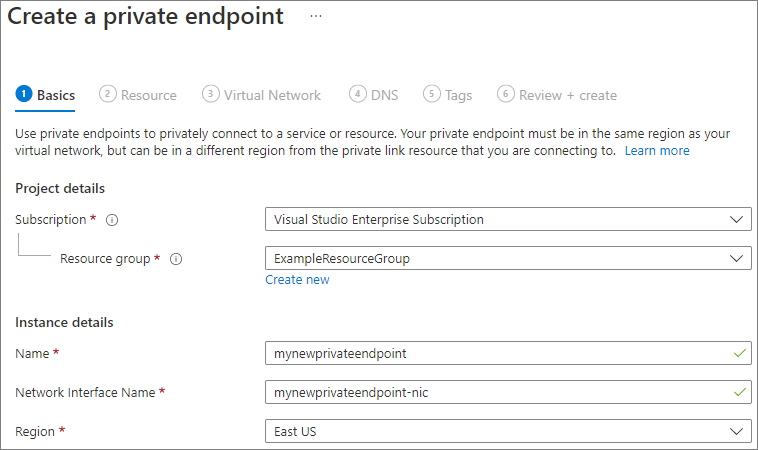
If you're using classic file shares:
In the Resource blade, choose Microsoft.Storage/storageAccounts from the drop-down menu for the resource type. Then select the specific storage account you want to connect to as Resource. The target sub-resource will auto-populate with file. Then select Next: Virtual Network.
If you're using the new file share:
In the Resource blade, choose Microsoft.FileShares/fileShares from the drop-down menu for the resource type. Then select the specific file share you want to connect to as Resource. The target sub-resource will auto-populate with FileShare. Then select Next: Virtual Network.
The Virtual Network blade allows you to select the specific virtual network and subnet you would like to add your private endpoint to. Select dynamic or static IP address allocation for the new private endpoint. If you select static, you'll also need to provide a name and a private IP address. You can also optionally specify an application security group. When you're finished, select Next: DNS.
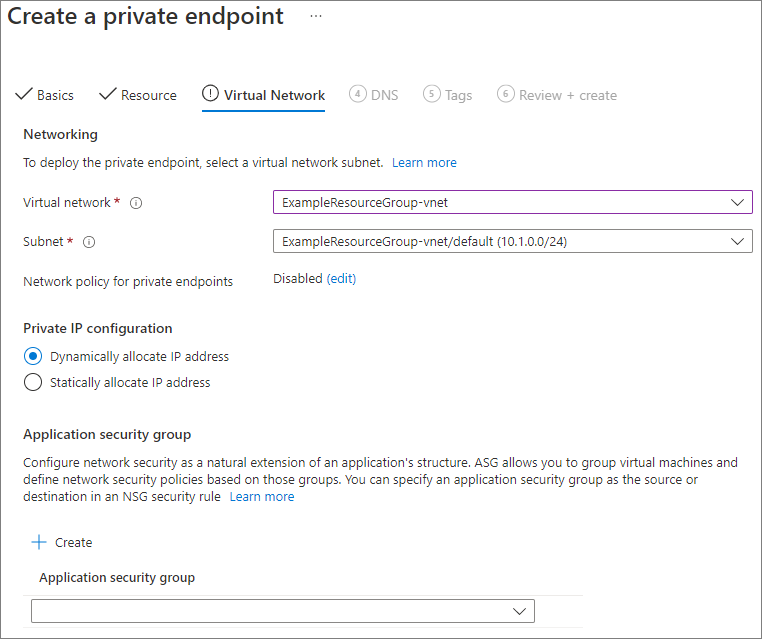
The DNS blade contains the information for integrating your private endpoint with a private DNS zone. Make sure the subscription and resource group are correct, then select Next: Tags.
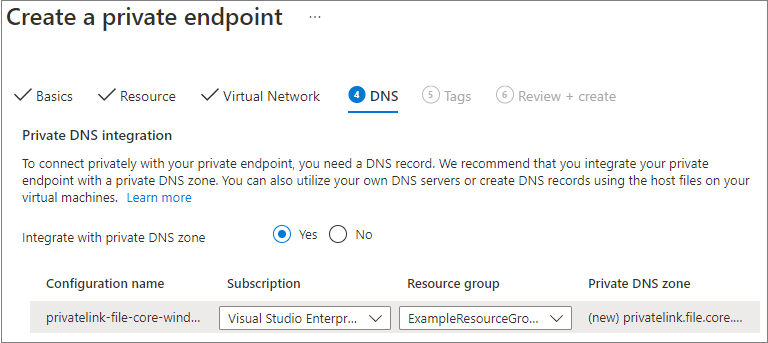
You can optionally apply tags to categorize your resources, such as applying the name Environment and the value Test to all testing resources. Enter name/value pairs if desired, and then select Next: Review + create.

Select Create to create the private endpoint.
To create a private endpoint, you first need to get a reference to your storage account or your file share and the virtual network subnet to which you want to add the private endpoint. Replace the placeholder values below with your own.
For classic file shares, get a reference to the storage account:
$storageAccountResourceGroupName = "<storage-account-resource-group-name>"
$storageAccountName = "<storage-account-name>"

$storageAccount = Get-AzStorageAccount `
        -ResourceGroupName $storageAccountResourceGroupName `
        -Name $storageAccountName `
        -ErrorAction SilentlyContinue

if ($null -eq $storageAccount) {
    $errorMessage = "Storage account $storageAccountName not found "
    $errorMessage += "in resource group $storageAccountResourceGroupName."
    Write-Error -Message $errorMessage -ErrorAction Stop
}

# Set common variables for private endpoint creation
$resourceGroupName = $storageAccountResourceGroupName
$privateLinkResourceId = $storageAccount.Id
$groupId = "file"
$dnsRecordName = $storageAccountName
For file shares created with the Microsoft.FileShares resource provider, get a reference to the file share:
 $fileShareResourceGroupName = "<resource-group-name>"
 $fileShareName = "<file-share-name>"

 $fileShare = Get-AzFileShare `
         -ResourceGroupName $fileShareResourceGroupName `
         -ResourceName $fileShareName `
         -ErrorAction SilentlyContinue

 if ($null -eq $fileShare) {
     $errorMessage = "File share $fileShareName not found "
     $errorMessage += "in resource group $fileShareResourceGroupName."
     Write-Error -Message $errorMessage -ErrorAction Stop
 }

 # Extract hostName and hostNamePrefix for DNS record
 $hostName = $fileShare.HostName
 $hostNamePrefix = $hostName.Split('.')[0]

 # Set common variables for private endpoint creation
 $resourceGroupName = $fileShareResourceGroupName
 $privateLinkResourceId = $fileShare.Id
 $groupId = "FileShare"
 $dnsRecordName = $hostNamePrefix
After setting the common variables above, the remaining steps are the same for both experiences. Get references to the virtual network and subnet:
 $virtualNetworkResourceGroupName = "<vnet-resource-group-name>"
 $virtualNetworkName = "<vnet-name>"
 $subnetName = "<vnet-subnet-name>"

 # Get virtual network reference, and throw error if it doesn't exist
 $virtualNetwork = Get-AzVirtualNetwork `
         -ResourceGroupName $virtualNetworkResourceGroupName `
         -Name $virtualNetworkName `
         -ErrorAction SilentlyContinue

 if ($null -eq $virtualNetwork) {
     $errorMessage = "Virtual network $virtualNetworkName not found "
     $errorMessage += "in resource group $virtualNetworkResourceGroupName."
     Write-Error -Message $errorMessage -ErrorAction Stop
 }

 # Get reference to virtual network subnet, and throw error if it doesn't exist
 $subnet = $virtualNetwork | `
     Select-Object -ExpandProperty Subnets | `
     Where-Object { $_.Name -eq $subnetName }

 if ($null -eq $subnet) {
     Write-Error `
             -Message "Subnet $subnetName not found in virtual network $virtualNetworkName." `
             -ErrorAction Stop
 }
To create a private endpoint, you must create a private link service connection. The private link service connection is an input to the creation of the private endpoint.
 # Disable private endpoint network policies
 $subnet.PrivateEndpointNetworkPolicies = "Disabled"
 $virtualNetwork = $virtualNetwork | `
     Set-AzVirtualNetwork -ErrorAction Stop

 # Create a private link service connection.
 $privateEndpointConnection = New-AzPrivateLinkServiceConnection `
         -Name "$dnsRecordName-Connection" `
         -PrivateLinkServiceId $privateLinkResourceId `
         -GroupId $groupId `
         -ErrorAction Stop

 # Create a new private endpoint.
 $privateEndpoint = New-AzPrivateEndpoint `
         -ResourceGroupName $resourceGroupName `
         -Name "$dnsRecordName-PrivateEndpoint" `
         -Location $virtualNetwork.Location `
         -Subnet $subnet `
         -PrivateLinkServiceConnection $privateEndpointConnection `
         -ErrorAction Stop
Creating an Azure private DNS zone enables the original host name to resolve to the private IP inside of the virtual network. Although optional from the perspective of creating a private endpoint, it is explicitly required for mounting
the Azure file share directly using an AD user principal or accessing via the REST API.
 # Get the host name suffix (core.windows.net for public cloud).
 # This is done like this so this script will seamlessly work for non-public Azure.
 $hostNameSuffix = Get-AzContext | `
     Select-Object -ExpandProperty Environment | `
     Select-Object -ExpandProperty StorageEndpointSuffix

 # For public cloud, this will generate the following DNS suffix:
 # privatelink.file.core.windows.net.
 $dnsZoneName = "privatelink.file.$hostNameSuffix"

 # Find a DNS zone matching desired name attached to this virtual network.
 $dnsZone = Get-AzPrivateDnsZone | `
     Where-Object { $_.Name -eq $dnsZoneName } | `
     Where-Object {
         $privateDnsLink = Get-AzPrivateDnsVirtualNetworkLink `
                 -ResourceGroupName $_.ResourceGroupName `
                 -ZoneName $_.Name `
                 -ErrorAction SilentlyContinue

         $privateDnsLink.VirtualNetworkId -eq $virtualNetwork.Id
     }

 if ($null -eq $dnsZone) {
     # No matching DNS zone attached to virtual network, so create new one.
     $dnsZone = New-AzPrivateDnsZone `
             -ResourceGroupName $virtualNetworkResourceGroupName `
             -Name $dnsZoneName `
             -ErrorAction Stop

     $privateDnsLink = New-AzPrivateDnsVirtualNetworkLink `
             -ResourceGroupName $virtualNetworkResourceGroupName `
             -ZoneName $dnsZoneName `
             -Name "$virtualNetworkName-DnsLink" `
             -VirtualNetworkId $virtualNetwork.Id `
             -ErrorAction Stop
 }
Now that you have a reference to the private DNS zone, you must create a record.
 $privateEndpointIP = $privateEndpoint | `
     Select-Object -ExpandProperty NetworkInterfaces | `
     Select-Object @{
         Name = "NetworkInterfaces";
         Expression = { Get-AzNetworkInterface -ResourceId $_.Id }
     } | `
     Select-Object -ExpandProperty NetworkInterfaces | `
     Select-Object -ExpandProperty IpConfigurations | `
     Select-Object -ExpandProperty PrivateIpAddress

 $privateDnsRecordConfig = New-AzPrivateDnsRecordConfig `
         -IPv4Address $privateEndpointIP

 New-AzPrivateDnsRecordSet `
         -ResourceGroupName $virtualNetworkResourceGroupName `
         -Name $dnsRecordName `
         -RecordType A `
         -ZoneName $dnsZoneName `
         -Ttl 600 `
         -PrivateDnsRecords $privateDnsRecordConfig `
         -ErrorAction Stop | `
     Out-Null
To create a private endpoint, you first need to get a reference to your storage account or file share, plus the virtual network subnet to which you want to add the private endpoint. Replace the placeholder values below with your own.
For classic file shares, get a reference to the storage account:
storageAccountResourceGroupName="<storage-account-resource-group-name>"
storageAccountName="<storage-account-name>"

# Get storage account ID
privateLinkResourceId=$(az storage account show \
        --resource-group $storageAccountResourceGroupName \
        --name $storageAccountName \
        --query "id" --output tsv)

# Set common variables for private endpoint creation
resourceGroupName=$storageAccountResourceGroupName
groupId="file"
dnsRecordName=$storageAccountName
For file shares created with the Microsoft.FileShares resource provider, get a reference to the file share:
# Install the fileshares extension
az extension add --name fileshares

fileShareResourceGroupName="<resource-group-name>"
fileShareName="<file-share-name>"

# Get the file share resource ID and host name
privateLinkResourceId=$(az fileshare show \
        --resource-group $fileShareResourceGroupName \
        --name $fileShareName \
        --query "id" --output tsv)

hostName=$(az fileshare show \
        --resource-group $fileShareResourceGroupName \
        --name $fileShareName \
        --query "properties.hostName" --output tsv)

hostNamePrefix=$(echo $hostName | cut -d'.' -f1)

# Set common variables for private endpoint creation
resourceGroupName=$fileShareResourceGroupName
groupId="FileShare"
dnsRecordName=$hostNamePrefix
After setting the common variables above, the remaining steps are the same for both experiences. Get references to the virtual network and subnet:
virtualNetworkResourceGroupName="<vnet-resource-group-name>"
virtualNetworkName="<vnet-name>"
subnetName="<vnet-subnet-name>"

virtualNetwork=$(az network vnet show \
        --resource-group $virtualNetworkResourceGroupName \
        --name $virtualNetworkName \
        --query "id" --output tsv)

subnet=$(az network vnet subnet show \
        --resource-group $virtualNetworkResourceGroupName \
        --vnet-name $virtualNetworkName \
        --name $subnetName \
        --query "id" --output tsv)
To create a private endpoint, ensure the subnet's private endpoint network policy is disabled, then create the private endpoint with az network private-endpoint create.
# Disable private endpoint network policies
az network vnet subnet update \
        --ids $subnet \
        --disable-private-endpoint-network-policies \
        --output none

# Get virtual network location
region=$(az network vnet show \
        --ids $virtualNetwork \
        --query "location" --output tsv)

# Create a private endpoint
privateEndpoint=$(az network private-endpoint create \
        --resource-group $resourceGroupName \
        --name "$dnsRecordName-PrivateEndpoint" \
        --location $region \
        --subnet $subnet \
        --private-connection-resource-id $privateLinkResourceId \
        --group-id $groupId \
        --connection-name "$dnsRecordName-Connection" \
        --query "id" --output tsv)
Creating an Azure private DNS zone enables the original host name to resolve to the private IP inside the virtual network. Although optional from the perspective of creating a private endpoint, it's required for mounting the Azure file share using an AD user principal or accessing via the FileREST API.
# Get the desired storage account suffix (core.windows.net for public cloud).
# This is done so the script will work for non-public Azure clouds.
storageAccountSuffix=$(az cloud show \
        --query "suffixes.storageEndpoint" --output tsv)

# For public cloud, this generates the DNS suffix:
# privatelink.file.core.windows.net.
dnsZoneName="privatelink.file.$storageAccountSuffix"

# Find a DNS zone matching the desired name attached to this virtual network.
possibleDnsZones=$(az network private-dns zone list \
        --query "[?name == '$dnsZoneName'].id" \
        --output tsv)

dnsZone=""
for possibleDnsZone in $possibleDnsZones
do
    possibleResourceGroupName=$(az resource show \
            --ids $possibleDnsZone \
            --query "resourceGroup" --output tsv)

    link=$(az network private-dns link vnet list \
            --resource-group $possibleResourceGroupName \
            --zone-name $dnsZoneName \
            --query "[?virtualNetwork.id == '$virtualNetwork'].id" \
            --output tsv)

    if [ -n "$link" ]
    then
        dnsZoneResourceGroup=$possibleResourceGroupName
        dnsZone=$possibleDnsZone
        break
    fi
done

if [ -z "$dnsZone" ]
then
    # No matching DNS zone attached to the virtual network, so create a new one.
    dnsZone=$(az network private-dns zone create \
            --resource-group $virtualNetworkResourceGroupName \
            --name $dnsZoneName \
            --query "id" --output tsv)

    az network private-dns link vnet create \
            --resource-group $virtualNetworkResourceGroupName \
            --zone-name $dnsZoneName \
            --name "$virtualNetworkName-DnsLink" \
            --virtual-network $virtualNetwork \
            --registration-enabled false \
            --output none

    dnsZoneResourceGroup=$virtualNetworkResourceGroupName
fi
Now that you have a reference to the private DNS zone, create an A record.
privateEndpointNIC=$(az network private-endpoint show \
        --ids $privateEndpoint \
        --query "networkInterfaces[0].id" --output tsv)

privateEndpointIP=$(az network nic show \
        --ids $privateEndpointNIC \
        --query "ipConfigurations[0].privateIPAddress" --output tsv)

az network private-dns record-set a create \
        --resource-group $dnsZoneResourceGroup \
        --zone-name $dnsZoneName \
        --name $dnsRecordName \
        --output none

az network private-dns record-set a add-record \
        --resource-group $dnsZoneResourceGroup \
        --zone-name $dnsZoneName \
        --record-set-name $dnsRecordName \
        --ipv4-address $privateEndpointIP \
        --output none
If you have a VM inside of your virtual network, or you've configured DNS forwarding as described in Configuring DNS forwarding for Azure Files, you can test that your private endpoint is set up correctly. Run the following commands from PowerShell, the command line, or the terminal (works for Windows, Linux, or macOS).
For classic file shares, replace <storage-account-name> with the appropriate storage account name:
nslookup <storage-account-name>.file.core.windows.net
For file shares created with the Microsoft.FileShares resource provider, use the file share's host name. In the overview tab of the file share, Select JSON view from the upper right. In the JSON view, under properties, copy the value for hostName. The format looks like fs-xxxxxxxxxxxxxxxxx.xx.file.storage.azure.net.
nslookup <file-share-host-name>
If successful, you should see output similar to the following, where 192.168.0.5 is the private IP address of the private endpoint in your virtual network (output shown for Windows).
For classic file shares:
Server:  UnKnown
Address:  10.2.4.4

Non-authoritative answer:
Name:    storageaccount.privatelink.file.core.windows.net
Address:  192.168.0.5
Aliases:  storageaccount.file.core.windows.net
For file shares created with the Microsoft.FileShares resource provider:
Server:  UnKnown
Address:  10.2.4.4

Non-authoritative answer:
Name:    <hostNamePrefix>.privatelink.file.core.windows.net
Address:  192.168.0.5
Aliases:  <hostNamePrefix>.<zone>.file.storage.azure.net
If you have a VM inside of your virtual network, or you've configured DNS forwarding as described in Configuring DNS forwarding for Azure Files, you can test that your private endpoint is set up correctly by running the following commands:
For classic file shares:
 $storageAccountHostName = [System.Uri]::new($storageAccount.PrimaryEndpoints.file) | `
     Select-Object -ExpandProperty Host

 Resolve-DnsName -Name $storageAccountHostName
For file shares created with the Microsoft.FileShares resource provider:
Resolve-DnsName -Name $fileShare.HostName
If successful, you should see output similar to the following, where 192.168.0.5 is the private IP address of the private endpoint in your virtual network.
For classic file shares:
Name                             Type   TTL   Section    NameHost
----                             ----   ---   -------    --------
storageaccount.file.core.windows CNAME  60    Answer     storageaccount.privatelink.file.core.windows.net
.net

Name       : storageaccount.privatelink.file.core.windows.net
QueryType  : A
TTL        : 600
Section    : Answer
IP4Address : 192.168.0.5
For file shares created with the Microsoft.FileShares resource provider:
Name                                       Type   TTL   Section    NameHost
----                                       ----   ---   -------    --------
<hostNamePrefix>.<zone>.file.storage.azur  CNAME  60    Answer     <hostNamePrefix>.privatelink.file.core.windows.net
e.net

Name       : <hostNamePrefix>.privatelink.file.core.windows.net
QueryType  : A
TTL        : 600
Section    : Answer
IP4Address : 192.168.0.5
If you have a VM inside of your virtual network, or you've configured DNS forwarding as described in Configuring DNS forwarding for Azure Files, you can test that your private endpoint is set up correctly by running the following commands:
For classic file shares:
httpEndpoint=$(az storage account show \
        --resource-group $storageAccountResourceGroupName \
        --name $storageAccountName \
        --query "primaryEndpoints.file" --output tsv)

hostName=$(echo $httpEndpoint | cut -c7-$(expr length $httpEndpoint) | tr -d "/")
nslookup $hostName
For file shares created with the Microsoft.FileShares resource provider:
hostName=$(az fileshare show \
        --resource-group $fileShareResourceGroupName \
        --name $fileShareName \
        --query "properties.hostName" --output tsv)

nslookup $hostName
If successful, you should see output similar to the following, where 192.168.0.5 is the private IP address of the private endpoint in your virtual network. You should still use the original host name (storageaccount.file.core.windows.net for classic, or the file share's hostName for the new experience) to mount your file share instead of the privatelink path.
For classic file shares:
Server:         127.0.0.53
Address:        127.0.0.53#53

Non-authoritative answer:
storageaccount.file.core.windows.net      canonical name = storageaccount.privatelink.file.core.windows.net.
Name:   storageaccount.privatelink.file.core.windows.net
Address: 192.168.0.5
For file shares created with the Microsoft.FileShares resource provider:
Server:         127.0.0.53
Address:        127.0.0.53#53

Non-authoritative answer:
<hostNamePrefix>.<zone>.file.storage.azure.net      canonical name = <hostNamePrefix>.privatelink.file.core.windows.net.
Name:   <hostNamePrefix>.privatelink.file.core.windows.net
Address: 192.168.0.5
Limiting public endpoint access first requires you to disable general access to the public endpoint. Disabling access to the public endpoint does not impact private endpoints. After the public endpoint is disabled, you can select specific networks or IP addresses that may continue to access it. In general, most firewall policies for a storage account restrict networking access to one or more virtual networks.
When access to the public endpoint is disabled, the storage account can still be accessed through its private endpoints. Otherwise valid requests to the storage account's public endpoint will be rejected, unless they are from a specifically allowed source.
For classic file shares:
Navigate to the storage account for which you would like to restrict all access to the public endpoint. In the table of contents for the storage account, select Networking.
At the top of the page, select the Enabled from selected virtual networks and IP addresses radio button. This will un-hide a number of settings for controlling the restriction of the public endpoint. Select Allow Azure services on the trusted services list to access this storage account to allow trusted first party Microsoft services such as Azure File Sync to access the storage account.
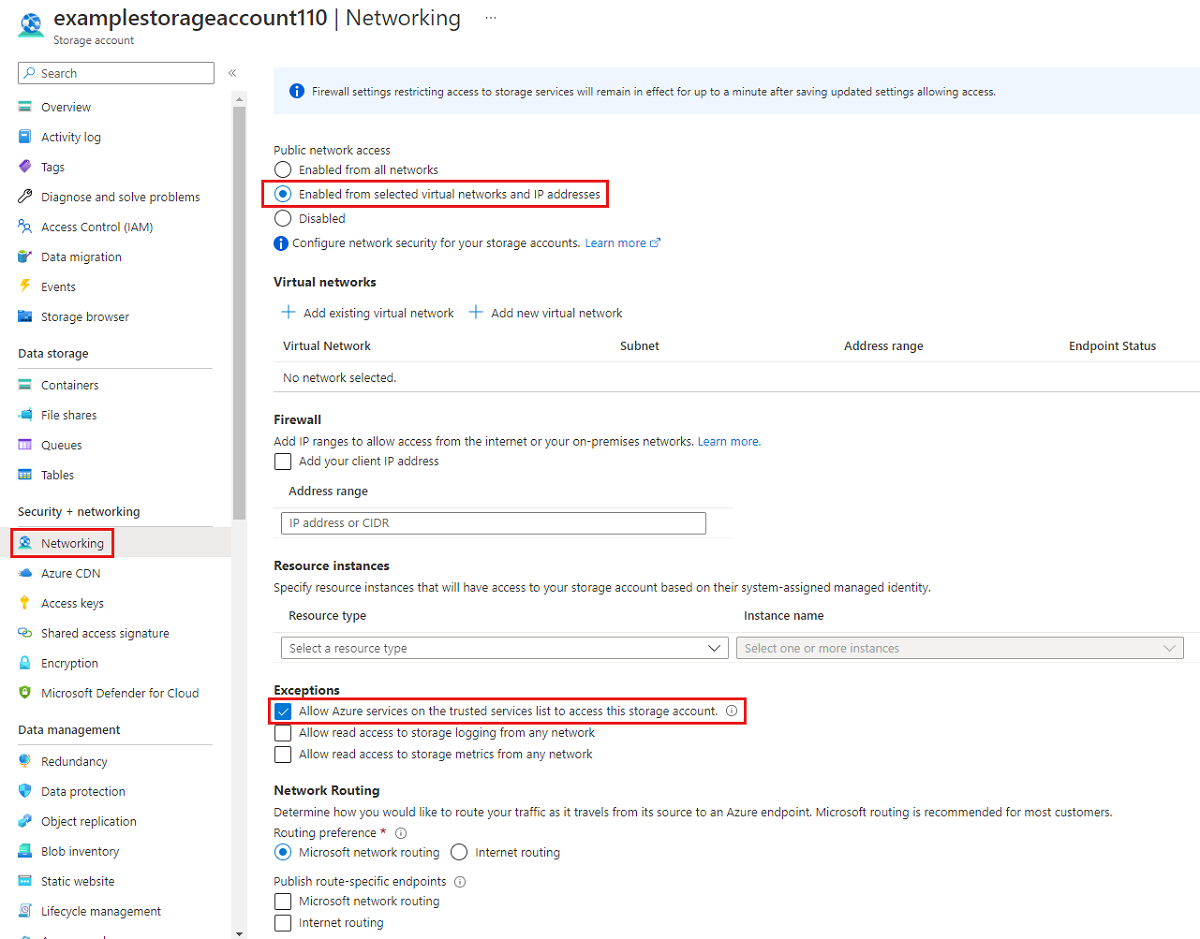
For file shares created with the Microsoft.FileShares resource provider:
Navigate to the file share for which you would like to disable public access. In the service menu, under Settings, select Configuration. Set Public network access to Disabled, and then select Save.
For classic file shares, the following PowerShell command denies all traffic to the storage account's public endpoint. The -Bypass parameter is set to AzureServices to allow trusted first party services such as Azure File Sync to access the storage account via the public endpoint.
# This assumes $storageAccount is still defined from the beginning of this guide.
$storageAccount | Update-AzStorageAccountNetworkRuleSet `
        -DefaultAction Deny `
        -Bypass AzureServices `
        -WarningAction SilentlyContinue `
        -ErrorAction Stop | `
    Out-Null
For file shares created with the Microsoft.FileShares resource provider, set -PublicNetworkAccess to Disabled on the file share.
# To learn more about the Az.FileShare module, see https://www.powershellgallery.com/packages/Az.FileShare/0.1.0
Install-Module -Name Az.FileShare -Repository psgallery -RequiredVersion 0.1.0

$fileShareResourceGroupName = "<resource-group-name>"
$fileShareName = "<file-share-name>"

Update-AzFileShare `
        -ResourceGroupName $fileShareResourceGroupName `
        -ResourceName $fileShareName `
        -PublicNetworkAccess Disabled
For classic file shares, the following CLI command denies all traffic to the storage account's public endpoint. The --bypass parameter is set to AzureServices to allow trusted first party services such as Azure File Sync to access the storage account via the public endpoint.
# This assumes $storageAccountResourceGroupName and $storageAccountName
# are still defined from the beginning of this guide.
az storage account update \
    --resource-group $storageAccountResourceGroupName \
    --name $storageAccountName \
    --bypass "AzureServices" \
    --default-action "Deny" \
    --output none
For file shares created with the Microsoft.FileShares resource provider, set --public-network-access to Disabled on the file share.
# Install the fileshares extension
az extension add --name fileshares

fileShareResourceGroupName="<resource-group-name>"
fileShareName="<file-share-name>"

az fileshare update \
    --name $fileShareName \
    --resource-group $fileShareResourceGroupName \
    --public-network-access Disabled
When you restrict the storage account to specific virtual networks, you're allowing requests to the public endpoint from within the specified virtual networks. This works by using a capability of the virtual network called service endpoints. This can be used with or without private endpoints.
For classic file shares:
Navigate to the storage account for which you would like to restrict the public endpoint to specific virtual networks. In the table of contents for the storage account, select Networking.
At the top of the page, select the Enabled from selected virtual networks and IP addresses radio button. This will un-hide a number of settings for controlling the restriction of the public endpoint. Select +Add existing virtual network to select the specific virtual network that should be allowed to access the storage account via the public endpoint. Select a virtual network and a subnet for that virtual network, and then select Enable.
Select Allow Azure services on the trusted services list to access this storage account to allow trusted first party Microsoft services such as Azure File Sync to access the storage account.
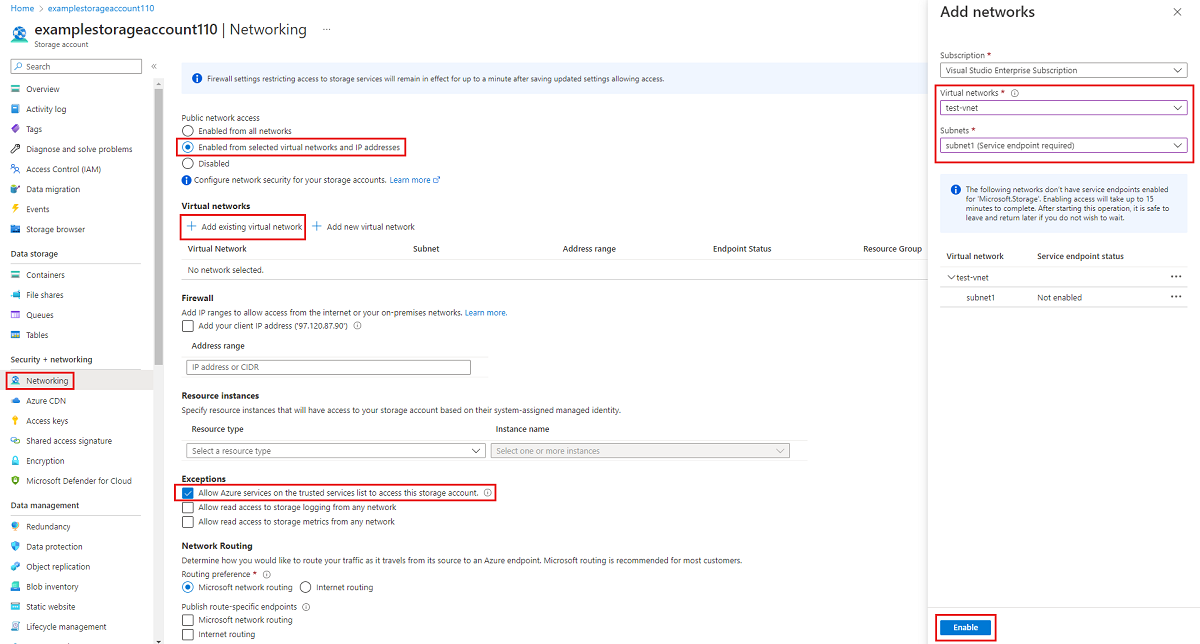
For file shares created with the Microsoft.FileShares resource provider:
Navigate to the file share for which you would like to restrict public access. In the service menu, under Settings, select Configuration. Under Public network access, select Enabled from selected virtual networks, then add the virtual networks and subnets allowed to access the share, and select Save.
For classic file shares, restricting access to the storage account's public endpoint to specific virtual networks uses service endpoints. First, collect information about the storage account and virtual network. Replace the placeholder values below with your own.
$storageAccountResourceGroupName = "<storage-account-resource-group>"
$storageAccountName = "<storage-account-name>"
$restrictToVirtualNetworkResourceGroupName = "<vnet-resource-group-name>"
$restrictToVirtualNetworkName = "<vnet-name>"
$subnetName = "<subnet-name>"

$storageAccount = Get-AzStorageAccount `
        -ResourceGroupName $storageAccountResourceGroupName `
        -Name $storageAccountName `
        -ErrorAction Stop

$virtualNetwork = Get-AzVirtualNetwork `
        -ResourceGroupName $restrictToVirtualNetworkResourceGroupName `
        -Name $restrictToVirtualNetworkName `
        -ErrorAction Stop

$subnet = $virtualNetwork | `
    Select-Object -ExpandProperty Subnets | `
    Where-Object { $_.Name -eq $subnetName }

if ($null -eq $subnet) {
    Write-Error `
            -Message "Subnet $subnetName not found in virtual network $restrictToVirtualNetworkName." `
            -ErrorAction Stop
}
In order for traffic from the virtual network to be allowed by the Azure network fabric to get to the storage account public endpoint, the virtual network's subnet must have the Microsoft.Storage service endpoint exposed. The following PowerShell commands add the Microsoft.Storage service endpoint to the subnet if it's not already there.
$serviceEndpoints = $subnet | `
    Select-Object -ExpandProperty ServiceEndpoints | `
    Select-Object -ExpandProperty Service

if ($serviceEndpoints -notcontains "Microsoft.Storage") {
    if ($null -eq $serviceEndpoints) {
        $serviceEndpoints = @("Microsoft.Storage")
    } elseif ($serviceEndpoints -is [string]) {
        $serviceEndpoints = @($serviceEndpoints, "Microsoft.Storage")
    } else {
        $serviceEndpoints += "Microsoft.Storage"
    }

    $virtualNetwork = $virtualNetwork | Set-AzVirtualNetworkSubnetConfig `
            -Name $subnetName `
            -AddressPrefix $subnet.AddressPrefix `
            -ServiceEndpoint $serviceEndpoints `
            -WarningAction SilentlyContinue `
            -ErrorAction Stop | `
        Set-AzVirtualNetwork `
            -ErrorAction Stop
}
The final step in restricting traffic to the storage account is to create a networking rule and add it to the storage account's network rule set.
$networkRule = $storageAccount | Add-AzStorageAccountNetworkRule `
    -VirtualNetworkResourceId $subnet.Id `
    -ErrorAction Stop

$storageAccount | Update-AzStorageAccountNetworkRuleSet `
        -DefaultAction Deny `
        -Bypass AzureServices `
        -VirtualNetworkRule $networkRule `
        -WarningAction SilentlyContinue `
        -ErrorAction Stop | `
    Out-Null
For file shares created with the Microsoft.FileShares resource provider, you can pass the allowed subnet resource IDs directly to Update-AzFileShare using -PublicAccessPropertyAllowedSubnet. There's no separate service endpoint or network rule configuration required on the storage account.
# To learn more about the Az.FileShare module, see https://www.powershellgallery.com/packages/Az.FileShare/0.1.0
Install-Module -Name Az.FileShare -Repository psgallery -RequiredVersion 0.1.0

$fileShareResourceGroupName = "<resource-group-name>"
$fileShareName = "<file-share-name>"
$virtualNetworkResourceGroupName = "<vnet-resource-group-name>"
$virtualNetworkName = "<vnet-name>"
$subnetName = "<subnet-name>"

$subnet = Get-AzVirtualNetwork `
        -ResourceGroupName $virtualNetworkResourceGroupName `
        -Name $virtualNetworkName | `
    Select-Object -ExpandProperty Subnets | `
    Where-Object { $_.Name -eq $subnetName }

Update-AzFileShare `
        -ResourceGroupName $fileShareResourceGroupName `
        -ResourceName $fileShareName `
        -PublicAccessPropertyAllowedSubnet @($subnet.Id)
For classic file shares, restricting access to the storage account's public endpoint to specific virtual networks uses service endpoints. First, collect information about the storage account and virtual network. Replace the placeholder values below with your own.
storageAccountResourceGroupName="<storage-account-resource-group>"
storageAccountName="<storage-account-name>"
restrictToVirtualNetworkResourceGroupName="<vnet-resource-group-name>"
restrictToVirtualNetworkName="<vnet-name>"
subnetName="<subnet-name>"

storageAccount=$(az storage account show \
        --resource-group $storageAccountResourceGroupName \
        --name $storageAccountName \
        --query "id" --output tsv)

virtualNetwork=$(az network vnet show \
        --resource-group $restrictToVirtualNetworkResourceGroupName \
        --name $restrictToVirtualNetworkName \
        --query "id" --output tsv)

subnet=$(az network vnet subnet show \
        --resource-group $restrictToVirtualNetworkResourceGroupName \
        --vnet-name $restrictToVirtualNetworkName \
        --name $subnetName \
        --query "id" --output tsv)
In order for traffic from the virtual network to be allowed by the Azure network fabric to get to the storage account public endpoint, the virtual network's subnet must have the Microsoft.Storage service endpoint exposed. The following CLI commands add the Microsoft.Storage service endpoint to the subnet if it's not already there.
serviceEndpoints=$(az network vnet subnet show \
        --resource-group $restrictToVirtualNetworkResourceGroupName \
        --vnet-name $restrictToVirtualNetworkName \
        --name $subnetName \
        --query "serviceEndpoints[].service" \
        --output tsv)

foundStorageServiceEndpoint=false
for serviceEndpoint in $serviceEndpoints
do
    if [ $serviceEndpoint = "Microsoft.Storage" ]
    then
        foundStorageServiceEndpoint=true
    fi
done

if [ $foundStorageServiceEndpoint = false ]
then
    serviceEndpointList=""

    for serviceEndpoint in $serviceEndpoints
    do
        serviceEndpointList+=$serviceEndpoint
        serviceEndpointList+=" "
    done

    serviceEndpointList+="Microsoft.Storage"

    az network vnet subnet update \
            --ids $subnet \
            --service-endpoints $serviceEndpointList \
            --output none
fi
The final step in restricting traffic to the storage account is to create a networking rule and add it to the storage account's network rule set.
az storage account network-rule add \
        --resource-group $storageAccountResourceGroupName \
        --account-name $storageAccountName \
        --subnet $subnet \
        --output none

az storage account update \
        --resource-group $storageAccountResourceGroupName \
        --name $storageAccountName \
        --bypass "AzureServices" \
        --default-action "Deny" \
        --output none
For file shares created with the Microsoft.FileShares resource provider, pass the allowed subnet resource IDs directly to az fileshare update using --allowed-subnets. No separate service endpoint or network rule configuration is required on the storage account.
# Install the fileshares extension
az extension add --name fileshares

fileShareResourceGroupName="<resource-group-name>"
fileShareName="<file-share-name>"
virtualNetworkResourceGroupName="<vnet-resource-group-name>"
virtualNetworkName="<vnet-name>"
subnetName="<subnet-name>"

subnetId=$(az network vnet subnet show \
        --resource-group $virtualNetworkResourceGroupName \
        --vnet-name $virtualNetworkName \
        --name $subnetName \
        --query "id" --output tsv)

az fileshare update \
        --name $fileShareName \
        --resource-group $fileShareResourceGroupName \
        --allowed-subnets $subnetId

