Note
Access to this page requires authorization. You can try signing in or changing directories.
Access to this page requires authorization. You can try changing directories.
Through integration with Fireworks AI, Microsoft Foundry customers can:
- Experiment with the latest open-source models often before they're available directly from Azure.
- Import and deploy custom model weights (bring your own model, or BYOM) onto Fireworks' on-demand GPU-backed infrastructure. For more information, see Import custom models on Microsoft Foundry with Fireworks.
- Scale up using Provisioned throughput.
- Optimize deployment performance for your workload by working with Fireworks to define a custom deployment shape.
All of these capabilities are available directly within your Foundry project, with Azure governance, access controls, and project management built in.
Prerequisites
An Azure subscription. If you don't have one, create a free account.
A Foundry resource with a Foundry project.
An Azure identity with the Subscription Owner or Subscription Contributor role to enable the feature.
To deploy models, you need the Foundry Owner role on the Foundry project. For more information, see Azure built-in roles.
Important
The Foundry RBAC roles were recently renamed. Foundry User, Foundry Owner, Foundry Account Owner, and Foundry Project Manager were previously named Azure AI User, Azure AI Owner, Azure AI Account Owner, and Azure AI Project Manager. You might still see the previous names in some places while the rename rolls out. The role IDs and core permissions are unchanged by the rename.
Region availability
For supported deployment types and regions, see Region availability in the Fireworks model catalog reference.
Enable Fireworks on Foundry
Important
Fireworks on Foundry is currently excluded from EU Data Boundary commitments.
FedRAMP isn't achieved for Fireworks on Foundry. If your organization requires FedRAMP, before use, consult with your Authorization Official to determine if use of Fireworks on Foundry is allowed.
Payment Card Industry (PCI) Data Security Standard (DSS) isn't applicable to Fireworks on Foundry. You shouldn't use Fireworks on Foundry to store, process, or transmit payment and cardholder data.
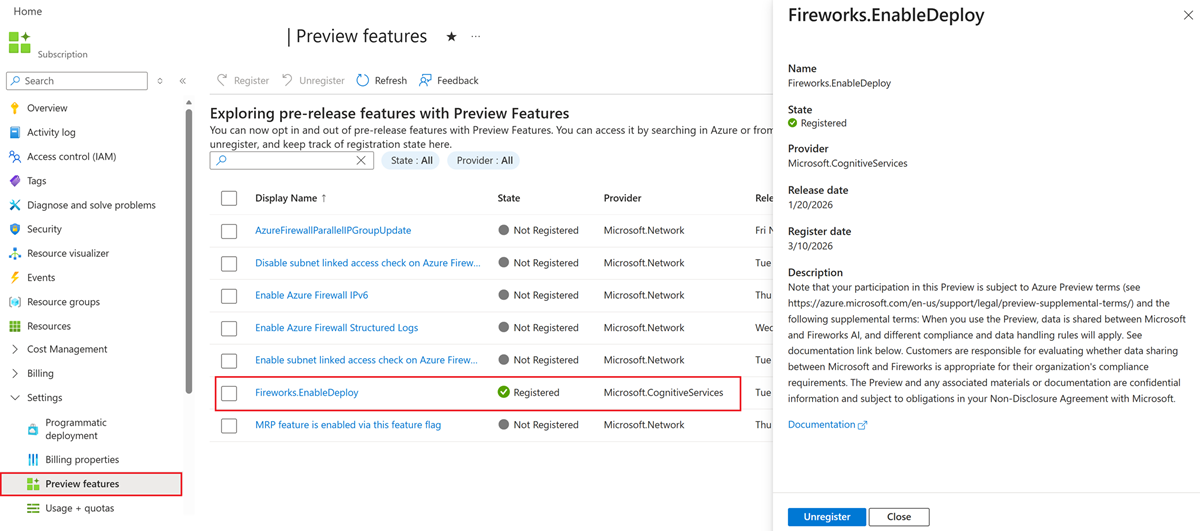
While Fireworks on Foundry is generally available, an administrator must enable the service within your Azure subscription. The Azure Preview features portal enables customers to turn on the service by using the following steps.
Sign in to the Azure portal.
In the search box, enter subscriptions and select Subscriptions.
Select the link for your subscription's name.
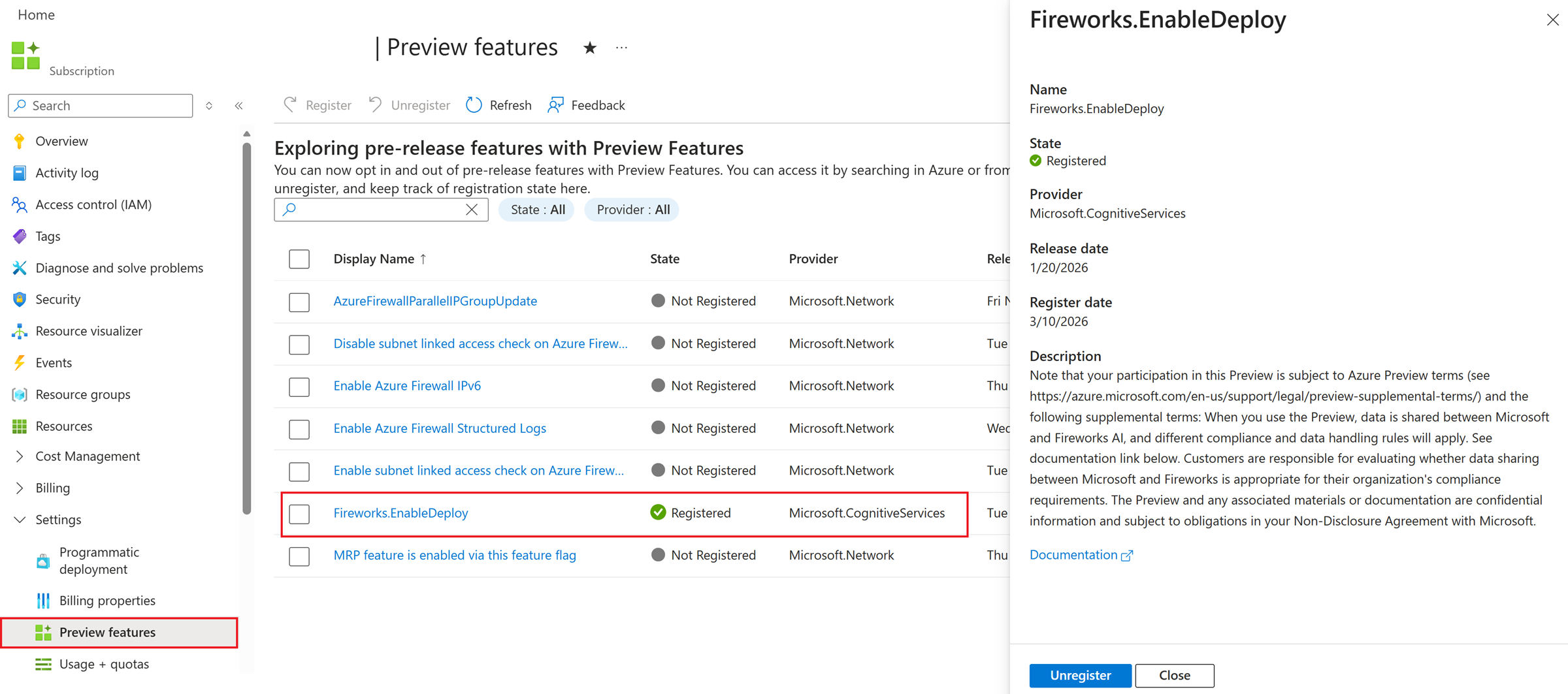
From the left menu, under Settings, select Preview features.
Search for and select the Fireworks.EnableDeploy preview feature.
Review the terms provided in the Description and the data privacy section in this documentation.
If you don't agree to the terms, select Close and don't continue. Otherwise, select Register.
Select OK. The Preview features screen refreshes and the preview feature's State is displayed. It might take up to 30 minutes for the feature to enable for your subscription.
Tip
To verify registration, refresh the Preview features page and confirm the State column shows Registered for the Fireworks on Foundry feature.
Deploy Fireworks models from the Foundry portal
After the feature is enabled, you can deploy Fireworks models from the Foundry model catalog. Complete these steps to get a live endpoint for chat completions. Browse available models in the Available catalog models section, or import your own custom model.
In the Foundry portal, navigate to Build > Catalog > Model Catalog to browse models.
Select your desired Fireworks model to view its details on the model page:
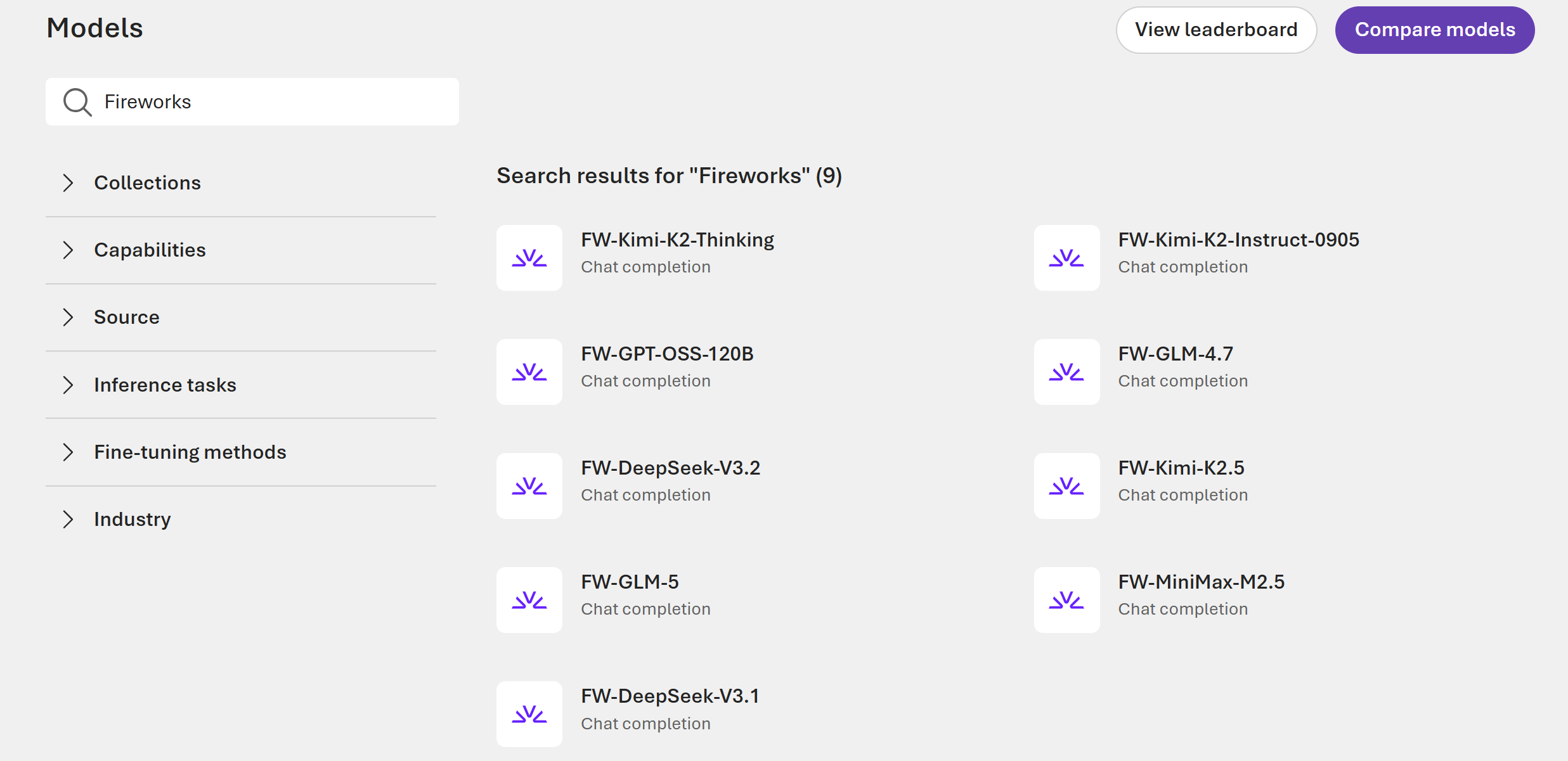
On the model page, select Deploy. For more information on deployment options, see Deploy Foundry Models in the portal.
In the deployment window, configure the following settings:
- Deployment name: Keep the default name or enter a custom name to identify the deployment.
- Token Plan: Select Pay-per-token -> Data Zone Standard or Global Standard, depending on the model. Select Provisioned Throughput -> Data Zone Provisioned or Global Provisioned. For more information, see Deployment types.
- Model version settings: Select the model version for the deployment. If Microsoft has configured a custom deployment shape for your subscription, select the model version provided for that shape.
- Tokens per Minute Rate Limit: Set a custom tokens-per-minute limit to manage costs and control usage. For pay-per-token deployments, see Quotas and rate limits.
- Guardrails: Select DefaultV2 or Default guardrail configuration. Models use the Microsoft.DefaultV2 guardrail unless a different one is specified. For more information, see Use guardrails to set boundaries on model outputs.
Select Deploy. The deployment process can take up to 30 minutes.
After deployment completes, use the provided endpoint and key to send inference requests to the model. To quickly test the deployment, use the Playground in your Foundry project.
Tip
To verify the deployment, select Build > Models in your project and confirm the deployment Status shows Succeeded.
Use the Responses API
Fireworks models support two Responses API routes:
- Foundry supported Responses API: Uses
https://{resource}.services.ai.azure.com/openai/v1/responsesorhttps://{resource}.services.ai.azure.com/api/projects/<project-name>/openai/v1/responses, with session management handled by Foundry. For details, see Use the Azure OpenAI Responses API. - Direct passthrough Responses API: Uses
https://{resource}.services.ai.azure.com/providers/fireworks/v1/responsesorhttps://{resource}.services.ai.azure.com/providers/fireworks/responses, with session management handled by Fireworks. This route bypasses the Foundry Responses API implementation and its extra session-management processing.
Use direct passthrough
Direct passthrough supports all parameters supported by the Fireworks Responses API. For parameter details and limitations, see the Fireworks Responses API documentation.
Replace YOUR_RESOURCE and YOUR_FOUNDRY_KEY with your Foundry resource name and API key. Don't include /api/projects/<project-name> in the endpoint. Replace YOUR_FIREWORKS_DEPLOYMENT_NAME with your Fireworks deployment name.
from openai import OpenAI

client = OpenAI(
    base_url=(
        "https://YOUR_RESOURCE.services.ai.azure.com/providers/fireworks/v1"
    ),
    api_key="YOUR_FOUNDRY_KEY",
)

response = client.responses.create(
    model="YOUR_FIREWORKS_DEPLOYMENT_NAME",
    input=(
        "Use the tool to list the first two documentation topics for "
        "modelcontextprotocol/python-sdk."
    ),
    tools=[{"type": "sse", "server_url": "https://mcp.deepwiki.com/mcp"}],
    store=False,
)

print(response.output_text)
Quotas and rate limits
For pay-per-token deployments, Global Standard and Data Zone Standard use separate quota pools. Enterprise customers have a default quota of 10 million tokens per minute (TPM) per region, per subscription, in each pool. Each pool is shared across all Fireworks models, and you can allocate quota to individual model deployments.
Fireworks directly enforces adaptive rate limits within your quota. Your effective limits can be lower than the full quota and adjust automatically as your usage grows.
Ramp up traffic gradually, and use exponential backoff when retrying HTTP 429 (Too Many Requests) responses. For more information, see Fireworks adaptive rate limits.
All customers can submit a quota increase request for more quota.
Improve prompt cache hit rate
Prompt caching reuses processing for requests that share the same prompt prefix. To improve the prompt cache hit rate, set a stable identifier for each user or session, and reuse the same value for related requests. Use one of these options:
- Set the
x-session-affinityHTTP header. - Set the
userrequest parameter. - Set the
prompt_cache_keyrequest parameter. This parameter takes priority overuserwhen both are present.
For more information, see Prompt caching in the Fireworks AI documentation.
Available catalog models
For the supported catalog models, deployment types, regions, and pay-per-token retirement dates, see Fireworks model catalog.
All catalog models support the OpenAI/v1 API for chat completions and the Responses API.
Use a custom deployment shape
A custom deployment shape is a serving configuration that Fireworks optimizes for your workload requirements, such as latency or throughput. Fireworks works with you and your Microsoft account team to define the configuration. You don't tune the underlying shape settings yourself in the Foundry portal.
Foundry makes the configured shape available to your subscription through a customer-specific model version. Different shapes for the same underlying model can have different performance profiles and provisioned throughput unit (PTU) sizing requirements.
To use a custom shape:
- Contact your Microsoft account team to coordinate with Fireworks. Describe the model and workload requirements that you want to optimize.
- Work with Fireworks to evaluate your requirements and define an optimized deployment shape.
- Fireworks provides the shape to Microsoft, and Microsoft configures it as a customer-specific model version for your subscription.
- After your account team confirms that the version is available, deploy the model in the Foundry portal. Select the provided model version and Provisioned Throughput, and use the PTU sizing requirements for that shape.
- Confirm that the deployment status shows Succeeded, then test the deployment with your workload.
A custom shape changes how a model is served, not its weights. You don't need custom model weights to use a custom shape. If you also use your own model weights, import the model separately and coordinate with your account team to confirm shape compatibility.
Custom models (bring your own model)
In addition to the catalog models, Fireworks on Foundry supports importing and deploying your own custom model weights. This BYOM capability lets you run proprietary or fine-tuned open-weight models within the Foundry ecosystem, with inference provided by the optimized Fireworks cloud.
Supported model architectures
Custom models must be based on one of the following supported architectures:
- Kimi (K2, K2.5, K2.6)
- GLM (4.7, 4.8)
- OpenAI (gpt-oss-120b)
- Qwen (qwen3.5-9B, qwen3.5-35B-A3B, qwen3.5-112B-A10B, qwen3.5-397B)
Limitations
- CLI-first workflow. The import process uses the Azure Developer CLI (
azd). The Foundry portal supports registering, viewing, and deploying models after upload. - Fireworks Agents and Agent Builder workflows aren't currently supported.
For step-by-step instructions, see Import custom models into Foundry.
Data privacy
When you use Fireworks on Foundry, data is shared between Microsoft and Fireworks AI, and different compliance and data handling rules will apply. See below for details. Customers are responsible for evaluating whether data sharing between Microsoft and Fireworks is appropriate for their organizations compliance requirements.
Fireworks on Foundry is currently excluded from EU Data Boundary commitments.
FedRAMP isn't achieved for Fireworks on Foundry. If your organization requires FedRAMP, before use, consult with your Authorization Official to determine if use of Fireworks on Foundry is allowed.
Payment Card Industry (PCI) Data Security Standard (DSS) isn't applicable to Fireworks on Foundry. You shouldn't use Fireworks on Foundry to store, process, or transmit payment and cardholder data.
Transparency note
Fireworks on Foundry allows customers to deploy and operate third-party and open-weight AI models using Microsoft Foundry platform services.
- Microsoft doesn't develop, train, fine-tune, or evaluate the safety, security, or Responsible AI characteristics of models deployed through Fireworks on Foundry.
- Microsoft makes no representations regarding the behavior, performance, or risk profile of these models.
- Customers are solely responsible for assessing the suitability of any model for their intended use, including performing any required safety, compliance, and Responsible AI evaluations, before deploying models in production or customer-facing applications.
Foundry provides the tools and best practices for performing your own risk and safety evaluations of models.
Frequently asked questions
Is Fireworks on Foundry available in Azure for US Government?
No, currently the Fireworks on Foundry service isn't available for Azure Government cloud users.
How can I get quota for Fireworks model deployments?
Use the quota request form to request added quota for Fireworks on Foundry.
I have a Fireworks AI account. Can I use my existing Fireworks deployments?
No, you need to create new deployments in Foundry. If you'd like to shift consumption to Azure, contact your Fireworks account team to assist.
Can I deploy LoRA or adapter-based models?
LoRA support is in public preview. See import custom Fireworks models for details. For compatible adapters trained in Foundry, see Deploy fine-tuned models with Fireworks on Foundry (preview); use the import guide for adapters trained elsewhere.
How do I import and deploy a custom model?
Custom model import uses a CLI-first workflow with the Azure Developer CLI. For step-by-step instructions, see Import custom models into Foundry.
How is Fireworks on Foundry billed?
Fireworks models deployed through Foundry support both pay-per-token and provisioned throughput offers.
How do I disable Fireworks in my Foundry project?
Fireworks can be disabled at the Azure subscription level. Follow the steps to unregister preview features in your Azure subscription.
How do I use the Responses API?
See Use the Responses API for the Foundry supported and direct passthrough routes.
Troubleshoot Fireworks on Foundry
Use the following guidance to resolve common issues with Fireworks on Foundry.
| Issue | Resolution |
|---|---|
| Preview registration stays in "Registering" state | Registration can take up to 30 minutes. Refresh the Preview features page to check the current status. If the state doesn't change after 30 minutes, try unregistering and re-registering the feature. |
| Fireworks models don't appear in the model catalog | Confirm that the preview feature state shows Registered for your subscription. Verify you're working in a supported region. |
| Deployment fails with a quota error | Use the quota request form to request added capacity for Fireworks on Foundry. |
| "Forbidden" or access denied during deployment | Verify that your identity has the Azure AI Developer role or higher on the Foundry project. Subscription-level roles alone aren't sufficient for deployment. |
| Model endpoint returns errors after deployment | Select Build > Models in your project and confirm the deployment status shows Succeeded. Verify you're using the correct Target URI and Key from the deployment details. |
For other queries, see the frequently asked questions section.
Related content
- Fine-tuning overview
- Deploy fine-tuned models with Fireworks on Foundry (preview)
- Import custom models into Foundry
- Deploy Foundry Models in the portal
- Foundry Models from partners and community
- Foundry model catalog overview
- Deployment types
- Provisioned throughput concepts
- Azure built-in roles
- Azure preview features
- Fireworks AI Trust Center