Note
Access to this page requires authorization. You can try signing in or changing directories.
Access to this page requires authorization. You can try changing directories.
Remote Desktop Protocol (RDP) Multipath improves session stability by continuously monitoring multiple network paths and dynamically selecting the most reliable one. This intelligent switching mechanism helps reduce the likelihood of disconnections and contributes to a smoother and more consistent user experience across different network conditions.
It offers several key benefits:
Seamless integration: No configuration changes are needed beyond ensuring your environment supports RDP Shortpath.
Intelligent path management: ICE discovers and evaluates multiple Remote Desktop Protocol (RDP) Shortpath routes using User Datagram Protocol (UDP) over STUN (Simple Traversal Underneath NAT) and TURN (Traversal Using Relays around NAT) protocols.
Enhanced reliability: Backup paths remain on standby. If the active path becomes unstable or fails, RDP Multipath automatically switches to the next best path, reducing session drops and interruptions.
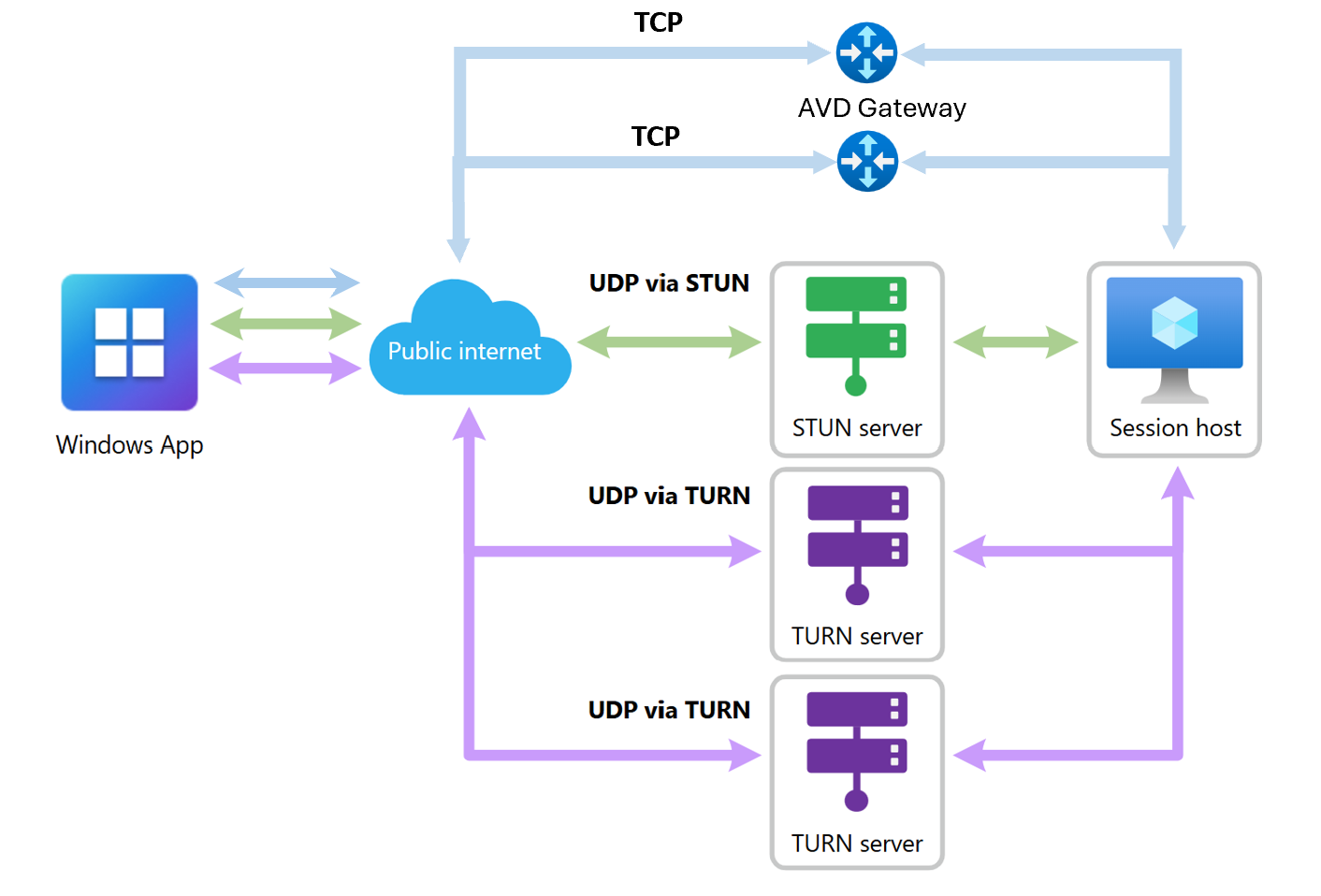
RDP Multipath uses multiple network paths to improve connection reliability. These paths can include combinations of UDP-based STUN or TURN connections when UDP connectivity is available, along with redundant TCP-based Reverse Connect paths established using Rendezvous. If the main transport path becomes degraded or fails, the system automatically switches to a backup available UDP or TCP transport path. If all paths are lost—such as during a network outage—the system attempts to reconnect once network connectivity is restored.
The following diagram illustrates how RDP Multipath works with Azure Virtual Desktop. In this user scenario, the primary active transport path is UDP via STUN, supplemented by redundant UDP connections through a TURN server.
When UDP‑based RDP Shortpath connectivity is available, UDP remains the preferred transport protocol for optimal performance and reliability. In addition to maintaining redundant UDP paths, Azure Virtual Desktop can establish redundant TCP standby transport paths to improve overall session resiliency.
Prerequisites
RDP Multipath works automatically when the following prerequisites are met:
Microsoft recommends configuring RDP Shortpath as the primary transport protocol to maximize the resiliency benefits of RDP Multipath. For more information, see Configure RDP Shortpath.
Connections must be from a local Windows device using Windows App, version 2.0.559.0 or later, which is the minimum supported version for RDP Multipath. This version enables RDP Multipath with multiple UDP transport paths.
To take advantage of the latest RDP Multipath enhancements, including support for multiple UDP transport paths and redundant TCP transport paths, connections must use Windows App Version 2.0.1069.0 or later
Other platforms aren't currently supported.
Required network endpoints for RDP transport
To support RDP connectivity using UDP‑based Shortpath and Multipath, as well as TCP‑based connections over Reverse Connect, ensure outbound connectivity to the following endpoints:
| # | RDP Method | FQDN | IP | Protocol/Port | Description |
|---|---|---|---|---|---|
| 1 | TCP-based RDP | *.wvd.microsoft.com | 40.64.144.0/20 | TCP 443 | TCP-based RDP connection. Initial connection made by every connection to a session host or Cloud PC. |
| 2 | UDP-based RDP via TURN | n/a | 51.5.0.0/16 | UDP 3478 | Relayed UDP-based RDP connection using TURN servers. Works when direct connectivity isn't possible. |
| 3 | UDP-based RDP using STUN | n/a | 51.5.0.0/16 | UDP 1024-65535 (Default: 49152-65535) | Direct 1:1 UDP connection between user device and session host or Cloud PC. |
Port scaling considerations
When using RDP Multipath, customers should plan firewall and network capacity with per‑user port scaling in mind.
Each active user session can establish up to five outbound transport paths:
Up to three UDP ports for UDP‑based RDP Shortpath and Multipath connections (for example, primary and redundant UDP paths discovered through STUN or TURN).
Up to two TCP ports for TCP‑based RDP connections over Reverse Connect, including redundant TCP transport paths when available.
Ensure that firewall rules, NAT capacity, and port exhaustion limits are configured to accommodate the expected number of concurrent user sessions and their associated transport paths at scale.
Important
Microsoft recommends using Windows App version 2.0.1069.0 or later and configuring RDP Shortpath as the primary transport protocol for the best RDP Multipath experience. With Windows App version 2.0.559.0 or later, users benefit from RDP Multipath with multiple UDP transport paths. With Windows App version 2.0.1069.0 or later, users gain the additional resiliency benefits of redundant TCP transport paths. If UDP connectivity is unavailable or restricted by network policy, RDP Multipath can continue to provide resiliency through redundant TCP transport paths.
Verify RDP Multipath connectivity
There are two ways to verify that RDP Multipath is being used for a connection:
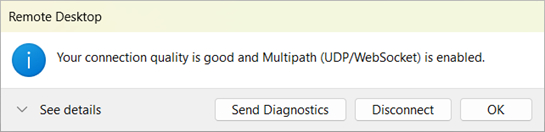
Users can check the connection status of a remote session from the connection bar, which shows RDP Multipath is enabled, as shown in the following example screenshot:
Azure Virtual Desktop administrators can view connection reliability information in Azure Virtual Desktop Insights. For more information, see the connection reliability use case for Azure Virtual Desktop Insights.
Related content
To learn more about RDP Shortpath, see RDP Shortpath for Azure Virtual Desktop.