Note
Access to this page requires authorization. You can try signing in or changing directories.
Access to this page requires authorization. You can try changing directories.
Responsible AI is guided by a set of principles that define how AI systems should operate. These principles focus on fairness, reliability, safety, privacy, security, inclusiveness, transparency, and accountability. They establish the standards that govern how Microsoft evaluates risks, designs AI features, and ensures responsible system behavior.

Applying these principles to agent design helps prevent unintended harm such as bias, misinformation, or privacy violations. It also supports user trust and long-term adoption. By following these guidelines, you can create AI agents that perform effectively while upholding the standards of integrity and respect that users and society expect from Microsoft products.
This article provides a high-level introduction to Responsible AI as it applies to agent design. For comprehensive guidance, see Microsoft's Responsible AI principles and approach.
Responsible AI principles
Responsible AI principles guide how you design, build, and operate agents in Microsoft 365 Copilot. They establish a shared standard for agent behavior, data handling, and user interaction to ensure AI systems are trustworthy, secure, and aligned with human values.
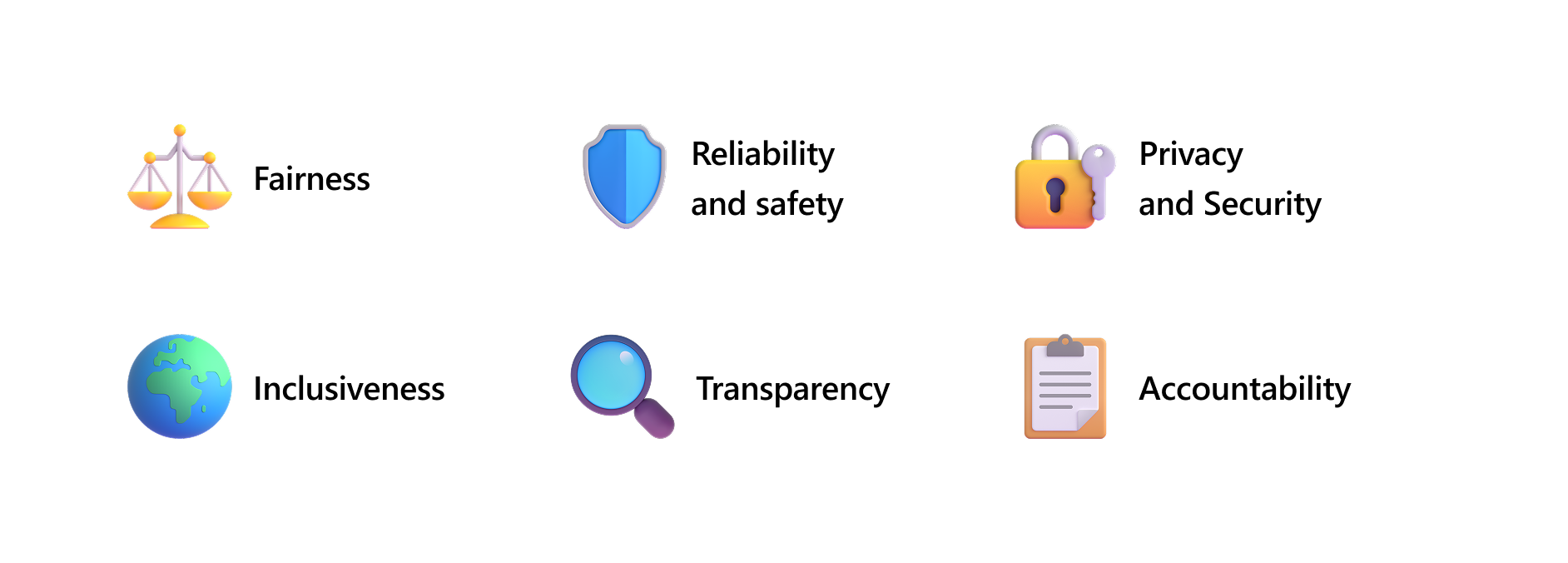
These principles apply across the entire agent lifecycle, from design and development to deployment and ongoing use. They inform decisions about interaction design, model and knowledge selection, autonomy, security, and governance. By following these principles, you ensure agents deliver value responsibly while maintaining user trust and long-term adoption.
| Principle | What it means for agent design |
|---|---|
| Fairness | AI systems should provide consistent and equitable outcomes for all users. Agent behaviors must avoid creating or reinforcing unfair treatment based on sensitive attributes or user context. |
| Reliability and safety | AI systems should perform as intended across a wide range of conditions. Agents must handle variability, edge cases, and unexpected inputs in ways that support safe and predictable behavior. |
| Privacy and security | AI systems must protect user data and respect established privacy and security requirements. Agents should only use information they're authorized to access and must handle that information responsibly. |
| Inclusiveness | AI systems should empower all users and accommodate diverse needs. Agents should consider accessibility, language variation, and different levels of technical proficiency to ensure an inclusive experience. |
| Transparency | AI systems should make their capabilities and limitations clear. Agents must communicate what they can do, how information is used, and how outputs are generated so users can make informed decisions. |
| Accountability | AI systems require clear oversight. Teams that develop agents are responsible for ensuring the system adheres to Responsible AI principles, meets compliance requirements, and operates under appropriate human governance. |
Applying Responsible AI in agent development
Microsoft uses a structured model to integrate Responsible AI principles throughout the development of AI agents. This model helps teams identify risks, find the right mitigations, and keep responsible behavior throughout the agent's lifecycle.
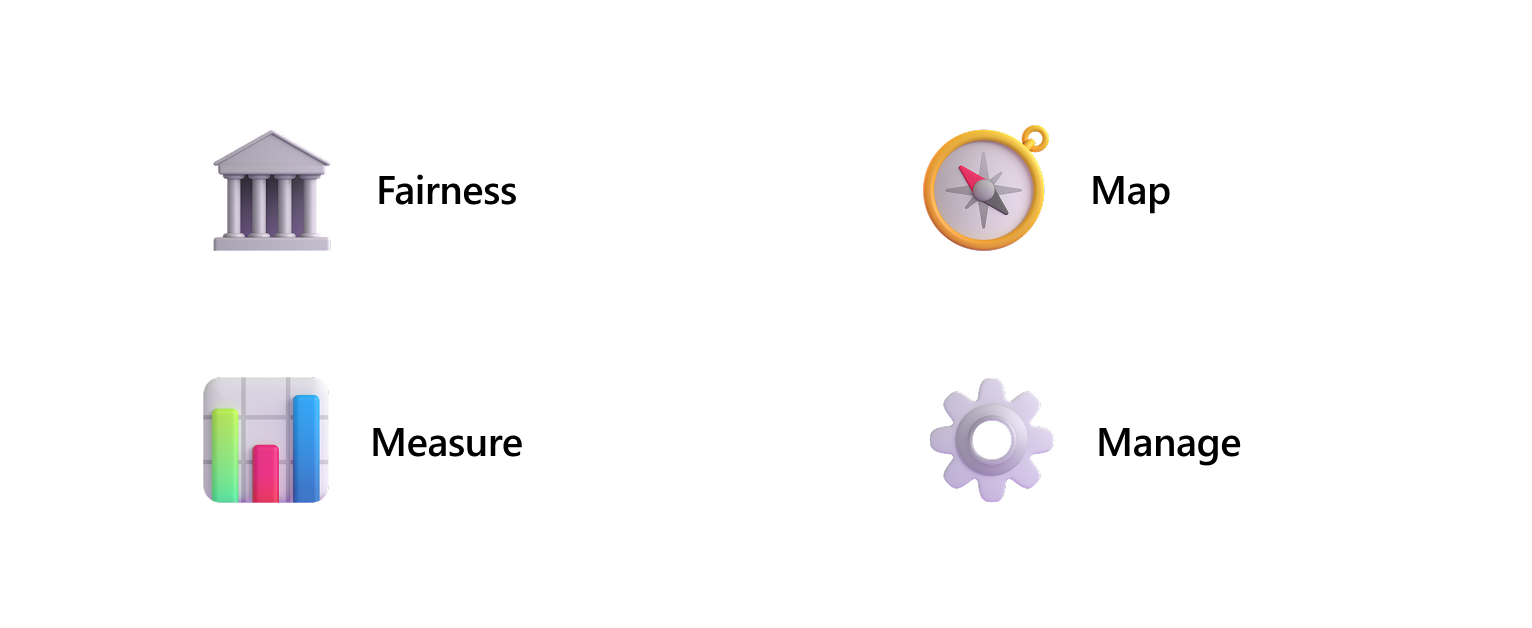
As a designer, your decisions directly affect how these functions are fulfilled. The following key functions describe how Responsible AI is put into practice:
| Function | Description |
|---|---|
| Govern | Establishes the policies, roles, and processes that teams follow when designing and deploying agents. Governance ensures alignment with Responsible AI principles and provides clear accountability. |
| Map | Identifies and prioritizes potential risks associated with an AI scenario. Mapping enables informed decisions about mitigation strategies and helps determine whether an AI solution is appropriate for the intended context. |
| Measure | Evaluates risks and system performance to guide the design and refinement of mitigations. Measurement is essential as AI capabilities grow in complexity and require ongoing assessment. |
| Manage | Applies and maintains risk mitigations throughout deployment and continued operation. Teams monitor system behavior and adjust mitigations as needed to ensure agents remain responsible over time. |
AI transparency and safety filters

Transparency is a cornerstone of responsible AI. When designing agents, clearly communicate the presence and role of AI within the product experience. Educate users about the agent's purpose, capabilities, limitations, and potential risks. This transparency empowers users to make informed decisions and fosters trust in the system.
Practical implementations of transparency include Transparency Notes and in-product disclosures that explain how the AI functions and what users can expect. For example, in the Business Chat experience, the agent uses clear indicators, like labeling such as "AI-generated content may be incorrect", to help set appropriate expectations and support responsible use.
Safety filters
Safety filters help ensure agents behave in ways that are appropriate, respectful, and aligned with Microsoft's Responsible AI principles. These safeguards reduce the risk of harmful, biased, or misleading outputs while protecting user privacy and sensitive information throughout the interaction.
Agents built on Copilot inherit Microsoft's Responsible AI commitments, which focus on fairness, reliability, privacy, and transparency. Safety filters play a critical role in enforcing these commitments by guiding how agents respond to user input, handle sensitive topics, and manage access to data.
Important
As a designer, you don't configure safety filters directly. Microsoft enforces them at the platform level. However, your design decisions around tone, scope, and transparency directly reinforce or undermine the trust that safety filters are designed to protect.
By applying safety filters consistently, agents can support user trust and confidence. Users are better able to rely on agent responses knowing that safeguards are in place to promote responsible behavior and ethical use of AI.
Tip
For comprehensive guidance about Microsoft's Responsible AI approach, including detailed principles, governance frameworks, and transparency reporting, see Microsoft's Responsible AI principles and approach.