Developer technologies | Transact-SQL
A Microsoft extension to the ANSI SQL language that includes procedural programming, local variables, and various support functions.
This browser is no longer supported.
Upgrade to Microsoft Edge to take advantage of the latest features, security updates, and technical support.
' cx='32' cy='32' r='32' /%3E%3Ctext x='50%25' y='55%25' dominant-baseline='middle' text-anchor='middle' fill='%23FFF' %3ECP%3C/text%3E%3C/svg%3E)
Hi Community,
Can someone let me know how to write code that will find fields that contain all NULLs?
For example, in the following table field 'client_surname' and field 'state' contain all NULLs.
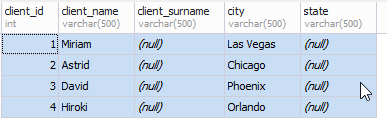
Can someone let me know the code to determine those fields containing all nulls.
Sample data
CREATE TABLE #tmpTable (
    client_id int,
    client_name varchar(500),
    client_surname varchar(500),
    city varchar(500),
    state varchar(500))

INSERT #tmpTable VALUES
(1,'Miriam',NULL,'Las Vegas',NULL),
(2,'Astrid',NULL,'Chicago',NULL),
(3,'David',NULL,'Phoenix',NULL),
(4,'Hiroki',NULL,'Orlando',NULL)

SELECT * FROM #tmpTable
A Microsoft extension to the ANSI SQL language that includes procedural programming, local variables, and various support functions.
Answer accepted by question author
' cx='32' cy='32' r='32' /%3E%3Ctext x='50%25' y='55%25' dominant-baseline='middle' text-anchor='middle' fill='%23FFF' %3EYK%3C/text%3E%3C/svg%3E)
Hi @Carlton Patterson ,
Please try the following solution.
It is using SQL Server XML and XQuery powers without dynamic SQL and cursors.
The algorithm is very simple.
When we are converting each row into XML, columns that hold NULL value are missing from the XML.
After that set operator EXCEPT brings us those missing columns comparing them with the full set of columns of the table.
SQL
USE tempdb;
GO

DROP TABLE IF EXISTS #tmpTable;

CREATE TABLE #tmpTable (
     client_id int,
     client_name varchar(500),
     client_surname varchar(500),
     city varchar(500),
     state varchar(500));

INSERT #tmpTable VALUES
(1,'Miriam',NULL,'Las Vegas',NULL),
(2,'Astrid',NULL,'Chicago',NULL),
(3,'David',NULL,'Phoenix',NULL),
(4,'Hiroki',NULL,'Orlando',NULL);

SELECT name
FROM tempdb.sys.columns
WHERE object_id = object_id('tempdb..#tmpTable')
 AND is_nullable = 1
EXCEPT
SELECT x.value('local-name(.)', 'SYSNAME')
FROM #tmpTable AS t
 CROSS APPLY (SELECT t.* FOR XML PATH(''), TYPE, ROOT('root')) AS t1(c)
 CROSS APPLY c.nodes('/root/*') AS t2(x);
Output
+----------------+
|      name      |
+----------------+
| client_surname |
| state          |
+----------------+

Amazing! My head is still spinning.
You will need to run query per column, but you can compose these with dynamic SQL:
   DECLARE @sql      nvarchar(MAX),
           @cur       CURSOR,
           @col       sysname,
           @hasnonnull bit

   SET @cur = CURSOR STATIC FOR
      SELECT name
      FROM   tempdb.sys.columns
      WHERE  object_id = object_id('tempdb..#tmpTable')
        AND  is_nullable = 1

   OPEN @cur

   WHILE 1 = 1
   BEGIN
      FETCH @cur INTO @col
      IF @@fetch_status <> 0
         BREAK

      SELECT @sql = 'SELECT @flag =
                        CASE WHEN EXISTS (
                              SELECT * FROM #tmpTable
                              WHERE ' + quotename(@col) + ' IS NOT NULL)
                             THEN 1
                             ELSE 0
                        END'

      EXEC sp_executesql @sql, N'@flag bit OUTPUT', @hasnonnull OUTPUT

      IF @hasnonnull = 0
         PRINT @col
   END
Wow,
Thanks Erland.
Going to check this out shortly
Just wanted to quickly say thanks
Hi Erland,
Just executed your code, the code executed successfully, but I didn't get any printed output.
Am I doing something wrong?
Hi Erland,
I modified your code to replace #tmpTable with a table called clients
DECLARE @sql      nvarchar(MAX),
        @cur       CURSOR,
        @col       sysname,
        @hasnonnull bit
SET @cur = CURSOR STATIC FOR
   SELECT name
   FROM   tempdb.sys.columns
   WHERE  object_id = object_id('tempdb..clients')
     AND  is_nullable = 1
OPEN @cur
WHILE 1 = 1
BEGIN
   FETCH @cur INTO @col
   IF @@fetch_status <> 0
      BREAK
   SELECT @sql = 'SELECT @flag =
                     CASE WHEN EXISTS (
                           SELECT * FROM clients
                           WHERE ' + quotename(@col) + ' IS NOT NULL)
                          THEN 1
                          ELSE 0
                     END'

   EXEC sp_executesql @sql, N'@flag bit OUTPUT', @hasnonnull OUTPUT
   IF @hasnonnull = 1
      PRINT @col
END
As I mentioend, it executed successfully, but no output.
Maybe there is no column with all NULL in that table?
When I ran your code with the table you posted it produced output. Here is the full script:`
   CREATE TABLE #tmpTable (
      client_id int   NOT NULL,
      client_name varchar(500),
      client_surname varchar(500),
      city varchar(500),
      state varchar(500))

   INSERT #tmpTable VALUES
   (1,'Miriam',NULL,'Las Vegas',NULL),
   (2,'Astrid',NULL,'Chicago',NULL),
   (3,'David',NULL,'Phoenix',NULL),
   (4,'Hiroki',NULL,'Orlando',NULL)
   go
   DECLARE @sql      nvarchar(MAX),
           @cur       CURSOR,
           @col       sysname,
           @hasnonnull bit

   SET @cur = CURSOR STATIC FOR
      SELECT name
      FROM   tempdb.sys.columns
      WHERE  object_id = object_id('tempdb..#tmpTable')
        AND  is_nullable = 1

   OPEN @cur

   WHILE 1 = 1
   BEGIN
      FETCH @cur INTO @col
      IF @@fetch_status <> 0
         BREAK

      SELECT @sql = 'SELECT @flag =
                        CASE WHEN EXISTS (
                              SELECT * FROM #tmpTable
                              WHERE ' + quotename(@col) + ' IS NOT NULL)
                             THEN 1
                             ELSE 0
                        END'

      EXEC sp_executesql @sql, N'@flag bit OUTPUT', @hasnonnull OUTPUT

      IF @hasnonnull = 1
         PRINT @col
   END
   go
   DROP TABLE #tmpTable
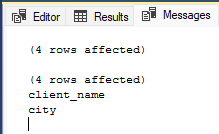
Also, beware that since I'm using PRINT the output comes in the Messages tab.
' cx='32' cy='32' r='32' /%3E%3Ctext x='50%25' y='55%25' dominant-baseline='middle' text-anchor='middle' fill='%23FFF' %3EA%3C/text%3E%3C/svg%3E)
Hello ErlandSommarskog.
Am I wrong or is the final test wrong?
It should be <> 1
<SPAN STYLE="redCheeks">
Oops... I guess I need to edit my post. Thanks for pointing it out.
</SPAN>
ok, not sure what I'm doing wrong.
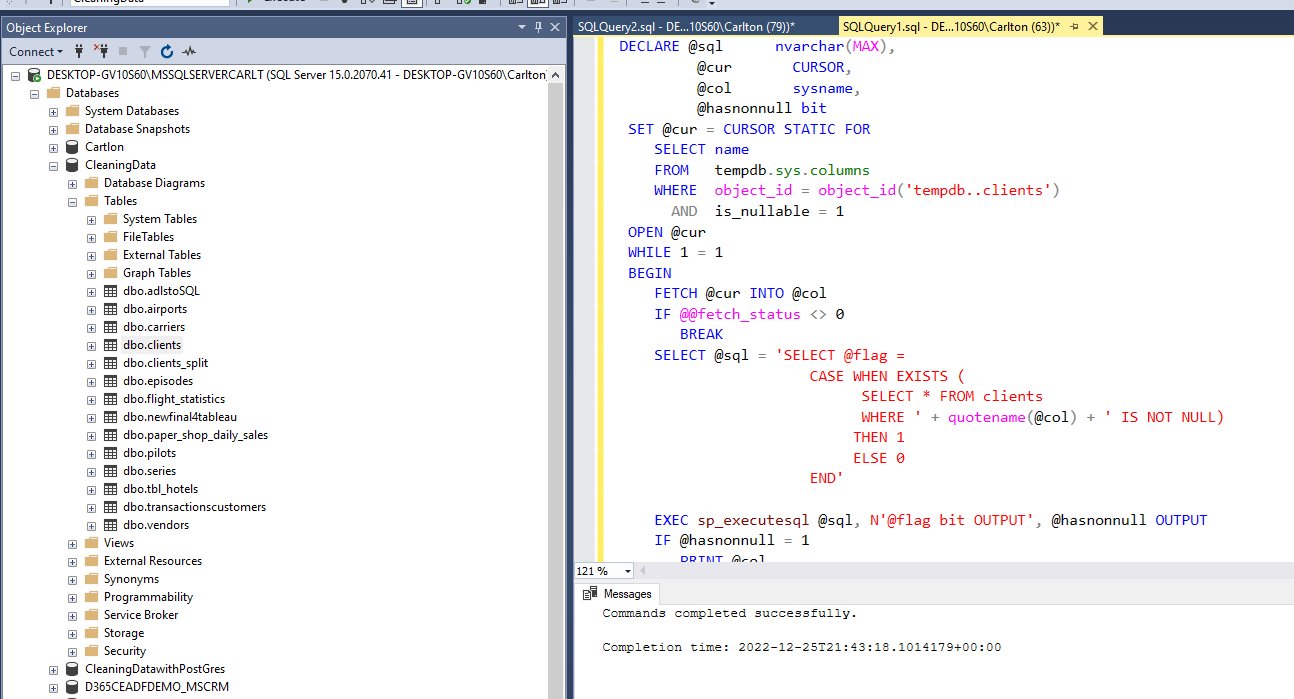
I have executed code from both Erland and YitzhakKhabinsky-0887, but I'm not getting a successful result - I executed both on SSMS
and
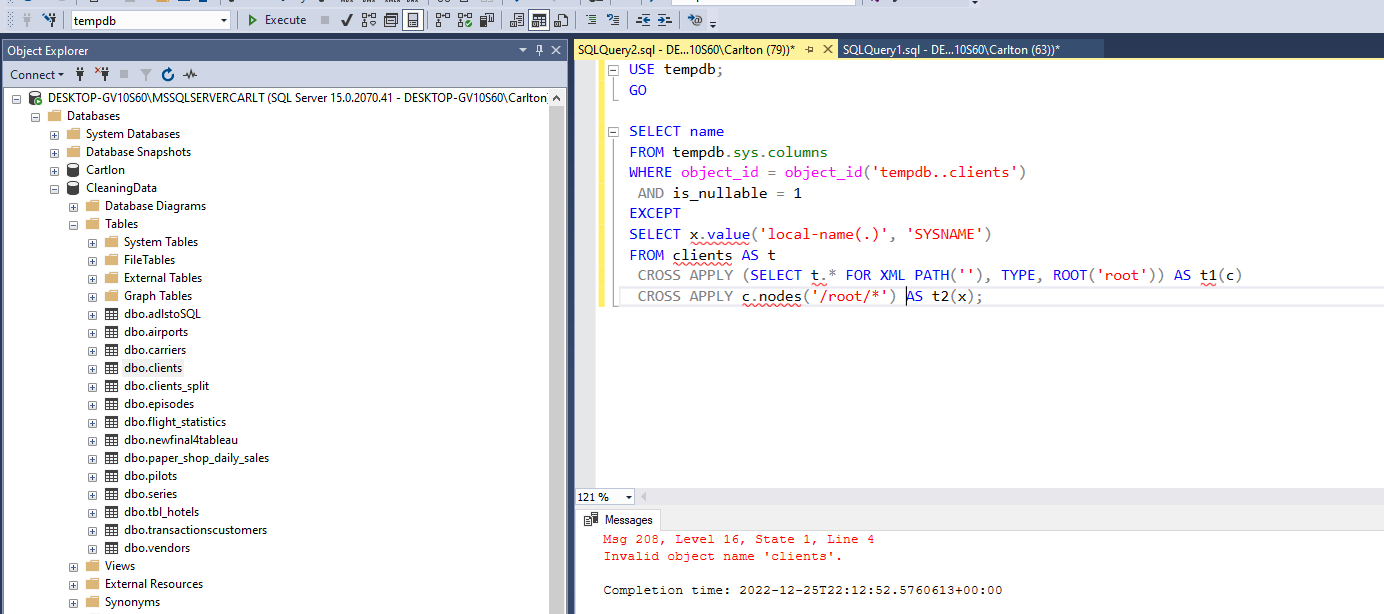
Is your clients table in tempdb? Judging from the OE on the left it is not.
Here is the kicker: you cannot treat the solutions you get here as black boxes. You should look to what is inside, so that you can do the necessary adaptions to your actual problem.
Hi Erland,
This is very strange.
The table that I'm executed your code on is as follows:
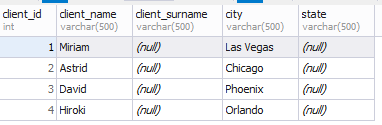
When execute your code on the table I get the following output
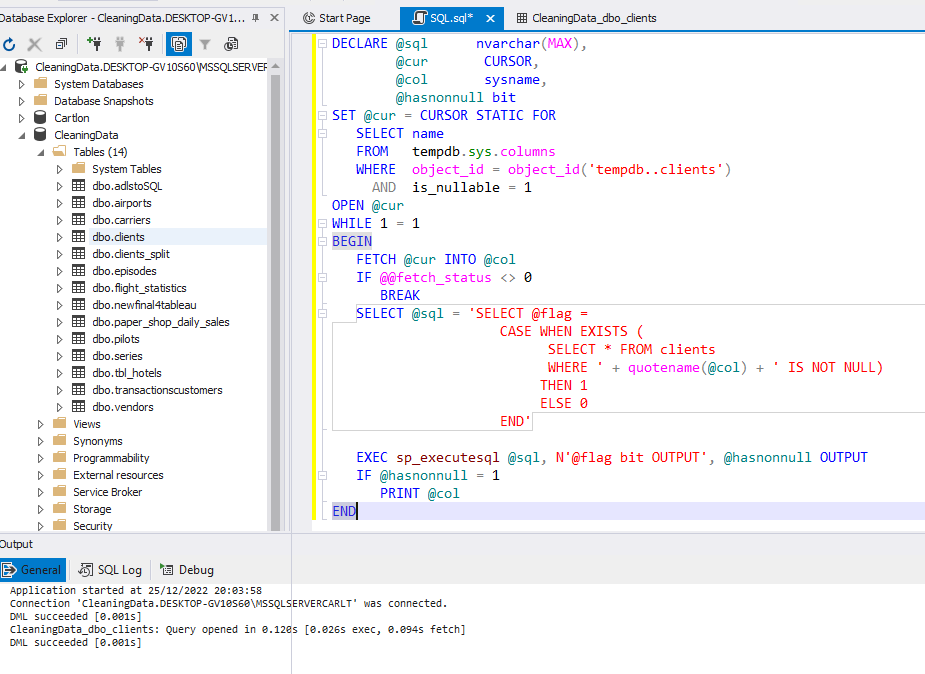
As you can see, no printout of the results
I am not familiar with the query tool you are using, so I can't say how it is dealing with PRINT output. (But I would check the other two tabs.)
Trying running my script in SSMS instead.

Maybe you should use a correct name in object_id('tempdb..clients'). For example, try object_id('clients'), and also use sys.columns instead of tempdb.sys.columns.