Share via

Recovery Partitions/System Reserved Partitions

Anonymous
2019-03-03T18:26:12+00:00

I have Windows 10 Home Version 1803 installed in my pc.

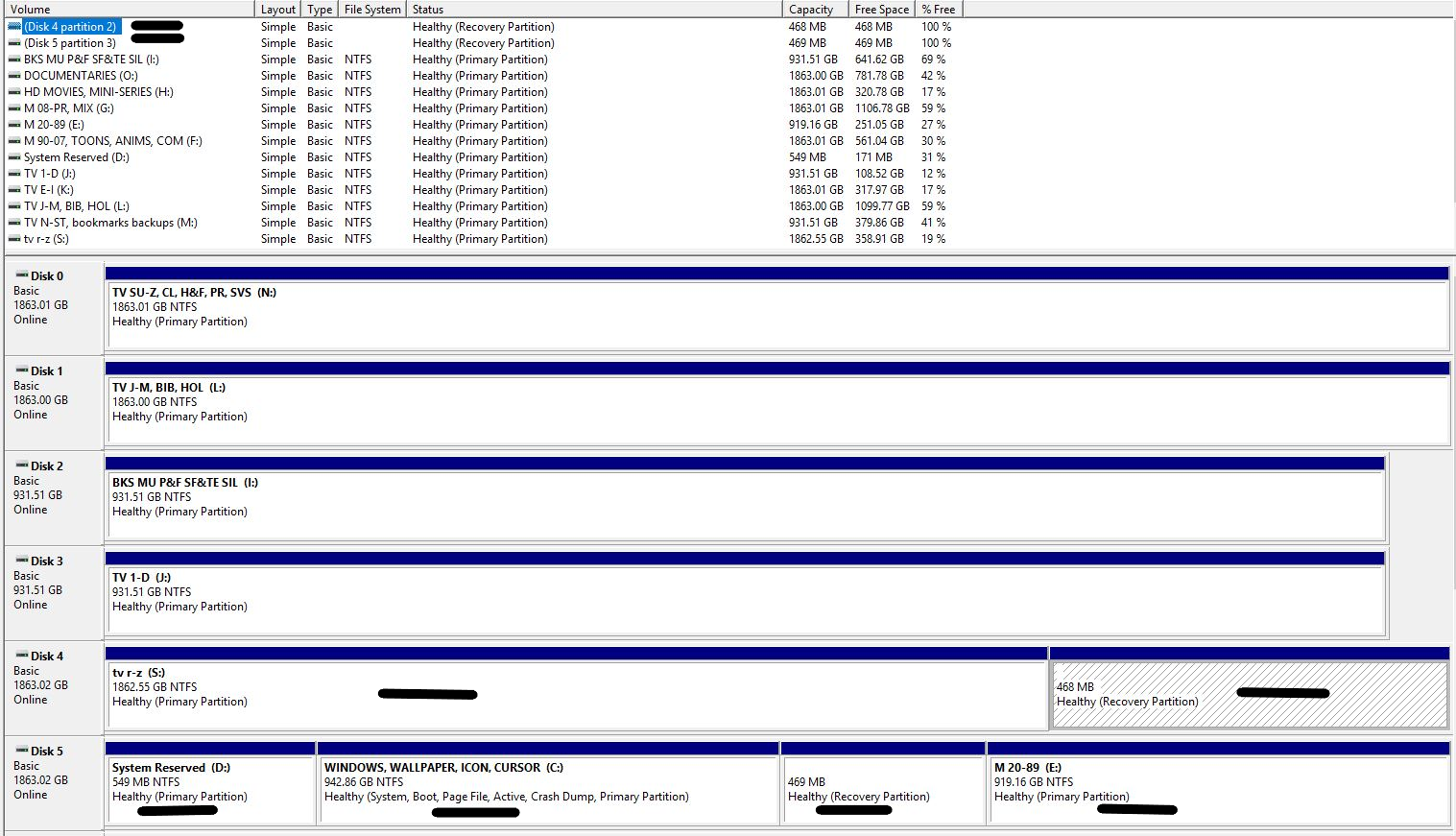
Windows is installed on Disk 5.  Disk 5 contains my C drive and D partition that I created after Windows was installed.  It also contains a partition named System Reserved which Windows created when I installed Windows and a partition named Recovery Partition, which Windows also created when I installed Windows.  It was a brand new hard drive, never before used, when I installed Windows on it.  Windows won't allow me to delete either of these partitions/merge them with my C or D partitions.  I don't understand why I have both a Recovery partition and a System Reserved partition.  Isn't the Recovery partition something that Windows 7 used to create?  I never had Windows 7.

Also, on my S drive which Windows labelled Disk 4, there is also a 468Mb Recovery partition that Windows created.  I don't understand why Windows created this partition on this hard drive.  It has no system files on it.  Windows didn't create a Recovery partition on any of my other hard drive.  All of my hard drives are WD Caviar Black, 1T and 2T.

I know that Windows 10 Home needs a System Reserved partition but can someone explain the reason for all these other partitions?  They're so small in size that I'm not concerned about the room they're taking up on the hard drives but I especially am interested in the reason Windows created a Recovery partition on my S drive.  I tried to merge the partitions but Windows wouldn't do it.  I then tried EaseUS Partition Manager and it couldn't merge the partitions either.
Windows for home | Windows 10 | Files, folders, and storage

Locked Question. This question was migrated from the Microsoft Support Community. You can vote on whether it's helpful, but you can't add comments or replies or follow the question.

0 comments No comments

11 answers

Sort by: Most helpful
  1. Anonymous
    2019-03-03T18:55:13+00:00

    Right now you are booting from the C partition.   I do not know where your recovery options are but you might open an admin command prompt enter the command below.  Copy and Paste the results when you post back.

    reagentc /info

    During some build upgrades, Windows has added extra partitions for recovery.  That is probably where the extra ones came from.  I have not seen a Legacy install for quite a while so I am not up to date on current configurations for those systems.  Your recovery options may be on the C partition like we used to do with Win 7.

    Was this answer helpful?

    1 person found this answer helpful.
    0 comments No comments
  2. DaveM121 881.2K Reputation points Independent Advisor
    2019-03-03T18:44:08+00:00

    Hi Denise

    The System Reserved partition contains the boot configuration fro Windows and should not be touched - you will brick your system if you remove that

    The recovery partition to the right of your C Drive contains the Windows 10 Recovery Image that you would need should you ever need to repair or Reset Windows 10

    If you right click the Recovery Partition on Disk 4, what options do you get?

    Was this answer helpful?

    1 person found this answer helpful.
    0 comments No comments
  3. DaveM121 881.2K Reputation points Independent Advisor
    2019-03-03T18:57:21+00:00

    Hi Denise

    If you right click the Recovery Partition on Disk 5, do you also only get the 'Help' option?

    Was this answer helpful?

    0 comments No comments
  4. Anonymous
    2019-03-03T18:54:58+00:00

    "The recovery partition to the right of your C Drive contains the Windows 10 Recovery Image that you would need should you ever need to repair or Reset Windows 10" - - -  Thanks for this information  :)

    When I right click on the Recovery Partition for Disk 4, the only option I get is "Help".

    Was this answer helpful?

    0 comments No comments
  5. Anonymous
    2019-03-03T18:40:26+00:00

    Hi DeniseJM

    My name is Sarah Kong and I am an independent adviser that is here to try and help you with your issue.

    You can remove those recovery partitions then merge them.

    Store the recovery on a USB drive.

    That's what I do.

    https://www.pcworld.com/article/3140449/everyth...

    Note: This is a non-Microsoft website. The page appears to be providing accurate, safe information. Watch out for ads on the site that may advertise products frequently classified as a PUP (Potentially Unwanted Products). Thoroughly research any product advertised on the site before you decide to download and install it.

    Was this answer helpful?

    0 comments No comments
