Developer technologies | Transact-SQL
A Microsoft extension to the ANSI SQL language that includes procedural programming, local variables, and various support functions.
This browser is no longer supported.
Upgrade to Microsoft Edge to take advantage of the latest features, security updates, and technical support.
' cx='32' cy='32' r='32' /%3E%3Ctext x='50%25' y='55%25' dominant-baseline='middle' text-anchor='middle' fill='%23FFF' %3EGM%3C/text%3E%3C/svg%3E)
I have the following table

And I want it to go like this:
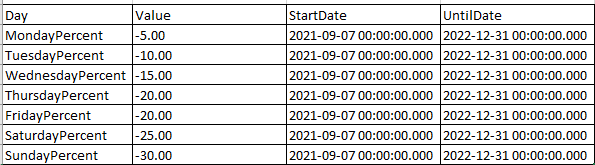
Is it possible using SQL Server PIVOT or UNPIVOT functions?
A Microsoft extension to the ANSI SQL language that includes procedural programming, local variables, and various support functions.
Additional SQL Server features and topics not covered by specific categories

Good day Glenn Mateus,
I have the following table
This is not a table but an image and we cannot query the content of an image.
In order to get help in writing a query, please provide the relevant queries to CREATE the table and INSERT sample data. In addition please describe the expeted result according to the sample data.
Is it possible using SQL Server PIVOT or UNPIVOT functions?
The short answer is yes, but we will discuss the options once we will have the table in our servers and we will be able to execute tests on it :-)
Answer accepted by question author

Hi @Glenn Mateus ,
Welcome to Microsoft Q&A!
I could not achieve your requirement using pivot/unpivot function after several attempts.
Is it possible using SQL Server PIVOT or UNPIVOT functions?
So it is NO from my side. But you could wait for any possible solution from other experts.
Please refer below another solution using CROSS APPLY:
create table #test
(MondayPercent decimal(5,2),
MondayStartDate datetime,
MondayUntilDate datetime,
TuesdayPercent decimal(5,2),
TuesdayStartDate datetime,
TuesdayUntilDate datetime,
WednesdayPercent decimal(5,2),
WednesdayStartDate datetime,
WednesdayUntilDate datetime,
ThursdayPercent decimal(5,2),
ThursdayStartDate datetime,
ThursdayUntilDate datetime)

insert into #test values
(-5.00,'2021-09-07','2022-12-31',-10.00,'2021-09-07','2022-12-31',-15.00,'2021-09-07','2022-12-31',-20.00,'2021-09-07','2022-12-31')

SELECT c.*
FROM #test
CROSS APPLY
(
  VALUES
    ('MondayPercent',MondayPercent, MondayStartDate, MondayUntilDate),
    ('TuesdayPercent',TuesdayPercent, TuesdayStartDate, TuesdayUntilDate),
	('WednesdayPercent',WednesdayPercent, WednesdayStartDate, WednesdayUntilDate),
	('ThursdayPercent',ThursdayPercent, ThursdayStartDate, ThursdayUntilDate)
) c ([day],[value], startdate, untildate)
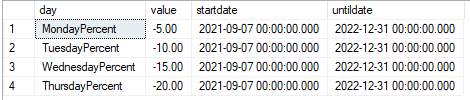
Output:
Best regards,
Melissa
If the answer is helpful, please click "Accept Answer" and upvote it.
Note: Please follow the steps in our documentation to enable e-mail notifications if you want to receive the related email notification for this thread.
But you could wait for any possible solution from other experts.
Not everything that can be used, should be used 
This is great solution for the description we got from the OP @MelissaMa-msft ! 
With that said, I am not sure what the OP want to get when he have multiple rows in the table. Seems like missing a column.
For example if I add another row using the above DDL+DML
insert into test values(
	-5.33,'2021-03-03','2022-04-04',-10.00,'2021-03-03','2022-05-05',-15.00,'2021-09-07','2022-12-31',-20.00,'2021-09-07','2022-12-31'
)
GO
Then we get the following result
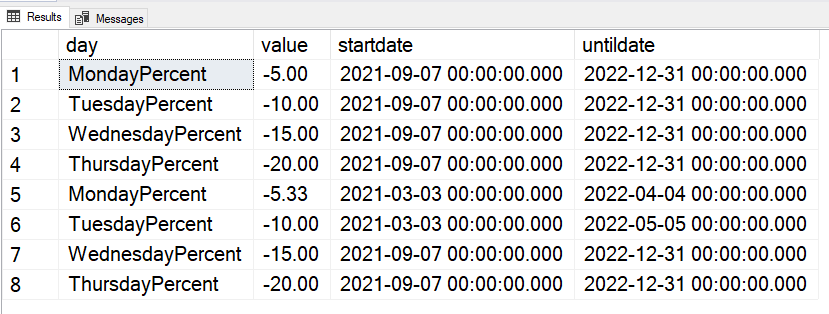
and this result make no sense to me since there are multiple rows for the same days and we cannot related any "MondayPercent" for example to the right "TuesdayPercent"
I recommend to add a column with ROW-NUMBER for example and present it in the result, but the OP should clarify what he need/want and confirm that it fit his needs
Hi @MelissaMa-msft thanks for your answer!
I also tried a lot to use PIVOT/ UNPIVOT and didn't succeed :/ But your idea was great for me.
best regards!
Good day @Glenn Mateus and @MelissaMa-msft
I understand that you struggled with solving the issue using UNPIVOT, so here it is for the sake of the discussion/learning :-)
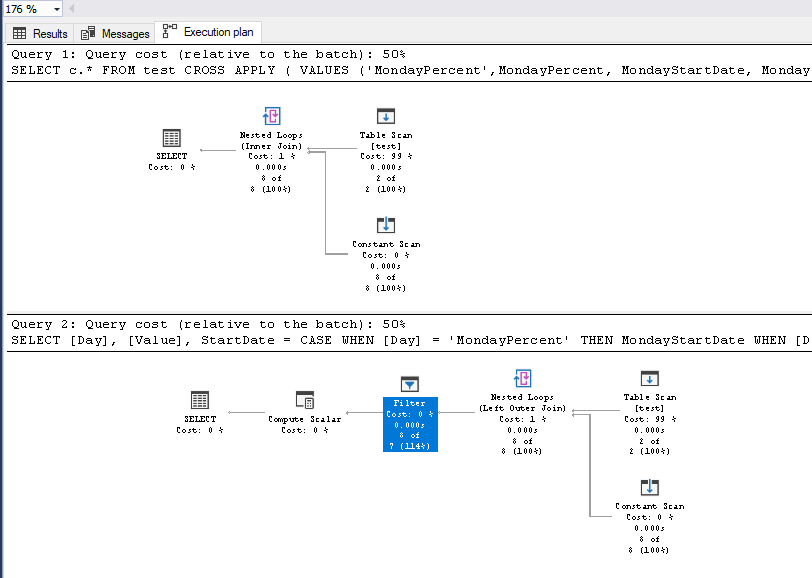
This is how we can solve UNPIVOT on multiple columns (this not necessarily provide the best performance, but if the requirement is to use UNPIVOT, for example during a learning course, then here you have it).
SELECT [Day], [Value],
 StartDate = CASE
 WHEN [Day] = 'MondayPercent' THEN MondayStartDate
 WHEN [Day] = 'TuesdayPercent' THEN TuesdayStartDate
 WHEN [Day] = 'WednesdayPercent' THEN WednesdayStartDate
 WHEN [Day] = 'ThursdayPercent' THEN ThursdayStartDate
 END,
 UntilDate = CASE
 WHEN [Day] = 'MondayPercent' THEN MondayUntilDate
 WHEN [Day] = 'TuesdayPercent' THEN TuesdayUntilDate
 WHEN [Day] = 'WednesdayPercent' THEN WednesdayUntilDate
 WHEN [Day] = 'ThursdayPercent' THEN ThursdayUntilDate
 END
FROM (
 select
 MondayPercent, MondayStartDate, MondayUntilDate,
 TuesdayPercent, TuesdayStartDate, TuesdayUntilDate,
 WednesdayPercent, WednesdayStartDate, WednesdayUntilDate,
 ThursdayPercent, ThursdayStartDate, ThursdayUntilDate
 from test
) p
UNPIVOT([Value] FOR [Day] IN (MondayPercent, TuesdayPercent, WednesdayPercent, ThursdayPercent) )AS unpvt;
GO
Is it possible using SQL Server PIVOT or UNPIVOT functions?
The answer to the question is YES - It is possible