Developer technologies | Transact-SQL
A Microsoft extension to the ANSI SQL language that includes procedural programming, local variables, and various support functions.
This browser is no longer supported.
Upgrade to Microsoft Edge to take advantage of the latest features, security updates, and technical support.
' cx='32' cy='32' r='32' /%3E%3Ctext x='50%25' y='55%25' dominant-baseline='middle' text-anchor='middle' fill='%23FFF' %3EA%3C/text%3E%3C/svg%3E)
hello,
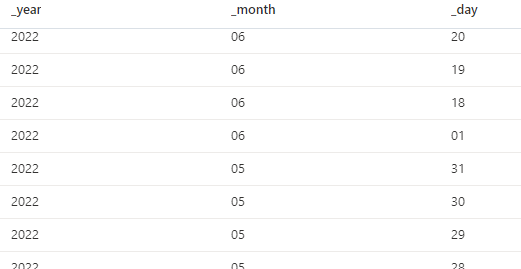
I have a table similar to below screen-shot which shows daily dates, year, month, day.
I am populating it daily.
Question:
As you see there are gaps where there are missing rows for some of the days.
How can I return the missing dates?
for example for the example shown here, I would like to return, something like:
year month days
--------------------
2022 06 02
2022 06 03
...
2022 06 17
thank you
A Microsoft extension to the ANSI SQL language that includes procedural programming, local variables, and various support functions.
' cx='32' cy='32' r='32' /%3E%3Ctext x='50%25' y='55%25' dominant-baseline='middle' text-anchor='middle' fill='%23FFF' %3EJL%3C/text%3E%3C/svg%3E)
Create an auxiliary calendar table in your database, it will save you lots of time to work on date/datetime related queries.
Answer accepted by question author

Hi Arkiboys,
The script below creates a date table with you can use to check your missing dates. I created the #temp table to represent your table.
DECLARE @Startdate date = CAST('20220101' as datetime)
DECLARE @Enddate date = CAST('20220110' as datetime)

DROP TABLE IF EXISTS #temp
CREATE TABLE #temp
(
_year int,
_month int,
_day int
)

INSERT INTO #temp VALUES (2022,1,1)
INSERT INTO #temp VALUES (2022,1,2)
INSERT INTO #temp VALUES (2022,1,4)
INSERT INTO #temp VALUES (2022,1,5)
INSERT INTO #temp VALUES (2022,1,6)
INSERT INTO #temp VALUES (2022,1,9)
INSERT INTO #temp VALUES (2022,1,10)


;WITH DateTable
AS
(
  SELECT @Startdate AS [date]
  UNION ALL
  SELECT DATEADD(dd, 1, [date])
  FROM DateTable
  WHERE DATEADD(dd, 1, [date]) <= @Enddate
)


SELECT [date] FROM DateTable
EXCEPT
select  datefromparts(_year, _month, _day) FROM #temp
OPTION (MAXRECURSION 0)

Hi @arkiboys
Try this code:
DECLARE @StartDate  DATE = '2022-05-28';
DECLARE @CutoffDate DATE = '2022-06-20'

;WITH seq(n) AS
(
  SELECT 0
  UNION ALL
  SELECT n + 1 FROM seq
  WHERE n < DATEDIFF(DAY, @StartDate, @CutoffDate)
),d(d) AS
(
  SELECT DATEADD(DAY, n, @StartDate) FROM seq
),src AS
(
  SELECT
    TheDate   = CONVERT(date, d),
    TheDay    = DATEPART(DAY, d),
    TheMonth  = DATEPART(MONTH, d),
    TheYear   = DATEPART(YEAR, d)
  FROM d
)
SELECT S.TheYear,S.TheMonth,S.TheDay
FROM src S LEFT JOIN Your_Table T ON S.TheYear=T._Year AND S.TheMonth=T._Month AND S.TheDay=T._Day
WHERE T._Year IS NULL
ORDER BY TheDate DESC
Best regards,
LiHong
If the answer is the right solution, please click "Accept Answer" and kindly upvote it. If you have extra questions about this answer, please click "Comment".
Note: Please follow the steps in our Documentation to enable e-mail notifications if you want to receive the related email notification for this thread.