Azure Data Lake Storage
An Azure service that provides an enterprise-wide hyper-scale repository for big data analytic workloads and is integrated with Azure Blob Storage.
This browser is no longer supported.
Upgrade to Microsoft Edge to take advantage of the latest features, security updates, and technical support.
' cx='32' cy='32' r='32' /%3E%3Ctext x='50%25' y='55%25' dominant-baseline='middle' text-anchor='middle' fill='%23FFF' %3ERJ%3C/text%3E%3C/svg%3E)
Hi everyone,
I have a question regarding SOAP API dynamic mapping into sink parquet.
I have a lookup activity that reads data fields iteratively and pass to the SOAP API Request body (dynamically). And the sink is parquet file format.
While writing the data:
Happy to discuss further.
Please let me know if anyone have any thoughts regarding the same.
Thank you in advance.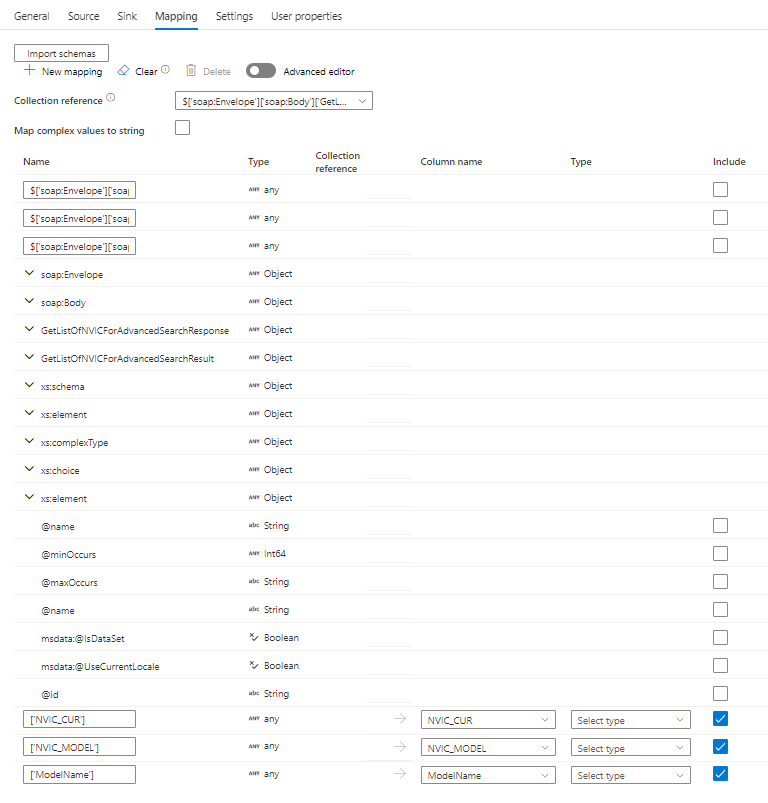
I guess this is the same issue I'm facing: https://learn.microsoft.com/en-us/answers/questions/597153/adf-copy-data-activity-xml-documents-with-only-one.html
Any updates on this ???
' cx='32' cy='32' r='32' /%3E%3Ctext x='50%25' y='55%25' dominant-baseline='middle' text-anchor='middle' fill='%23FFF' %3EMM%3C/text%3E%3C/svg%3E)
Hello @Rajesh Jyothi , We haven’t heard from you on the last response and was just checking back to see if you have a resolution yet. In case if you have any resolution please do share that same with the community as it can be helpful to others . Otherwise, will respond back with the more details and we will try to help .
Thanks Martin
Hello @Rajesh Jyothi and welcome to Microsoft Q&A.
The effect you see is a result of the ambiguousness when converting from XML to JSON. It has nothing to do with SOAP.
You can follow along with an online converter to better understand.
When we have XML like
<box>
    <record> data1 </record>
    <record> data2 </record>
</box>
it gets converted to JSOn like
{
   "box": {
      "record": [
         "data1",
         "data2"
      ]
   }
}
However when we have data like
<box>
    <record> data1 </record>
<box>
it gets converted to
{
   "box": {
      "record": "data1"
   }
}
There isn't any way to say we want
<box>
    <record> data1 </record>
<box>
to become
{
   "box": {
      "record": [
         "data1"
      ]
   }
}
Both look the same in XML.
So why not go the other way? (explained below)
{
   "box": {
      "record": "data1",
      "record: "data2"
   }
}
The above is invalid JSON because keys must be unique. The syntax to retrieve data1 is exactly the same to retrieve data2. This is a problem, so the solution is to merge the two and turn it into "record": ["data1","data2"] . Thus how we get our format.
So there isn't a good solution I can see. XML doesn't indicate whether an element should be looked at as a property, or a collection of 1.
The collection reference expects to work on an array, and when it isn't an array things break down like you saw. The collection reference happens after the conversion, so we can't put smarter logic in the mapping to change between property and collection on the fly.
If we could tell the XML reader ahead of time how to interpret the expected structure, and always make something an array/collection, we would have a solution.
If you have another perspective, I'd love to hear it, maybe your perspective can help find a solution not obvious to me.