Share via

SQL query left Join

Handian Sudianto 6,966 Reputation points
2024-10-04T01:08:24.86+00:00

I have sample data like this

DECLARE @TBL TABLE(col1 VARCHAR(100),col2 varchar(100))

INSERT INTO @TBL VALUES ('server-1','11111')

INSERT INTO @TBL VALUES ('server-2','22222')

INSERT INTO @TBL VALUES ('server-3','33333')

INSERT INTO @TBL VALUES ('server-4','44444')

DECLARE @TBL2 TABLE(col1 VARCHAR(100),col2 varchar(100))

INSERT INTO @TBL2 VALUES ('server-1.mydomain.com','2 oct 2024')

INSERT INTO @TBL2 VALUES ('server-1.mydomain.com','1 oct 2024')

INSERT INTO @TBL2 VALUES ('server-1.mydomain.com','3 oct 2024')

INSERT INTO @TBL2 VALUES ('server-2.mydomain.com','1 oct 2024')

INSERT INTO @TBL2 VALUES ('server-3.mydomain.com','1 sept 2024')

INSERT INTO @TBL2 VALUES ('server-3.mydomain.com','3 oct 2024')

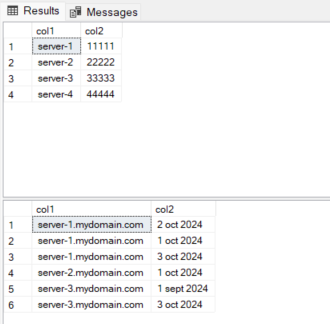
select * from @tbl

select * from @tbl2

and the result is
User's image

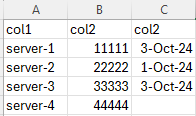
Now some one can help to to join both table with this criteria :

  1. join tbl with tbl2 with col1 as key, and when joining to the tbl2 get only last record by col2 asc
  2. any record with no data in the tbl2 will showing as null or empty.

So the final result is :
User's image

SQL Server | Other
0 comments No comments

Answer accepted by question author

  1. Viorel 126.9K Reputation points
    2024-10-04T06:05:29.2933333+00:00

    A possible solution:

    ;
    with Q1 as
    (
    	select *, left(col1, charindex('.', col1)-1) s 
    	from @tbl2
    ),
    Q2 as
    (
    	select t1.col1, t1.col2, t2.col2 as d, row_number() over (partition by t2.s order by t2.col2 desc) as n
    	from @tbl t1
    	left join Q1 t2 on t1.col1 = t2.s
    )
    select col1, col2, d as col2
    from Q2
    where n = 1
    order by col1
    

    However, the type of @tbl2.col2 column should be changed to date, otherwise the queries are incorrect or difficult to made.

    0 comments No comments

0 additional answers

Sort by: Most helpful

Your answer

Answers can be marked as 'Accepted' by the question author and 'Recommended' by moderators, which helps users know the answer solved the author's problem.