Developer technologies | C#
An object-oriented and type-safe programming language that has its roots in the C family of languages and includes support for component-oriented programming.
This browser is no longer supported.
Upgrade to Microsoft Edge to take advantage of the latest features, security updates, and technical support.
' cx='32' cy='32' r='32' /%3E%3Ctext x='50%25' y='55%25' dominant-baseline='middle' text-anchor='middle' fill='%23FFF' %3EA%3C/text%3E%3C/svg%3E)
Hello,
I am getting a compiler error, which seems illogical to me.
It would take longer to describe the problem, than to reproduce it.
Just insert, please, a slash after the very first slash in the code below, and the compiler will make the problem obvious.
using System;
using System.Collections;
using System.Collections.Generic;

namespace TestConsoleApp {
    class CEnumerable<ElemTypeBase> : IEnumerable<ElemTypeBase> where ElemTypeBase : class {
        public IEnumerator<ElemTypeBase> GetEnumerator() { throw new NotImplementedException(); }
        IEnumerator IEnumerable.GetEnumerator() { throw new NotImplementedException(); }
    }
    class CElemTypeBase { }
    class CElemTypeDerived : CElemTypeBase { }
    class Program {
        /* // To see the problem, insert a slash after the very first slash in this line and compile.
        // Why the line below causes problems,
        static public void MethodElemEnumArg(CEnumerable<CElemTypeBase> enumArg) { } // Problematic signature.
        /*/ // while the next line does not?
        static public void MethodElemEnumArg(IEnumerable<CElemTypeBase> enumArg) { }
        //*/
        static public void MethodElemArg(CElemTypeBase elemArg) { }
        static void Main() {
            CEnumerable<CElemTypeBase> enumBase = new CEnumerable<CElemTypeBase>();
            CEnumerable<CElemTypeDerived> enumDerived = new CEnumerable<CElemTypeDerived>();
            CElemTypeBase argBase = new CElemTypeBase();
            CElemTypeBase argDerived = new CElemTypeDerived();
            MethodElemArg(argBase);
            MethodElemArg(argDerived); // Surely works.
            MethodElemEnumArg(enumBase);
            MethodElemEnumArg(enumDerived); // Produces compiler error with the problematic signature.
        }
    }
}
An object-oriented and type-safe programming language that has its roots in the C family of languages and includes support for component-oriented programming.
Answer accepted by question author

Try another signature:
static public void MethodElemEnumArg( IEnumerable<CElemTypeBase> enumArg ) { }
Hello, Viorel-1,
Thank you for the reply. I am sorry, that initially I improperly submitted my question and you probably have not seen it in proper form. I have already been using the signature you mentioned. The question is not whether I should keep using it (I do not see an alternative for the moment). The question is if there is a bug in the C# compiler or it works as designed.
It seems that covariance were designed to work for some interfaces and arrays, but not for classes:
List<object> lst = new List<string>( ); // does not work

IEnumerable<string> e1 = new List<string>( );
IEnumerable<object> e2 = e1; // works

object[] arr = new string[] { "a", "b" }; // works
' cx='32' cy='32' r='32' /%3E%3Ctext x='50%25' y='55%25' dominant-baseline='middle' text-anchor='middle' fill='%23FFF' %3EDZ%3C/text%3E%3C/svg%3E)
Hi pnn,
A brief summary of facts about variance in the common language runtime:
If the response is helpful, please click "Accept Answer" and upvote it.
Note: Please follow the steps in our documentation to enable e-mail notifications if you want to receive the related email notification for this thread.
using System;
using System.Collections;
using System.Collections.Generic;

namespace TestConsoleApp {
    class CEnumerable<ElemTypeBase> : IEnumerable<ElemTypeBase> where ElemTypeBase : class {
        public IEnumerator<ElemTypeBase> GetEnumerator() { throw new NotImplementedException(); }
        IEnumerator IEnumerable.GetEnumerator() { throw new NotImplementedException(); }
    }
    class CElemTypeBase { }
    class CElemTypeDerived : CElemTypeBase { }
    class Program {
        /* // To see the problem, insert a slash after the very first slash in this line and compile.
        // Why the line below causes problems,
        static public void MethodElemEnumArg(CEnumerable<CElemTypeBase> enumArg) { } // Problematic signature.
        /*/ // while the next line does not?
        static public void MethodElemEnumArg(IEnumerable<CElemTypeBase> enumArg) { }
        //*/
        static public void MethodElemArg(CElemTypeBase elemArg) { }
        static void Main() {
            CEnumerable<CElemTypeBase> enumBase = new CEnumerable<CElemTypeBase>();
            CEnumerable<CElemTypeDerived> enumDerived = new CEnumerable<CElemTypeDerived>();
            CElemTypeBase argBase = new CElemTypeBase();
            CElemTypeBase argDerived = new CElemTypeDerived();
            MethodElemArg(argBase);
            MethodElemArg(argDerived); // Surely works.
            MethodElemEnumArg(enumBase);
            MethodElemEnumArg(enumDerived); // Produces compiler error with the problematic signature.
        }
    }
}

Hello,
The single / is seen as a math operator in this case. // is a comment and /// is used for marking a class, method or property comment.
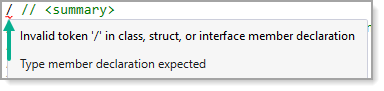
These are valid