SQL Server Reporting Services
A SQL Server technology that supports the creation, management, and delivery of both traditional, paper-oriented reports and interactive, web-based reports.
This browser is no longer supported.
Upgrade to Microsoft Edge to take advantage of the latest features, security updates, and technical support.
' cx='32' cy='32' r='32' /%3E%3Ctext x='50%25' y='55%25' dominant-baseline='middle' text-anchor='middle' fill='%23FFF' %3EA%3C/text%3E%3C/svg%3E)
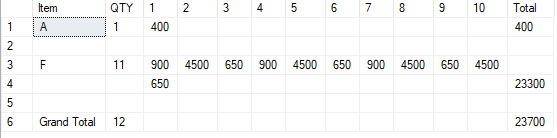
Below is data ,i want to convert Bweight into Row as display in image.
CREATE TABLE #item (ItemCode int,ItemName varchar(max))

CREATE TABLE #DistpatchM(DID int,E_Date date)
CREATE TABLE #Distpatch_BD(ID int,DID int,Itemcode int,DisQTY int,Bweight int)

INSERT INTO #item VALUES(1001, 'A')
INSERT INTO #item VALUES(1002, 'B')
INSERT INTO #item VALUES(1003, 'C')
INSERT INTO #item VALUES(1004, 'D')
INSERT INTO #item VALUES(1005, 'E')
INSERT INTO #item VALUES(1006, 'F')
INSERT INTO #item VALUES(1007, 'G')


INSERT INTO #DistpatchM values(111,'2019-05-28')
INSERT INTO #DistpatchM values(112,'2018-05-29')

INSERT INTO #Distpatch_BD values(1,1001,111,1 ,500)
INSERT INTO #Distpatch_BD values(2,1002,111 ,1,600)
INSERT INTO #Distpatch_BD values(3,1003,111 ,1,800)
INSERT INTO #Distpatch_BD values(4,1006,112,1,900)
INSERT INTO #Distpatch_BD values(5,1006,112,1,4500)
INSERT INTO #Distpatch_BD values(6,1006,112,1,650)
INSERT INTO #Distpatch_BD values(7,1006,112,1,900)
INSERT INTO #Distpatch_BD values(8,1006,112,1,4500)
INSERT INTO #Distpatch_BD values(9,1006,112,1,650)
INSERT INTO #Distpatch_BD values(10,1006,112,1,900)
INSERT INTO #Distpatch_BD values(11,1006,112,1,4500)
INSERT INTO #Distpatch_BD values(12,1006,112,1,650)
INSERT INTO #Distpatch_BD values(13,1006,112,1,4500)
INSERT INTO #Distpatch_BD values(14,1006,112,1,650)
INSERT INTO #Distpatch_BD values(14,1001,112,1,400)

Select  #item.ItemName,#Distpatch_BD.DisQTY,#Distpatch_BD.Bweight
From #Distpatch_BD inner join #item on #item.itemcode=#Distpatch_BD.itemcode
where #Distpatch_BD.DID=112

A SQL Server technology that supports the creation, management, and delivery of both traditional, paper-oriented reports and interactive, web-based reports.
A Microsoft extension to the ANSI SQL language that includes procedural programming, local variables, and various support functions.
Additional SQL Server features and topics not covered by specific categories

Can you explain the logic for the expected result, please?
This is not any logic,just i want to display Bweight from #Distpatch_BD into row,but have 10 columns as shown in image.
' cx='32' cy='32' r='32' /%3E%3Ctext x='50%25' y='55%25' dominant-baseline='middle' text-anchor='middle' fill='%23FFF' %3EYK%3C/text%3E%3C/svg%3E)
While asking a question you need to provide a minimal reproducible example:
(1) DDL and sample data population, i.e. CREATE table(s) plus INSERT, T-SQL statements.
(2) What you need to do, i.e. logic, and your attempt implementation of it in T-SQL.
(3) Desired output based on the sample data in the #1 above.
(4) Your SQL Server version (SELECT @@version;)

i want to just look #DistpatchM DID 112 data ,which exit in both table
Select #item.ItemName,#Distpatch_BD.DisQTY,#Distpatch_BD.Bweight
From #Distpatch_BD inner join #item on #item.itemcode=#Distpatch_BD.itemcode
where #Distpatch_BD.DID=112
Above query is displaying Data into Column ,but i want into Row Just Bweight
it is Displaying Data into Column ,But i want Disqty Sum and Begwight into row
Select #item.ItemName,#Distpatch_BD.DisQTY,#Distpatch_BD.Bweight
From #Distpatch_BD inner join #item on #item.itemcode=#Distpatch_BD.itemcode
where #Distpatch_BD.DID=112
Answer accepted by question author
' cx='32' cy='32' r='32' /%3E%3Ctext x='50%25' y='55%25' dominant-baseline='middle' text-anchor='middle' fill='%23FFF' %3EEM%3C/text%3E%3C/svg%3E)
According to Viorel-1's suggestion, the modified code should be::
 CREATE TABLE #item (ItemCode int,ItemName varchar(max))
 CREATE TABLE #DistpatchM(DID int,E_Date date)
 CREATE TABLE #Distpatch_BD(ID int, Itemcode int, DID int, DisQTY int, Bweight int)


 INSERT INTO #item VALUES(1001, 'A')
 INSERT INTO #item VALUES(1002, 'B')
 INSERT INTO #item VALUES(1003, 'C')
 INSERT INTO #item VALUES(1004, 'D')
 INSERT INTO #item VALUES(1005, 'E')
 INSERT INTO #item VALUES(1006, 'F')
 INSERT INTO #item VALUES(1007, 'G')

 INSERT INTO #DistpatchM values(111,'2019-05-28')
 INSERT INTO #DistpatchM values(112,'2018-05-29')

 INSERT INTO #Distpatch_BD values(1,1001,111,1 ,500)
 INSERT INTO #Distpatch_BD values(2,1002,111 ,1,600)
 INSERT INTO #Distpatch_BD values(3,1003,111 ,1,800)
 INSERT INTO #Distpatch_BD values(4,1006,112,1,900)
 INSERT INTO #Distpatch_BD values(5,1006,112,1,4500)
 INSERT INTO #Distpatch_BD values(6,1006,112,1,650)
 INSERT INTO #Distpatch_BD values(7,1006,112,1,900)
 INSERT INTO #Distpatch_BD values(8,1006,112,1,4500)
 INSERT INTO #Distpatch_BD values(9,1006,112,1,650)
 INSERT INTO #Distpatch_BD values(10,1006,112,1,900)
 INSERT INTO #Distpatch_BD values(11,1006,112,1,4500)
 INSERT INTO #Distpatch_BD values(12,1006,112,1,650)
 INSERT INTO #Distpatch_BD values(13,1006,112,1,4500)
 INSERT INTO #Distpatch_BD values(14,1006,112,1,650)
 INSERT INTO #Distpatch_BD values(14,1001,112,1,400)


;with I as
 (
     select *
     from #Distpatch_BD
     where DID in (112)
 ),
 N as
 (
     select *, row_number() over (partition by itemcode order by ID) - 1 as n
     from I
 ),
 P as
 (
     select *, cast(Bweight as varchar(max)) as BweightT, n % 10 + 1 as c, n / 10 + 1 as r
     from N
 ),
 G as
 (
     select *,
         isnull(lead(BweightT, 0) over (partition by itemcode order by ID), '') as [1],
         isnull(lead(BweightT, 1) over (partition by itemcode order by ID), '') as [2],
         isnull(lead(BweightT, 2) over (partition by itemcode order by ID), '') as [3],
         isnull(lead(BweightT, 3) over (partition by itemcode order by ID), '') as [4],
         isnull(lead(BweightT, 4) over (partition by itemcode order by ID), '') as [5],
         isnull(lead(BweightT, 5) over (partition by itemcode order by ID), '') as [6],
         isnull(lead(BweightT, 6) over (partition by itemcode order by ID), '') as [7],
         isnull(lead(BweightT, 7) over (partition by itemcode order by ID), '') as [8],
         isnull(lead(BweightT, 8) over (partition by itemcode order by ID), '') as [9],
         isnull(lead(BweightT, 9) over (partition by itemcode order by ID), '') as [10]
     from P
 ),
 R as
 (
     select *
     from G
     where c = 1
 ),
 F as
 (
     select
         case r when 1 then t.ItemName else '' end as Item,
         case r when 1 then cast((select count(*) from I where itemcode = R.itemcode) as varchar(max)) else '' end as QTY,
         case when lead(R.itemcode) over (partition by R.itemcode order by r) is null
             then cast((select sum(Bweight) from I where itemcode = R.itemcode) as varchar(max)) else '' end as Total,
         R.*
     from R
     inner join #item t on t.ItemCode = R.itemcode
 ),
 GT as
 (
     select
         cast(count(*) as varchar(max)) as GrandTotalQTY,
         cast(sum(I.Bweight) as varchar(max)) as GrandTotalBWeight
     from I
 ),
 E as
 (
     select distinct itemcode
     from I
 ),
 U as
 (
     select itemcode, Item, QTY, [1], [2], [3], [4], [5], [6], [7], [8], [9], [10], Total, 1 as ord1, 1 as ord2
     from F
     union all
     select itemcode, '', '', '', '', '', '', '', '', '', '', '', '', '', 2, 1
     from E
     union all
     select NULL, 'Grand Total', GrandTotalQTY, '', '', '', '', '', '', '', '', '', '', GrandTotalBWeight, 1, 2
     from GT
 )
 select Item, QTY, [1], [2], [3], [4], [5], [6], [7], [8], [9], [10], Total
 from U
 order by ord2, itemcode, ord1
Output:
I meant something else, but I do not insist.
Check a long unoptimised solution too:
;
with I as
(
    select *
    from #Distpatch_BD
    where itemcode in (112)
),
N as
(
    select *, row_number() over (partition by DID order by ID) - 1 as n
    from I
),
P as
(
    select *, cast(Bweight as varchar(max)) as BweightT, n % 10 + 1 as c, n / 10 + 1 as r
    from N
),
G as
(
    select *,
        isnull(lead(BweightT, 0) over (partition by DID order by ID), '') as [1],
        isnull(lead(BweightT, 1) over (partition by DID order by ID), '') as [2],
        isnull(lead(BweightT, 2) over (partition by DID order by ID), '') as [3],
        isnull(lead(BweightT, 3) over (partition by DID order by ID), '') as [4],
        isnull(lead(BweightT, 4) over (partition by DID order by ID), '') as [5],
        isnull(lead(BweightT, 5) over (partition by DID order by ID), '') as [6],
        isnull(lead(BweightT, 6) over (partition by DID order by ID), '') as [7],
        isnull(lead(BweightT, 7) over (partition by DID order by ID), '') as [8],
        isnull(lead(BweightT, 8) over (partition by DID order by ID), '') as [9],
        isnull(lead(BweightT, 9) over (partition by DID order by ID), '') as [10]
    from P
),
R as
(
    select *
    from G
    where c = 1
),
F as
(
    select
        case r when 1 then t.ItemName else '' end as Item,
        case r when 1 then cast((select count(*) from I where DID = R.DID) as varchar(max)) else '' end as QTY,
        case when lead(DID) over (partition by DID order by r) is null
            then cast((select sum(Bweight) from I where DID = R.DID) as varchar(max)) else '' end as Total,
        R.*
    from R
    inner join #item t on t.ItemCode = R.DID
),
GT as
(
    select
        cast(count(*) as varchar(max)) as GrandTotalQTY,
        cast(sum(I.Bweight) as varchar(max)) as GrandTotalBWeight
    from I
),
E as
(
    select distinct DID
    from I
),
U as
(
    select DID, Item, QTY, [1], [2], [3], [4], [5], [6], [7], [8], [9], [10], Total, 1 as ord1, 1 as ord2
    from F
    union all
    select DID, '', '', '', '', '', '', '', '', '', '', '', '', '', 2, 1
    from E
    union all
    select NULL, 'Grand Total', GrandTotalQTY, '', '', '', '', '', '', '', '', '', '', GrandTotalBWeight, 1, 2
    from GT
)
select Item, QTY, [1], [2], [3], [4], [5], [6], [7], [8], [9], [10], Total
from U
order by ord2, DID, ord1
Hi @Viorel ,
Your query is working fine,but you used Codeitem instead of DID and DID is used instead of Codeitem,
Please make it change where you used DID ,replace with Codeitem and where you used codeitem replace with DID.
Please
Probably you should fix the definition of your table, replacing
CREATE TABLE #Distpatch_BD(ID int,DID int,Itemcode int,DisQTY int,Bweight int)
with
CREATE TABLE #Distpatch_BD(ID int, Itemcode int, DID int, DisQTY int, Bweight int)
Then replace all of DID with Itemcode (or R.Itemcode in some cases) in the query, keeping the first one unchanged: ‘where DID in (112)’.
i have change it ,but column total is not coming ,as i asked in new question.
https://learn.microsoft.com/en-us/answers/questions/281236/row-total-is-not-displaying.html
The output of above script, with and without modifications, includes the Total column:
/*

Item        QTY      1       2       3       4       5       6       7       8       9       10    Total
A             1    400                                                                               400

F            11    900    4500     650     900    4500     650     900    4500     650     4500
                   650                                                                             23300

Grand Total  12                                                                                    23700

*/
Probably you have other script and data.
yes your provided solution, is working 100% fine. Data is same ,just i changed field names
as you can see in image just last row total is coming

;with cte
as(Select  i.ItemName,d.DisQTY,d.Bweight
From #Distpatch_BD d
inner join #item i
on i.itemcode=d.DID
where d.Itemcode=112)
,cte2 as(select *,row_number() over(partition by ItemName order by ItemName) rr
         from cte)
,cte3
as(select 'B' Item,* from (select rr,Bweight from cte2 where ItemName='F') as t
   pivot (max(Bweight) for rr in ([1],[2],[3],[4],[5],[6],[7],[8],[9],[10],[11])) as p
   union all
   select 'A' Item,*,null,null,null,null,null,null,null,null,null,null from (select rr,Bweight from cte2 where ItemName='A') as t
   pivot (max(Bweight) for rr in ([1])) as p)

select * from cte3
order by Item
as you used hardcore
     as(select 'B' Item,* from (select rr,Bweight from cte2 where ItemName='F') as t
        pivot (max(Bweight) for rr in ([1],[2],[3],[4],[5],[6],[7],[8],[9],[10],[11])) as p
        union all
        select 'A' Item,*,null,null,null,null,null,null,null,null,null,null from (select rr,Bweight from cte2 where ItemName='A') as t
        pivot (max(Bweight) for rr in ([1])) as p)
i do not want this,it pick from Database ,second thing is ,qty is not coming