Developer technologies | Transact-SQL
A Microsoft extension to the ANSI SQL language that includes procedural programming, local variables, and various support functions.
This browser is no longer supported.
Upgrade to Microsoft Edge to take advantage of the latest features, security updates, and technical support.
' cx='32' cy='32' r='32' /%3E%3Ctext x='50%25' y='55%25' dominant-baseline='middle' text-anchor='middle' fill='%23FFF' %3ETZ%3C/text%3E%3C/svg%3E)
please see my code example
ALTER PROC USP_GetLastCSMSavedData
(
    @Ticker VARCHAR(10)=NULL,
    @ClientName VARCHAR(10)=NULL,
    @LastCSMDate Datetime=NULL,
    @PageIndex INT = 1,
    @PageSize INT = 10
)
AS
BEGIN
    DECLARE @SQL VARCHAR(MAX)
    DECLARE @offset INT
    SET @offset = (@PageIndex - 1) * @PageSize


    SET @SQL='SELECT * FROM (SELECT
    CAST(ROW_NUMBER() OVER (ORDER BY LastCSMDeliveredDate DESC) AS INT) AS ''RowNumber'',
    ID,
    Ticker,
    c.ClientName,
    Earnings,
    PrePost,
    IIF([QC-ViewAllContent] IS NULL,0,1) HasViewAllContent,
    IIF([QCCommentsContent] IS NULL,0,1) HasQCCommentsContent,
    InsertedOn,
    LastCSMDeliveredDate,
    Action,
    UserName
    from tblLastCSMDelivered csm JOIN tblClient c
    ON csm.ClientCode=c.ClientCode
    WHERE LastCSMDeliveredDate IS NOT NULL) X
    WHERE CAST(X.RowNumber AS INT)>='+@offset+' AND CAST(X.RowNumber AS INT)<'+(@offset+@PageSize)

    IF @Ticker IS NOT NULL
    BEGIN
        SET @SQL=@SQL+' AND X.Ticker='+@Ticker
    END

    IF @ClientName IS NOT NULL
    BEGIN
        SET @SQL=@SQL+' AND X.ClientName='+@ClientName
    END

    IF @LastCSMDate IS NOT NULL
    BEGIN
        SET @SQL=@SQL+' AND CONVERT(VARCHAR,X.LastCSMDeliveredDate,112)=CONVERT(VARCHAR,'+@LastCSMDate+',112)'
    END

    --EXEC @SQL
    PRINT @SQL
END
I assume for this line WHERE CAST(X.RowNumber AS INT)>='+@offset+' AND CAST(X.RowNumber AS INT)<'+(@offset+@PageSize) i am getting runtime error Msg 245, Level 16, State 1, Procedure USP_GetLastCSMSavedData, Line 16 [Batch Start Line 20] Conversion failed when converting the varchar value
please tell me what i have missed in my code. i want to do this by dynamic sql. thanks
EDIT
@Viorel still getting error after changing code as you said
WHERE X.RowNumber between ' + cast(@offset as varchar(max)) + ' AND ' + cast(@offset+@PageSize - 1 as varchar(max))
see the screenshot also
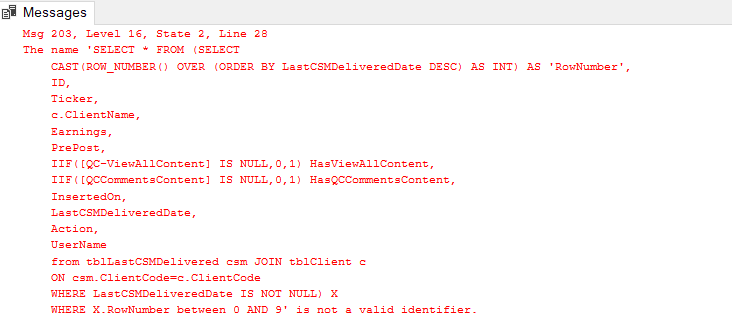
I found another way to compose this SQL with dynamic SQL. here sharing that code.
CREATE PROC USP_GetLastCSMSavedData
(
    @Ticker VARCHAR(10)='',
    @ClientCode VARCHAR(10)='',
    @LastCSMDate VARCHAR(10)='',
    @PageIndex INT = 1,
    @PageSize INT = 10
)
AS
BEGIN
  DECLARE @SQL VARCHAR(MAX)
  DECLARE @ClientName VARCHAR(200)

 IF @ClientCode<>''
 BEGIN
  SELECT @ClientName=ClientName FROM tblClient WHERE ClientCode=@ClientCode
 END
 ELSE
 BEGIN
  SET @ClientName=''
 END

    DECLARE @offset INT
    SET @offset = (@PageIndex - 1) * @PageSize

    SELECT * FROM (
        SELECT CAST(ROW_NUMBER() OVER (ORDER BY LastCSMDeliveredDate DESC) AS INT) AS 'RowNumber',
        ID,
        Ticker,
        c.ClientName,
        Earnings,
        PrePost,
        IIF([QC-ViewAllContent] IS NULL,0,1) HasViewAllContent,
        IIF([QCCommentsContent] IS NULL,0,1) HasQCCommentsContent,
        InsertedOn,
        LastCSMDeliveredDate,
        IIF([Action]='I','INSERTED','UPDATED') AS [Action],
        UserName
        from tblLastCSMDelivered csm
        JOIN tblClient c
            ON csm.ClientCode=c.ClientCode
        WHERE LastCSMDeliveredDate IS NOT NULL
    ) X
    WHERE CAST(X.RowNumber AS INT)> @offset  AND CAST(X.RowNumber AS INT)<= (@offset+@PageSize)
    AND (@Ticker ='' OR X.Ticker = @Ticker)
    AND (@ClientName ='' OR X.ClientName = @ClientName)
    AND (@LastCSMDate ='' OR CAST(X.LastCSMDeliveredDate AS DATE)=CAST(@LastCSMDate AS DATE))

    SELECT COUNT(*) AS CNT FROM tblLastCSMDelivered
    WHERE LastCSMDeliveredDate IS NOT NULL
    AND (@Ticker ='' OR Ticker = @Ticker)
    AND (@ClientCode ='' OR ClientCode = @ClientCode)
    AND (@LastCSMDate ='' OR CAST(LastCSMDeliveredDate AS DATE)=CAST(@LastCSMDate AS DATE))

END

Hi @T.Zacks ,
Please refer below and check whether it is working:
ALTER PROC USP_GetLastCSMSavedData
 (
     @Ticker VARCHAR(10)=NULL,
     @ClientName VARCHAR(10)=NULL,
     @LastCSMDate Datetime=NULL,
     @PageIndex INT = 1,
     @PageSize INT = 10
 )
 AS
 BEGIN
     DECLARE @SQL NVARCHAR(MAX)
     DECLARE @offset INT
     SET @offset = (@PageIndex - 1) * @PageSize
     SET @SQL=N'SELECT * FROM (SELECT
     CAST(ROW_NUMBER() OVER (ORDER BY LastCSMDeliveredDate DESC) AS INT) AS ''RowNumber'',
     ID,
     Ticker,
     c.ClientName,
     Earnings,
     PrePost,
     IIF([QC-ViewAllContent] IS NULL,0,1) HasViewAllContent,
     IIF([QCCommentsContent] IS NULL,0,1) HasQCCommentsContent,
     InsertedOn,
     LastCSMDeliveredDate,
     Action,
     UserName
     from tblLastCSMDelivered csm JOIN tblClient c
     ON csm.ClientCode=c.ClientCode
     WHERE LastCSMDeliveredDate IS NOT NULL) X
     WHERE CAST(X.RowNumber AS INT)>='+cast(@offset as char(10))+' AND CAST(X.RowNumber AS INT)<'+cast((@offset+@PageSize) as char(10))

     IF @Ticker IS NOT NULL
     BEGIN
         SET @SQL=@SQL+' AND X.Ticker='+@Ticker
     END

     IF @ClientName IS NOT NULL
     BEGIN
         SET @SQL=@SQL+' AND X.ClientName='+@ClientName
     END

     IF @LastCSMDate IS NOT NULL
     BEGIN
         SET @SQL=@SQL+' AND CONVERT(VARCHAR,X.LastCSMDeliveredDate,112)=CONVERT(VARCHAR,'+@LastCSMDate+',112)'
     END

     EXECUTE sp_executesql  @SQL
     --PRINT @SQL
 END
Best regards,
Melissa
If the answer is helpful, please click "Accept Answer" and upvote it.
Note: Please follow the steps in our documentation to enable e-mail notifications if you want to receive the related email notification for this thread.
I When i execute your script then i got this error
Msg 203, Level 16, State 2, Line 17
The name 'SELECT * FROM (SELECT
CAST(ROW_NUMBER() OVER (ORDER BY LastCSMDeliveredDate DESC) AS INT) AS 'RowNumber',
ID,
Ticker
from tblLastCSMDelivered csm JOIN tblClient c
ON csm.ClientCode=c.ClientCode
WHERE LastCSMDeliveredDate IS NOT NULL) X
WHERE CAST(X.RowNumber AS INT)>=0 AND CAST(X.RowNumber AS INT)<10 ' is not a valid identifier.

No, you don't. You get that error when you execute a script that you don't show us.
More precisely, you get this error when you say:
EXEC @sql
`This line means "Execute the stored procedure of which the name is given in the variable @sql", and then it goes downhill from there.
Melissa's post avoids that problem. How, is left as an exercise to the reader.
However, you should not do as in Melissa's post. You should use a parameterised statement as I demonstrated in my post. This is a lot better for a number of reasons. Only to mention one: it's simpler!
Sorry Madam i made mistake that is why it did not worked but later i was it was perfectly working.
Thank you

Did you consider other suggestions and efforts too (unless you are interested in answers)?
Hi @T.Zacks ,
Thanks for your confirmation.
You could use EXEC (@alenzi ) instead of EXEC @alenzi so that you could avoid the 'is not a valid identifier.' error.
I personally recommend to use EXECUTE sp_executesql @alenzi to avoid many errors. One point is to declare @alenzi as nvarchar(max).
You could also refer other suggestions mentioned by other experts.
Best regards,
Melissa
Try another line:
WHERE X.RowNumber between ' + cast(@offset as varchar(max)) + ' AND ' + cast(@offset+@PageSize - 1 as varchar(max))
Also check if OFFSET and FETCH can be used in your case: https://learn.microsoft.com/en-us/sql/t-sql/queries/select-order-by-clause-transact-sql#Offset. (Then ROW_NUMBER is not needed).
The code should be:
SET @SQL='SELECT * FROM (SELECT
     CAST(ROW_NUMBER() OVER (ORDER BY LastCSMDeliveredDate DESC) AS INT) AS ''RowNumber'',
     ID,
     Ticker,
     c.ClientName,
     Earnings,
     PrePost,
     IIF([QC-ViewAllContent] IS NULL,0,1) HasViewAllContent,
     IIF([QCCommentsContent] IS NULL,0,1) HasQCCommentsContent,
     InsertedOn,
     LastCSMDeliveredDate,
     Action,
     UserName
     from tblLastCSMDelivered csm JOIN tblClient c
     ON csm.ClientCode=c.ClientCode
     WHERE LastCSMDeliveredDate IS NOT NULL) X
     WHERE CAST(X.RowNumber AS INT) @offset AND CAST(X.RowNumber AS INT)< (@offset+@PageSize)'
And then you invoke the dynamic SQL with
SELECT @params = N'@offset int,
                                 @pagesize int'
EXEC sp_executesql @sql, @params, @offset, @pagesize
You should handle the parameters you have (@Ticker etc), in the same way. You will find that this makes your code at lot easier to write and maintain!
Sir i execute this way as per your guide line but getting error Incorrect syntax near '@offset'.
DECLARE @PageSize INT,@PageIndex INT
    DECLARE @offset INT
    DECLARE @SQL NVARCHAR(MAX)
    DECLARE @params NVARCHAR(MAX)
    SET @PageIndex=1
    SET @PageSize=10
    SET @offset = (@PageIndex - 1) * @PageSize

    SET @SQL='SELECT * FROM (SELECT
    CAST(ROW_NUMBER() OVER (ORDER BY LastCSMDeliveredDate DESC) AS INT) AS ''RowNumber'',
    ID,
    Ticker,
    c.ClientName,
    Earnings,
    PrePost,
    IIF([QC-ViewAllContent] IS NULL,0,1) HasViewAllContent,
    IIF([QCCommentsContent] IS NULL,0,1) HasQCCommentsContent,
    InsertedOn,
    LastCSMDeliveredDate,
    Action,
    UserName
    from tblLastCSMDelivered csm JOIN tblClient c
    ON csm.ClientCode=c.ClientCode
    WHERE LastCSMDeliveredDate IS NOT NULL) X
    WHERE CAST(X.RowNumber AS INT) @offset AND CAST(X.RowNumber AS INT)< (@offset+@PageSize)'


    SELECT @params = N'@offset int,@pagesize int'
    EXEC sp_executesql @sql, @params, @offset, @pagesize
I'm sorry about the syntax error, but I need to ask: Did it never occurred to you that you could try to find the syntax error yourself? It should be fairly simple to see what character that is missing.