Please boot into Windows.
Post the latest Disk Management screenshot.
This browser is no longer supported.
Upgrade to Microsoft Edge to take advantage of the latest features, security updates, and technical support.
' cx='32' cy='32' r='32' /%3E%3Ctext x='50%25' y='55%25' dominant-baseline='middle' text-anchor='middle' fill='%23FFF' %3EAR%3C/text%3E%3C/svg%3E)
I'm currently running Windows 11 Pro 23H2 (22631.6199), and I've had problems updating to 24/25H2. I've tried updating from the windows updater, as well as from the bootable media. I currently get the following error:
0xC1900101 - 0x20017The installation failed in the SAFE_OS phase with an error during BOOT operation.
I've exhausted virtually all solutions that I've found online, including the following:
sfc /scannowDISM /Online /Cleanup-Image /RestoreHealthWhile attempting these, there were a few references to reagentc - disabling and re-enabling it. This is where I noticed a problem, and I believe it's what's blocking the update.
Running reagentc /info shows it as disabled:
Attempting to enable it says that it's successful, but it's still disabled.
I've tried replacing the winre.wim file and the reagent.xml file from the update image (adding them to C:\Windows\System32\Recovery) - and enabling after that does remove the files - but everything still shows as disabled.
I then recalled that I actually cloned my old windows drive to the current SSD its on - and noticed that I had 2 recovery partitions, and 2 system partitions. After a lot of experimenting, I deleted both recovery partitions and recreated a single recovery partition - but that still did not work:
I'm honestly at my wits end with this, and would appreciate any help. Running reagentc /enable is doing something, but I've no idea what windows thinks my recovery partition is, or why it isn't enabling. Any advice or assistance is greatly appreciated.

Please boot into Windows.
Post the latest Disk Management screenshot.
Still not good. Now C is acting as the system partition. Perhaps someone copied the EFI folder there.
Please create a **FAT32 **partition in the following space:
Format it as FAT32 and assign the drive letter Y.
Run:
diskpart
select disk 1
select part 1
set id=c12a7328-f81f-11d2-ba4b-00a0c93ec93b override
gpt attributes=0x8000000000000000
assign letter=Y
list part
list vol
exit
bcdboot c:\windows /s Y:
Also, run msinfo32 and click System Summary.
Post a screenshot.
I didn't post those commands. Where did you get that from?
In this comment - it seems like that should be part 4, not part 1 - since part 1 is the main OS partition.
diskpart
select disk 1
select part 1
set id=c12a7328-f81f-11d2-ba4b-00a0c93ec93b override
gpt attributes=0x8000000000000000
assign letter=Y
list part
list vol
exit
bcdboot c:\windows /s Y:
Please post the latest Disk Management screenshot.
I did create the FAT32 partition - which ended up being 99MB. It's in the first slot in disk management, but listed as part 4 in diskpart:
Gotcha. Maybe it's a good idea to post a screenshot of Disk Management after a reboot.
Edit: By "Gotcha", I meant "I understand". It can sometimes convey a different meaning.
The next steps will be:
To create the EFI partition
Remove the EFI partition located at the end of the drive.
Remove the boot folder in the C drive. This has to be done via WinRE (USB boot).
Once done, enable WinRE.
The commands ran fine.
Can you open msinfo32.exe and check the boot mode?
It should read UEFI.
Run:
diskpart
disk 1
select part 4
set id=ebd0a0a2-b9e5-4433-87c0-68b6b72699c7
gpt attributes=0x0000000000000000
exit
Now, you should be able to delete the EFI partition at the end of Disk 1. Please do so.
Great. Please boot into WinRE using the USB disk.
In WinRE Command Prompt, run:
bcdedit | find "osdevice"
In the output, note the drive letter for the OS partition.
Suppose it's D:\
Run:
attrib -s -h -r D:\EFI

ren D:\EFI D:\Unused.EFI

wpeutil reboot
(If you get any errors, please mention them here.)
Boot into Windows and post the latest Disk Management screenshot.
I'm getting this when running bcdedit from the command line:
The boot configuration data store could not be opened.
The requested system device cannot be found.
Though checking the volumes, it is assigned D:
Let's see if the drive letter Y is intact.
Run:
diskpart
list vol
exit
Run:
select volume 2
assign letter=y
list vol
exit
bcdboot d:\windows /s Y: /f ALL
dir Y:\BCD /s /a
Let's rename the EFI folder on the OS drive. (If Windows doesn't boot, we may need to revert the change later.)
Run:
attrib -s -h -r D:\EFI

attrib -s -h -r D:\Boot

ren D:\EFI Unused.EFI

ren D:\Boot Unused.Boot

wpeutil reboot
(If you get any errors, please mention them here.)
Boot into Windows and post the latest Disk Management screenshot.
I've modified the 3rd command. Please refresh this page.
Very good.
Please run:
bcdedit

reagentc /disable

reagentc /enable

reagentc /info
Great. WinRE is sorted. Unfortunately, I skipped checking the Disk Management screenshot (in your original post) earlier. Only noticed the problem in the full Disk Management screenshot posted today.
If you want to merge the free space next to the Recovery partition, let me know.
If this also fixes the 0xC1900101 error, that will be great.
I'll be able to handle merging the unused space back in myself - have recreated the recovery partition before, so I'm not too worried about that (and it's only a few hundred megs anyway).
I'll test updating again tomorrow - hopefully this has fixed the issue. Thanks for all your help so far!
Good luck and keep me posted.
Thanks for all your help so far!
You're welcome.
Updated this morning, and everything went smoothly. Looks like the WinRE issue was the culprit in this case.
Thanks for your help!
Excellent. Duly noted. Henceforth, one must check the EFI partition for 0xC1900101 - 0x20017 issues. WinRE wasn't the problem because it's not boot-critical. The EFI partition was the issue.
Thanks for the feedback!
No wonder you were unable to enable WinRE. The problem here is the system is booting from the System Reserved partition instead of the EFI partition.
Please boot into Windows RE using the Windows 11 USB setup disk. We have to fix the boot partitions.
In WinRE Command Prompt, type the following commands:
diskpart

select disk 1

list part

list vol

Exit
Take a photo of the output screen and upload the image(s) here.
Don't quit WinRE yet. Some more commands need to be run.
Note:
Here's how to create the USB setup disk.
Create installation media for Windows - Microsoft Support
This comment has been deleted due to a violation of our Code of Conduct. The comment was manually reported or identified through automated detection before action was taken. Please refer to our Code of Conduct for more information.
Run:
select disk 1
select part 1
del part override
create partition efi size=100
format fs=fat32 quick
assign letter=Y
list vol
Post the screenshot.
Run:
select disk 1
list part
exit
Run:
bcdboot d:\windows /s Y:
diskpart
select disk 1
select part 4
del part override
select volume Y
remove
exit
Note: It appears you didn't exit from diskpart. Please exit diskpart before running the latest commands.
Install the latest chipset drivers and Ethernet drivers for your PC Z390-A PRO (MS-7B98).
https://www.msi.com/Motherboard/Z390-A-PRO/support#driver
Restart Windows.
Create a System Restore Point
Unplug all peripherals (except the keyboard, mouse, WiFI) and run these commands:
rundll32.exe pnpclean.dll,RunDLL_PnpClean /DEVICES /DRIVERS /MAXCLEAN

sc.exe delete AthDfu

sc.exe delete cbfs3

pnputil /delete-driver oem115.inf /uninstall /force
Rerun the 25H2 upgrade. Let's see how it goes.
Unfortunately getting the same error when installing after following all the steps above.
Please post the latest setup logs and the Farbar scan logs.
If it's 0xC1900101 - 0x20017 (which can be a stubborn issue), we need to remove more drivers.
I've re-run FRST, and I wasn't sure what you meant by the setup logs, so I used 'Get-WindowsUpdateLog' from PowerShell. The results are all in the zip here: https://gofile.io/d/9Gi1VQ
Can you confirm that the error code and the extended error code are the same as before (i.e., 0xC1900101 - 0x20017)?
Yep, I'm pretty certain that they were - though I don't have a screenshot of the latest.
Creating an image-based backup of the OS partition is suggested. You can use Macrium Reflect or Hasleo (free).
Once done, please uninstall the following:
CORSAIR iCUE 4 Software (HKLM\...\{6F5800BD-8EBC-4C38-BAF0-5CE5205AEC9F}) (Version: 4.32.129 - Corsair)

ViGEm Bus Driver (HKLM\...\{4030BA52-E312-462E-B020-CCB5A2AC5497}) (Version: 1.16.116 - Nefarius Software Solutions e.U.)

ViGEm Bus Driver (HKLM\...\{9C581C76-2D68-40F8-AA6F-94D3C5215C05}) (Version: 1.21.442 - Nefarius Software Solutions e.U.)
I see that an additional driver got added which wasn't present in the earlier FRST logs.
S3 pneteth; C:\Windows\System32\drivers\pneteth.sys [15360 2011-11-25] (June Fabrics Technology Inc.) [File not signed]
Run:
reg query "HKLM\SYSTEM\CurrentControlSet\Control\Class" /f *erfilters* /s
Post the output.
I can uninstall those for now. iCue is for my keyboard, and ViGEm is for DS4Windows.
The additional driver looks to be from the ethernet drivers that I installed earlier.
Here's the output from the query: Reg Query Output.txt
If your keyboard will still be functional after uninstalling iCue, then I'd go ahead and uninstall it. Our objective is to get rid of 3rd party drivers as much as possible.
pneteth.sys is the PdaNet Broadband Adapter Driver, a system file from June Fabrics Technology, Inc., that enables smartphone USB tethering for internet access on Windows PCs
It can be deleted using this command:
sc.exe delete pneteth
Run:
dism /online /get-drivers /format:table >c:\drivers2.txt
Upload c:\drivers2.txt.
Uninstalled iCue, got rid of the ViGEm driver, and uninstalled the pneteth driver.
Here's the output from that: drivers2.txt
These two apps can be uninstalled.
MSI Afterburner 4.6.4 (HKLM-x32\...\Afterburner) (Version: 4.6.4 - MSI Co., LTD)

WinFsp 2023 (HKLM-x32\...\{E4C768C9-0ED1-4E8D-9B05-CC533F7D1B1A}) (Version: 2.0.23075 - Navimatics LLC)
Likewise, there are some outdated drivers that we can get rid of. But creating an OS image backup (Macrium Reflect download link) is suggested, as mentioned earlier.
oem121.inf     | btath_bus.inf                 | No    | System                | Qualcomm Atheros Communications | 21/01/2014 | 10.0.1.316

oem21.inf      | iccwdt.inf                    | No    | System                | Intel                           | 19/09/2017 | 11.7.0.1000

oem70.inf      | iqvw64e.inf                   | No    | NALDevice             | Intel                           | 06/04/2018 | 1.3.2.16

oem94.inf      | iqvw64e.inf                   | No    | NALDevice             | Intel                           | 22/08/2017 | 1.3.2.14

oem15.inf      | steamstreamingmicrophone.inf  | No    | MEDIA                 | Valve Corporation               | 28/07/2017 | 8.33.15.17

oem109.inf     | steamstreamingspeakers.inf    | No    | MEDIA                 | Valve Corporation               | 20/07/2017 | 17.56.13.764
To uninstall them, run:
pnputil /delete-driver oem121.inf /uninstall /force

pnputil /delete-driver oem21.inf /uninstall /force

pnputil /delete-driver oem70.inf /uninstall /force

pnputil /delete-driver oem94.inf /uninstall /force

pnputil /delete-driver oem15.inf /uninstall /force

pnputil /delete-driver oem109.inf /uninstall /force
Here's the latest output from FRST, reg query, pnputil and dism: https://gofile.io/d/EdfxBn
It's definitely starting to get a bit tiring trying to install these updates. I didn't think that it'd be this difficult.
sc.exe delete iccwdt
Run:
c:\windows\system32\wbem\wmic.exe sysdriver get Name, PathName, Caption, State, StartMode
Post the output.
There are 4 disks in the computer. Is it possible to disconnect the non-OS disks before retrying the setup?
It's definitely starting to get a bit tiring trying to install these updates. I didn't think that it'd be this difficult.
I agree. It's one of the toughest errors to solve. Usually, it's caused by outdated BIOS or storage controller drivers or another boot start driver.
Here's the output: Driver Startmode.txt
I can try disconnect the other drives - though the image I'm installing from is on one of them. Will try free some additional space on the C:\ drive (though windows updates are taking up a lot of space).
I also cleaned up the Epson XP-3100 device and Nvidia Audio drivers, since those were unnecessary.
As you have the OS image backup, you may uninstall these two drivers using PnpUtil.
oem128.inf     | nvppc.inf                     | No    | USB                   | NVIDIA                          | 20/03/2024 | 1.52.831.832
oem134.inf     | xvdd.inf                      | No    | SCSIAdapter           | Xbox                            | 14/10/2025 | 10.0.22025.3
Note: All of the driver packages we removed have already been backed up to C:\DrvStore, in case they're needed later.
Use Display Driver Uninstaller (DDU) download version 18.1.4.0 to uninstall the graphics drivers completely.
Visit the following link to download the latest 25H2 ISO:
https://uupdump.net/selectlang.php?id=8f24a30b-b9f9-4608-9e79-2947e26360ec
Select the OS language, and click Next.
Select the editions you need, and click Next.
Click the "Create download package" button.
It downloads a .zip file. Extract the zip file contents to a folder.
Run the file "uup_download_windows.cmd" to launch the ISO download.
Note: The setup source files are downloaded from Microsoft's servers.
Disconnect non-OS disks.
I'll try that on Monday - burned out from it today.
I tried installation with all my drives disconnected (which was a pain, since Windows updates are eating 60GB of my 256GB C:). Still failed the exact same way.
Did the above - still the exact same issue.
At this point I'm really wondering if it's actually a driver issue. We've stripped virtually everything away, and it still fails at the exact same point (the first restart during updating).
I still do wonder if it's something with my bootloader or drive config. I know that's not what the error code indicates, but I'm running out of faith in that. The fact that there's something with the recovery environment not working (reagentc /enable not actually enabling), and that it's a cloned drive that I've then run mbr2gpt on makes me very suspicious.
Regarding the WinRE issue, please upload the file C:\Windows\Logs\ReAgent\Reagent.log in your next reply.
Run verifier.exe, and click Next.
Click Select driver names from a list, and click Next.
In the next screen, sort the entries by "provider". Post a screenshot of the non-Microsoft entries with the version number clearly shown in the screenshot.
Here's the reagent.log: ReAgent.log
And here are the pictures of the non-MS driver entries:
That LogMeIn driver can definitely go, and I did reinstall my Nvidia drivers after the last failed install (since the computer is basically unusable without them).
Last comment was deleted for some reason. Here's it again, but without my comments (other than graphics drivers being reinstalled):
Ok. There are only two 3rd party drivers, logmein and Realtek.
2026-01-09 10:49:44, Warning [ReAgentc.exe] winreGetWinReGuid BcdOpenObject failed: 0xc0000034
Do these commands run correctly?
bcdedit

bcdedit /export C:\bcd.bak
I can remove those two drivers and retry.
Yep, both commands work:
Please run the fixlist below.
NOTE: The fixlist.txt script was written specifically for this user and for use on that particular machine. It is not recommended to run it on another machine, and don't run the same fixlist.txt more than once.
There's the fix log from running the above.
The following driver packages are very outdated.
oem115.inf     | cbfs.inf                      | No    | StorLib               | EldoS Corporation                | 08/04/2012 | 3.2.107.14
oem65.inf      | droidcamvideo.inf             | No    | Media                 | DEV47APPS                        | 03/03/2021 | 21.4.1.0
Please run pnputil /enum-devices /connected
Copy the output to a text file and upload it.
Right-click Start, and click Device Manager.
Click on View, and enable "Show hidden devices".
Scroll down to the item "Virtual File System".
Expand this list.
(Post a screenshot.)
Right-click on "StorLib bus (virtual storages support)", and click Properties.
Click "Driver" and post a screenshot of that dialog.
I don't have any Virtual File System entry (even with hidden devices enabled) - though I recognise the Droid Cam name from oem65.inf. I can just remove that app/driver if you think it'll help. If I view devices by driver, I do find the Droid Cam device:
For the StorLib Bus, here are the details:
Yes. Please uninstall both, including their driver packages.
Hi,
The 0xC1900101 - 0x20017 error is not related to the WinRE issue.
From Upgrade resolution procedures - Windows Client | Microsoft Learn
| 0xC1900101 - 0x20017 | Ensure that all that drivers are updated. Open the Setuperr.log and Setupact.log files in the %windir%\Panther directory, and then locate the problem drivers. For more information, see Windows Vista, Windows 7, Windows Server 2008 R2, Windows 8.1, and Windows 10 setup log file locations. Update or uninstall the problem drivers. | A driver has caused an illegal operation. Windows wasn't able to migrate the driver, resulting in a rollback of the operating system. This is a SafeOS boot failure, typically caused by drivers or non-Microsoft disk encryption software. This can also be caused by a hardware failure. |
|---|
Please share your Farbar scan logs for analysis.- Download Farbar Recovery Scan Tool 64-bit FRST64.exe
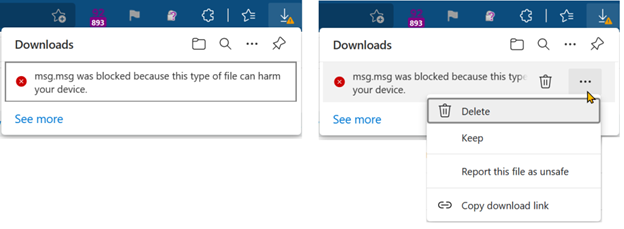
FRST64.exe to FRST64English.exe.Note: If Microsoft Edge or Chrome mislabels the Farbar Scanner executable as PUA/malware, choose to keep it by tapping … in the bottom bar, choosing Keep, and then choosing Keep anyway in the dialog that appears. See this screenshot. It's a safe tool used in most antimalware forums.
Here's a link to the FRST results: https://gofile.io/d/iIggpC
Will prepare a fixlist to cleanup some drivers. Meanwhile, please backup the registry using Acelogix Regbak.
Let me know once it's done.
Please uninstall:
BIG-IP Edge Client Components (All Users) (HKLM-x32\...\F5 Networks Client Components) (Version: 70.2011.0325.1920 - F5 Networks, Inc.)

Npcap (HKLM-x32\...\NpcapInst) (Version: 1.10 - Nmap Project)
I haven't sent you a fixlist yet. Please wait.
Will prepare a fixlist to cleanup some drivers. Meanwhile, please backup the registry using Acelogix Regbak.
Let me know once it's done.