Developer technologies | Transact-SQL
A Microsoft extension to the ANSI SQL language that includes procedural programming, local variables, and various support functions.
This browser is no longer supported.
Upgrade to Microsoft Edge to take advantage of the latest features, security updates, and technical support.
' cx='32' cy='32' r='32' /%3E%3Ctext x='50%25' y='55%25' dominant-baseline='middle' text-anchor='middle' fill='%23FFF' %3EAA%3C/text%3E%3C/svg%3E)
I have 3 tables from which I am building a view.

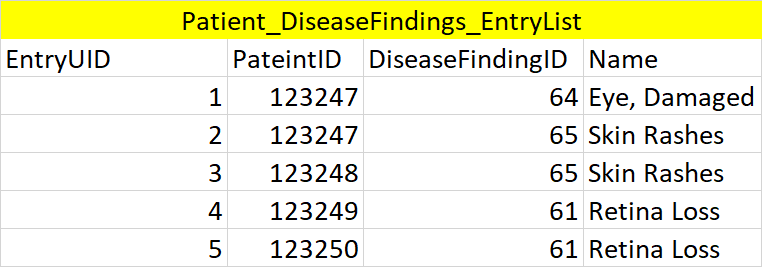
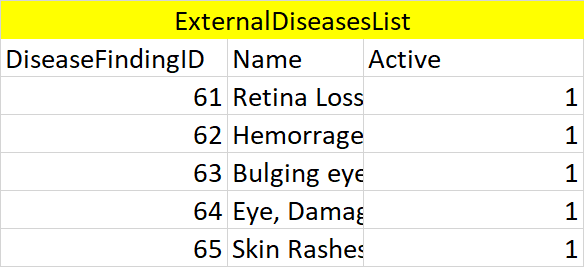
Below is the query to build the Patients Overview view
/****** Script for SelectTopNRows command from SSMS  ******/
SELECT
      PE.[PatientID]
	  ,[Year]
      ,[Season]
      ,[Serial]
	  ,[Age]
      ,[Length]
	  ,PDF.[Name] as [Disease Finding]
      ,[DoctorName]
      ,[Comments_Lab]
      ,[SampleID]
      ,[LabAssistant]
FROM [dbo].[Pantient] PE
   , [dbo].[Patient_DiseaseFindings_EntryList] PDF
   , [dbo].ExternalDiseasesList EDL
WHERE PE.PatientID = PDF.PatientID
   and PDF.DiseaseFindingID = EDL.DiseaseFindingID
Group By
   PE.[PatientID],[Year],[Season],[Serial],[Age],[Length],PDF.[Name],[DoctorName],[Comments_Lab],[SampleID],[LabAssistant]
I get the output but for each disease I get individual line

But I need the output in one line for each patient with each disease as a column from the ExternalDiseasesList. If the patient has that disease then out Yes else No.
So my query must do a pivot view /Transposed. How should I select to make the pivot?

Your guidance will help. Thank you.
NewB

SELECT
       PE.[PatientID]
       ,[Year]
       ,[Season]
       ,[Serial]
       ,[Age]
       ,[Length]
       ,IIF(EXISTS (SELECT *
                    FROM   [dbo].[Patient_DiseaseFindings_EntryList] PDF
                    JOIN   [dbo].ExternalDiseasesList EDL ON PDF.DiseaseFindingID = EDL.DiseaseFindingID
                    WHERE  PE.PatientID = PDF.PatientID
                      AND  PDF = 'Eye, Damaged'), 'Yes', 'No') AS "Eye, Damaged"
       ,IIF(EXISTS (SELECT *
                    FROM   [dbo].[Patient_DiseaseFindings_EntryList] PDF
                    JOIN   [dbo].ExternalDiseasesList EDL ON PDF.DiseaseFindingID = EDL.DiseaseFindingID
                    WHERE  PE.PatientID = PDF.PatientID
                      AND  PDF = 'Skin Rashes'), 'Yes', 'No') AS "Skin Rashes"
        --- Et cetera
       ,[DoctorName]
       ,[Comments_Lab]
       ,[SampleID]
       ,[LabAssistant]
 FROM [dbo].[Pantient] PE
If you tell me that you want the list of diseases to be dynamic, you should give this a second thought of whether you actually want to do this in the data layer. This is often better handled in the presentation layer. To do it dynamically in the data layer, you need dynamic SQL and that raises the stakes considerably.
Thank you for the guidance. Yes, I agree that we can try to make the presentation layer to pivot the table. I will try it. But very helpful.
' cx='32' cy='32' r='32' /%3E%3Ctext x='50%25' y='55%25' dominant-baseline='middle' text-anchor='middle' fill='%23FFF' %3EEM%3C/text%3E%3C/svg%3E)
Please check:
CREATE TABLE Patients(PatientID INT,[Year] INT,Season INT,Serial INT,
Age INT,[Length] decimal(3,2),Doctor varchar(15),
Comments varchar(15),Sampleid INT,Lab varchar(15))
INSERT INTO Patients VALUES(123248,2018,1,1228,3,3.75,'Saas','Test'
,1054,'Kristian'),
(123249,2018,1,1229,4,5,'Aug','Refer',1055,'Kristian'),
(123247,2018,1,1228,3,3.75,'Saas','Test',1054,'Kristian'),
(123247,2018,1,1228,3,3.75,'Saas','Test',1054,'Kristian')

CREATE TABLE Patient_DiseaseFindings_EntryList
(EntryUID INT,PatientID INT,DiSeaid INT,
[Name] varchar(15))
INSERT INTO Patient_DiseaseFindings_EntryList VALUES
(1,123247,64,'Eye,Damaged'),
(2,123247,65,'skin'),
(3,123248,65,'skin'),
(4,123249,61,'Retina'),
(5,123250,61,'Retina')

CREATE TABLE ExternalDiseasesList
(DiSeaid INT,[Name] varchar(15),Active INT)
INSERT INTO ExternalDiseasesList  VALUES
(61,'Retina',1),
(62,'Hemorrage',1),
(63,'Bulging',1),
(64,'Eye,Damaged',1),
(65,'skin',1)

SELECT * FROM Patients
SELECT * FROM Patient_DiseaseFindings_EntryList
SELECT * FROM ExternalDiseasesList

;WITH cte
as(SELECT P.[PatientID],[Year],[Season],[Serial],[Age],[Length]
       ,e.[Name] as [Disease Finding]
FROM ExternalDiseasesList e
LEFT JOIN  [Patient_DiseaseFindings_EntryList] pd
ON  e.DiseaID = pd.DiseaID
LEFT JOIN  Patients p
ON p.PatientID = PD.PatientID
Group By
    p.[PatientID],[Year],[Season],
 [Serial],[Age],[Length],pd.[Name],
 e.[Name])

SELECT [PatientID],[Season],[Serial],[Age],[Length]
,CASE WHEN Retina IS NULL THEN 'No' ELSE 'Yes' END Retina,
CASE WHEN skin IS NULL THEN 'No' ELSE 'Yes' END skin,
CASE WHEN [Eye,Damaged] IS NULL THEN 'No' ELSE 'Yes' END [Eye,Damaged],
CASE WHEN Bulging IS NULL THEN 'No' ELSE 'Yes' END Bulging ,
CASE WHEN Hemorrage IS NULL THEN 'No' ELSE 'Yes' END Hemorrage
FROM (SELECT * FROM cte) c
PIVOT (MAX([Year]) FOR [Disease Finding]
IN(Retina,skin,[Eye,Damaged],Bulging,Hemorrage)) P
WHERE [PatientID] IS NOT NULL
ORDER BY [PatientID] DESC


DROP TABLE Patients
DROP TABLE Patient_DiseaseFindings_EntryList
DROP TABLE ExternalDiseasesList
Output:

If you have any question, please feel free to let me know.
Regards
Echo
If the answer is helpful, please click "Accept Answer" and upvote it.
Thank you for the input. I will try this method in the query.