I have a MFC application, but it is configured to build with the C++ 20 standard. Where useful I try to use the newer constructs.
Today, I decided to try and implement some variadic functions. This is what I have so far:
    void CBaseCsvImporter::LogInfo(const CString& msg)
    {
        m_dlgLog.AddLogEntry(msg, true);
    }

    void CBaseCsvImporter::LogSkip(const CString& msg)
    {
        m_dlgLog.AddLogEntry(msg, true);
        ++m_skippedCount;
    }

    void CBaseCsvImporter::LogError(const CString& msg)
    {
        m_dlgLog.AddLogEntry(msg, true);
        m_dlgLog.SetErrorMode(true);
        ++m_errorCount;
    }

    void CBaseCsvImporter::LogInfo(const wchar_t* fmt, ...)
    {
        CString msg;
        va_list args;
        va_start(args, fmt);
        msg.FormatV(fmt, args);
        va_end(args);

        LogInfo(msg); // calls the existing CString overload
    }

    void CBaseCsvImporter::LogSkip(const wchar_t* fmt, ...)
    {
        CString msg;
        va_list args;
        va_start(args, fmt);
        msg.FormatV(fmt, args);
        va_end(args);

        LogSkip(msg);
    }

    void CBaseCsvImporter::LogError(const wchar_t* fmt, ...)
    {
        CString msg;
        va_list args;
        va_start(args, fmt);
        msg.FormatV(fmt, args);
        va_end(args);

        LogError(msg);
    }
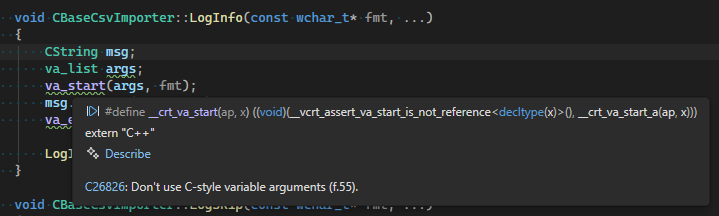
Understandably the Visual Studio IDE started showing code analysis warnings, discouraging me from using this approach:
I decided to ask Copilot / ChatGPT about this and it prosed using these functions in the header instead:
template<typename... Args>
void LogInfo(std::wstring_view fmt, Args&&... args)
{
    std::wstring msg = std::vformat(fmt, std::make_wformat_args(args...));
    LogInfo(CString(msg.c_str()));
}
AI says that I would need to adjust my code to call it like this:
LogSkip(L"Skipped line {}: duplicate publisher '{}'", csvLine, name);
Eventually the error messages will come from the string table as a resource. I would appreciate guidance on the best way forward to make use of the new way of doing the variadic functiosn, but keeping in mind that ultimately I use CString.
' cx='32' cy='32' r='32' /%3E%3Ctext x='50%25' y='55%25' dominant-baseline='middle' text-anchor='middle' fill='%23FFF' %3EC%3C/text%3E%3C/svg%3E)

