Developer technologies | Transact-SQL
A Microsoft extension to the ANSI SQL language that includes procedural programming, local variables, and various support functions.
This browser is no longer supported.
Upgrade to Microsoft Edge to take advantage of the latest features, security updates, and technical support.
' cx='32' cy='32' r='32' /%3E%3Ctext x='50%25' y='55%25' dominant-baseline='middle' text-anchor='middle' fill='%23FFF' %3EZ%3C/text%3E%3C/svg%3E)
Hi,
Could you please help me how to find 8 calendar days in a row(Consecutive date) that have absenceDate(taking into consideration Saturday and Sunday)?
Here is the sample data of large table.
Create table test (Id int,caseid varchar(20),S_AbsenceDate DateTime,E_AbsenceDate DateTime)
Insert into test (caseid,S_AbsenceDate,E_AbsenceDate)
values('F12','2022-03-7','2022-03-8')
,values('F12','2022-03-11','2022-03-11')
,values('F12','2022-03-14','2022-03-14')
,values('F12','2022-03-15','2022-03-15')
,values('F12','2022-03-18','2022-03-18')
,values('F13','2022-03-18','2022-03-21')
,values('F13','2022-03-23','2022-03-23')
,values('F13','2022-03-24','2022-03-25')
,values('F13','2022-03-28','2022-03-31')
,values('F14','2022-03-22','2022-03-22')
,values('F15','2022-03-4','2022-03-4')
,values('F15','2022-03-7','2022-03-7')
,values('F15','2022-03-8','2022-03-8')
,values('F15','2022-03-9','2022-03-9')
,values('F15','2022-03-10','2022-03-10)
,values('F15','2022-03-11','2022-03-11')
,values('F15','2022-03-14','2022-03-14')
,values('F15','2022-03-15','2022-03-15')
,values('F15','2022-03-16','2022-03-16')
Result shoulb be:
Caseid, CNT,S_AbsenceDate,E_AbsenceDate
F13,9,2022-03-23,2022-03-31
F15,10,2022-03-7,2022-3-16
Thank you
A Microsoft extension to the ANSI SQL language that includes procedural programming, local variables, and various support functions.
Answer accepted by question author
' cx='32' cy='32' r='32' /%3E%3Ctext x='50%25' y='55%25' dominant-baseline='middle' text-anchor='middle' fill='%23FFF' %3ELM%3C/text%3E%3C/svg%3E)
Hi @Zaran
Please check this query:
;WITH CTE1 AS
(
 SELECT *,CASE WHEN DATEPART(weekday,E_AbsenceDate) = 6 THEN DATEADD(DAY,2,E_AbsenceDate) ELSE E_AbsenceDate END AS E_AbsenceDate_R
 FROM test
),CTE2 AS
(
 SELECT Id,caseid,S_AbsenceDate,E_AbsenceDate_R ,LEAD(S_AbsenceDate,1,DATEADD(DAY,2,E_AbsenceDate_R))OVER(PARTITION BY caseid ORDER BY S_AbsenceDate) AS LEAD_S_AbsenceDate
 FROM CTE1
),CTE3 AS
(
 SELECT *,CASE WHEN DATEDIFF(DAY,E_AbsenceDate_R,LEAD_S_AbsenceDate)>1 THEN 1 ELSE 0 END AS PART
 FROM CTE2
),CTE4 AS
(
 SELECT Id,caseid,S_AbsenceDate,E_AbsenceDate_R ,SUM(PART)OVER(ORDER BY caseid ASC,S_AbsenceDate DESC) AS PART
 FROM CTE3
)
SELECT caseid,DATEDIFF(DAY,MIN(S_AbsenceDate),MAX(E_AbsenceDate_R))+1 AS CNT,MIN(S_AbsenceDate)AS S_AbsenceDate,MAX(E_AbsenceDate_R)AS E_AbsenceDate
FROM CTE4
GROUP BY caseid,PART
HAVING DATEDIFF(DAY,MIN(S_AbsenceDate),MAX(E_AbsenceDate_R))+1>=8
ORDER BY caseid,S_AbsenceDate
Output:

The final output is somewhat different from your desired result. Considering that March 5th and 6th are weekends, I think the absence date of F15 should be calculated from March 4th.
Best regards,
LiHong
If the answer is the right solution, please click "Accept Answer" and kindly upvote it. If you have extra questions about this answer, please click "Comment".
Note: Please follow the steps in our Documentation to enable e-mail notifications if you want to receive the related email notification for this thread.
Hi LiHong,
The only thing from you query didn't consider is:
If the last day of the E_AbsenceDate is Firday and there is no more date for the caseid, it will calculate weekend while for this situation we don't need to consider the weekend, because there is no more records for it.
Can you please fix it in your code?
Thank you so much.
Hi @Zaran
For example, for caseid F12 ,E_AbsenceDate '2022-03-18' is Friday and it is the last day for caseid F12. When calculating this ,wo don't need to consider weekend, so the consecutive AbsenceDate should be 1day, not 3 days.
If I am right,then check this:
 ;WITH CTE AS
 (
  SELECT *,ROW_NUMBER()OVER(PARTITION BY caseid ORDER BY E_AbsenceDate DESC)AS RNum
  FROM #test
 ),CTE1 AS
 (
  SELECT *,CASE WHEN DATEPART(weekday,E_AbsenceDate) = 6 AND RNum > 1 THEN DATEADD(DAY,2,E_AbsenceDate) ELSE E_AbsenceDate END AS E_AbsenceDate_R
  FROM CTE
 ),CTE2 AS(
  SELECT Id,caseid,S_AbsenceDate,E_AbsenceDate_R ,LEAD(S_AbsenceDate)OVER(PARTITION BY caseid ORDER BY S_AbsenceDate) AS LEAD_S_AbsenceDate
  FROM CTE1
 ),CTE3 AS(
  SELECT *,CASE WHEN DATEDIFF(DAY,E_AbsenceDate_R,LEAD_S_AbsenceDate)=1 THEN 0 ELSE 1 END AS PART
  FROM CTE2
 ),CTE4 AS
 (
  SELECT Id,caseid,S_AbsenceDate,E_AbsenceDate_R ,SUM(PART)OVER(ORDER BY caseid ASC,S_AbsenceDate DESC) AS PART
  FROM CTE3
 )
 SELECT caseid,DATEDIFF(DAY,MIN(S_AbsenceDate),MAX(E_AbsenceDate_R))+1 AS CNT,MIN(S_AbsenceDate)AS S_AbsenceDate,MAX(E_AbsenceDate_R)AS E_AbsenceDate
 FROM CTE4
 GROUP BY caseid,PART
 HAVING DATEDIFF(DAY,MIN(S_AbsenceDate),MAX(E_AbsenceDate_R))+1>=8
 ORDER BY caseid,S_AbsenceDate
Best regards,
LiHong
Thank you, LiHong,
Yes, You are right.
Query doesn't work correctly and gave me wrong result, and also many rows for one Caseid.
I appreciated it if you can review it again.
Hi Lihang,
Thank you very much for your help.
Please consider the values below, and review the code with the values below.
Create table test (Id int identity(1,1)
,caseid varchar(20)
,S_AbsenceDate DateTime
,E_AbsenceDate DateTime)
Insert into test (caseid,S_AbsenceDate,E_AbsenceDate)
values ('F12','2022-03-7','2022-03-8')
, ('F12','2022-03-11','2022-03-11')
, ('F12','2022-03-14','2022-03-14')
, ('F12','2022-03-15','2022-03-15')
, ('F12','2022-03-18','2022-03-18')
, ('F13','2022-03-18','2022-03-21')
, ('F13','2022-03-23','2022-03-23')
, ('F13','2022-03-24','2022-03-25')
, ('F13','2022-03-28','2022-03-31')
, ('F13','2022-04-01','2022-04-1')
, ('F14','2022-03-22','2022-03-22')
, ('F15','2022-03-4','2022-03-4')
, ('F15','2022-03-7','2022-03-7')
, ('F15','2022-03-8','2022-03-8')
, ('F15','2022-03-9','2022-03-9')
, ('F15','2022-03-10','2022-03-10')
, ('F15','2022-03-11','2022-03-11')
, ('F15','2022-03-14','2022-03-14')
, ('F15','2022-03-15','2022-03-15')
, ('F15','2022-03-16','2022-03-16')
, ('F15','2022-03-16','2022-03-17')
, ('F15','2022-03-16','2022-03-18')
, ('F15','2022-03-16','2022-03-19')
I have added records for the F13 and F15. I have checked your code with the above values and the result is not correct for the F15. the result form your codes is :
caseid CNT S_AbsenceDate E_AbsenceDate
F13 10 2022-03-23 00:00:00.000 2022-04-01 00:00:00.000
F15 17 2022-03-04 00:00:00.000 2022-03-20 00:00:00.000
and the correct result should be:
caseid CNT S_AbsenceDate E_AbsenceDate
F13 10 2022-03-23 00:00:00.000 2022-04-01 00:00:00.000
F15 17 2022-03-04 00:00:00.000 2022-03-19 00:00:00.000
Hi Zaran
Please check this:
;WITH CTE AS
(
 SELECT *,ROW_NUMBER()OVER(PARTITION BY caseid ORDER BY E_AbsenceDate DESC)AS RNum
 FROM test
),CTE1 AS
(
 SELECT *,CASE WHEN DATEPART(weekday,E_AbsenceDate) IN(6,7) AND RNum > 1 THEN DATEADD(DAY,2,E_AbsenceDate) ELSE E_AbsenceDate END AS E_AbsenceDate_R
 FROM CTE
),CTE2 AS
(
 SELECT Id,caseid,S_AbsenceDate,E_AbsenceDate,E_AbsenceDate_R ,LEAD(S_AbsenceDate,1,DATEADD(DAY,2,E_AbsenceDate_R))OVER(PARTITION BY caseid ORDER BY S_AbsenceDate,E_AbsenceDate_R) AS LEAD_S_AbsenceDate
 FROM CTE1
),CTE3 AS
(
 SELECT *,CASE WHEN DATEDIFF(DAY,E_AbsenceDate_R,LEAD_S_AbsenceDate)> 1 THEN 1 ELSE 0 END AS PART
 FROM CTE2
),CTE4 AS
(
 SELECT Id,caseid,S_AbsenceDate,E_AbsenceDate,E_AbsenceDate_R ,SUM(PART)OVER(ORDER BY caseid ASC,S_AbsenceDate DESC) AS PART
 FROM CTE3
)
SELECT caseid,DATEDIFF(DAY,MIN(S_AbsenceDate),MAX(E_AbsenceDate_R))+1 AS CNT,MIN(S_AbsenceDate)AS S_AbsenceDate,MAX(E_AbsenceDate)AS E_AbsenceDate
FROM CTE4
GROUP BY caseid,PART
HAVING DATEDIFF(DAY,MIN(S_AbsenceDate),MAX(E_AbsenceDate_R))+1>=8
ORDER BY caseid,S_AbsenceDate
Best regards,
LiHong
Thank you LiHong,
The result shows wrong result:
caseid CNT S_AbsenceDate E_AbsenceDate
F12 12 2022-03-07 00:00:00.000 2022-03-18 00:00:00.000
F13 15 2022-03-18 00:00:00.000 2022-04-01 00:00:00.000
F13 9 2022-03-23 00:00:00.000 2022-03-31 00:00:00.000
F15 16 2022-03-04 00:00:00.000 2022-03-19 00:00:00.000
and correct result should be:
caseid CNT S_AbsenceDate E_AbsenceDate
F13 10 2022-03-23 00:00:00.000 2022-04-01 00:00:00.000
F15 16 2022-03-04 00:00:00.000 2022-03-18 00:00:00.000:
How about this:
 ;WITH CTE AS
 (
  SELECT *,ROW_NUMBER()OVER(PARTITION BY caseid ORDER BY E_AbsenceDate DESC)AS RNum
  FROM test
 ),CTE1 AS
 (
  SELECT *,CASE WHEN DATEPART(weekday,E_AbsenceDate) = 6 AND RNum > 1 THEN DATEADD(DAY,2,E_AbsenceDate) ELSE E_AbsenceDate END AS E_AbsenceDate_R
  FROM CTE
 ),CTE2 AS(
  SELECT Id,caseid,S_AbsenceDate,E_AbsenceDate_R ,LEAD(S_AbsenceDate,1,DATEADD(DAY,2,E_AbsenceDate_R))OVER(PARTITION BY caseid ORDER BY S_AbsenceDate) AS LEAD_S_AbsenceDate
  FROM CTE1
 ),CTE3 AS(
  SELECT *,CASE WHEN DATEDIFF(DAY,E_AbsenceDate_R,LEAD_S_AbsenceDate)> 1 THEN 1 ELSE 0 END AS PART
  FROM CTE2
 ),CTE4 AS
 (
  SELECT Id,caseid,S_AbsenceDate,E_AbsenceDate_R ,SUM(PART)OVER(ORDER BY caseid ASC,S_AbsenceDate DESC) AS PART
  FROM CTE3
 )
 SELECT caseid,DATEDIFF(DAY,MIN(S_AbsenceDate),MAX(E_AbsenceDate_R))+1 AS CNT,MIN(S_AbsenceDate)AS S_AbsenceDate,MAX(E_AbsenceDate_R)AS E_AbsenceDate
 FROM CTE4
 GROUP BY caseid,PART
 HAVING DATEDIFF(DAY,MIN(S_AbsenceDate),MAX(E_AbsenceDate_R))+1>=8
 ORDER BY caseid,S_AbsenceDate
I test this code using the sample datas you gave,and it runs well. If it didn't work ,then you need to update your sample datas so that we can provide a tested, verifiable solution to your issue.
Best regards,
LiHong
Hi LiHang,
I couldn't put my comments here, so I had to put my comments as of Answer box.
Please check it
Thank you so much
Hi Lihang,
Thank you very much for your help.
I have added records for the F13 and F15. and run your query, the result is not correct for the F15.
, ('F13','2022-04-01','2022-04-1')
, ('F15','2022-03-16','2022-03-17')
, ('F15','2022-03-18','2022-03-18')
, ('F15','2022-03-19','2022-03-19')
the result form your codes is :
caseid CNT S_AbsenceDate E_AbsenceDate
F13 10 2022-03-23 00:00:00.000 2022-04-01 00:00:00.000
F15 17 2022-03-04 00:00:00.000 2022-03-20 00:00:00.000
and the correct result should be:
caseid CNT S_AbsenceDate E_AbsenceDate
F13 10 2022-03-23 00:00:00.000 2022-04-01 00:00:00.000
F15 17 2022-03-04 00:00:00.000 2022-03-19 00:00:00.000
Hi Lihang,
Thank you very much for your help.
I have added records for the F13 and F15. and run your query, the result is not correct for the F15.
, ('F13','2022-04-01','2022-04-1')
, ('F15','2022-03-16','2022-03-17')
, ('F15','2022-03-18','2022-03-18')
, ('F15','2022-03-19','2022-03-19')
the result form your codes is :
caseid CNT S_AbsenceDate E_AbsenceDate
F13 10 2022-03-23 00:00:00.000 2022-04-01 00:00:00.000
F15 17 2022-03-04 00:00:00.000 2022-03-20 00:00:00.000
and the correct result should be:
caseid CNT S_AbsenceDate E_AbsenceDate
F13 10 2022-03-23 00:00:00.000 2022-04-01 00:00:00.000
F15 17 2022-03-04 00:00:00.000 2022-03-19 00:00:00.000
' cx='32' cy='32' r='32' /%3E%3Ctext x='50%25' y='55%25' dominant-baseline='middle' text-anchor='middle' fill='%23FFF' %3EI1%3C/text%3E%3C/svg%3E)
Hi @Zaran
I did a local test , my out put is a little different from yours.I wonder if your desire output is right ,because
'F15','2022-03-4','2022-03-4')
,('F15','2022-03-7','2022-03-7')
the two dates are consecutive,isn't it ?
Below is my test code:
CREATE TABLE TABLETEMP
 (Id int,caseid varchar(20),S_AbsenceDate DateTime,E_AbsenceDate DateTime)


declare @STOcaseid varchar(20)='F12'
declare @STOSTARTDATE DateTime='2022-03-7'
declare @STOENDDATE DateTime ='2022-03-8'
declare @caseid varchar(20)
declare @STARTDATE DateTime
declare @ENDDATE DateTime
declare @currentrow int = 0
DECLARE DB_CURSOR CURSOR FOR
SELECT caseid,S_AbsenceDate,E_AbsenceDate FROM test

OPEN DB_CURSOR
FETCH NEXT FROM DB_CURSOR INTO @caseid,@STARTDATE,@ENDDATE
 set @currentrow =@currentrow+1
FETCH NEXT FROM DB_CURSOR INTO @caseid,@STARTDATE,@ENDDATE
 set @currentrow =@currentrow+1
PRINT @STARTDATE
WHILE @@FETCH_STATUS = 0
BEGIN
   set @currentrow =@currentrow+1

   IF (@STOcaseid = @caseid)
   BEGIN
      DECLARE @diffdays INT  = (SELECT DATEDIFF(DAY,@STOENDDATE,@STARTDATE))

   declare @lagweekday int = (select DATEPART(WEEKDAY,@STOENDDATE))
   declare @currentweekday int = (select DATEPART(WEEKDAY,@STARTDATE))
   print @currentrow
   print @diffdays
   print @lagweekday
   print @currentweekday

      IF (@diffdays =0 OR @diffdays = 1 OR (@lagweekday = 6 AND @currentweekday = 2))
   BEGIN
       print 'COMBINE'
       set @STOENDDATE = @ENDDATE

   END
   ELSE
   BEGIN
     print 'APART DATE INSERT'
     INSERT INTO TABLETEMP(Id, caseid,S_AbsenceDate,E_AbsenceDate)
        VALUES(1,@STOcaseid,@STOSTARTDATE,@STOENDDATE)
   set @STOcaseid = @caseid
   set @STOSTARTDATE = @STARTDATE
      set @STOENDDATE = @ENDDATE
   END
   END
   ELSE
   BEGIN
     print 'APART CASE INSERT'
    INSERT INTO TABLETEMP(Id, caseid,S_AbsenceDate,E_AbsenceDate)
        VALUES(1,@STOcaseid,@STOSTARTDATE,@STOENDDATE)
      set @STOcaseid = @caseid
   set @STOSTARTDATE = @STARTDATE
      set @STOENDDATE = @ENDDATE
   END

   FETCH NEXT FROM DB_CURSOR INTO @caseid,@STARTDATE,@ENDDATE
END
print 'LAST ROW INSERT'
 INSERT INTO TABLETEMP(Id, caseid,S_AbsenceDate,E_AbsenceDate)
        VALUES(1,@STOcaseid,@STOSTARTDATE,@STOENDDATE)
CLOSE DB_CURSOR
DEALLOCATE DB_CURSOR
Result preview:
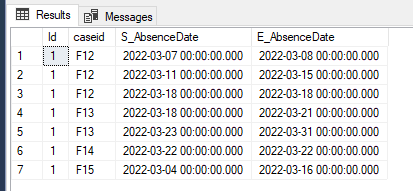
WITH CTE AS(SELECT *,CONSECUTIVEDAYS = DATEDIFF(DAY,S_AbsenceDate,E_AbsenceDate) FROM TABLETEMP)
SELECT * FROM CTE WHERE CONSECUTIVEDAYS >=8
Result preview:

Best Regards,
Isabella
Hi Isabella,
I didn't check your query, I see the result is not correct.
Thank you to participate.
' cx='32' cy='32' r='32' /%3E%3Ctext x='50%25' y='55%25' dominant-baseline='middle' text-anchor='middle' fill='%23FFF' %3EJL%3C/text%3E%3C/svg%3E)
Create table test (Id int identity(1,1)
,caseid varchar(20)
,S_AbsenceDate DateTime
,E_AbsenceDate DateTime)
Insert into test (caseid,S_AbsenceDate,E_AbsenceDate)
values ('F12','2022-03-7','2022-03-8')
, ('F12','2022-03-11','2022-03-11')
, ('F12','2022-03-14','2022-03-14')
, ('F12','2022-03-15','2022-03-15')
, ('F12','2022-03-18','2022-03-18')
, ('F13','2022-03-18','2022-03-21')
, ('F13','2022-03-23','2022-03-23')
, ('F13','2022-03-24','2022-03-25')
, ('F13','2022-03-28','2022-03-31')
, ('F14','2022-03-22','2022-03-22')
, ('F15','2022-03-4','2022-03-4')
, ('F15','2022-03-7','2022-03-7')
, ('F15','2022-03-8','2022-03-8')
, ('F15','2022-03-9','2022-03-9')
, ('F15','2022-03-10','2022-03-10')
, ('F15','2022-03-11','2022-03-11')
, ('F15','2022-03-14','2022-03-14')
, ('F15','2022-03-15','2022-03-15')
, ('F15','2022-03-16','2022-03-16')
declare @minDate date=(select min(S_AbsenceDate) from test)
declare @maxDate date=(select max(E_AbsenceDate) from test)
--===== Create number table on-the-fly
;WITH Num1 (n) AS (
SELECT 1 as n
Union all
Select n+1 as n
FROM Num1 Where n<101),
Num2 (n) AS (SELECT 1 FROM Num1 AS X, Num1 AS Y),
Nums (n) AS (SELECT ROW_NUMBER() OVER(ORDER BY n) FROM Num2)
,myDateCTE as
(
Select dateadd(day,n-1, @minDate ) dt from Nums
Where dateadd(day,n-1, @minDate )<= @maxDate
)
, mycte as (
select dt, caseid, row_number() Over(Partition by caseid order by dt) rn1 from
(select distinct caseid from test) t1, myDateCTE
)
,mycte1 as (
SELECT caseid, dt, rn1, row_number() Over(Partition by caseid order by dt) rn2
FROM mycte t1
WHERE EXISTS
(SELECT * FROM test t2
WHERE (t1.dt BETWEEN t2.S_AbsenceDate AND t2.E_AbsenceDate and t1.caseid=t2.caseid)
or (datepart(weekday,t1.dt) in (1,7))) )
Select caseid, 1+datediff(day,Min(m.dt),Max(m.dt)) as CNT, Min(m.dt) As S_AbsenceDate, Max(m.dt) As E_AbsenceDate
From mycte1 m
Group By caseid, m.rn1 - m.rn2
having(datediff(day,Min(m.dt),Max(m.dt))>7)
Order by caseid
drop table test
/*
caseid CNT S_AbsenceDate E_AbsenceDate
F13 9 2022-03-23 2022-03-31
F15 13 2022-03-04 2022-03-16
*/
Hi Jing,
I didn't check your query, i will chek and let you know.
Thank you to participate.