Developer technologies | Transact-SQL
A Microsoft extension to the ANSI SQL language that includes procedural programming, local variables, and various support functions.
This browser is no longer supported.
Upgrade to Microsoft Edge to take advantage of the latest features, security updates, and technical support.
' cx='32' cy='32' r='32' /%3E%3Ctext x='50%25' y='55%25' dominant-baseline='middle' text-anchor='middle' fill='%23FFF' %3ES%3C/text%3E%3C/svg%3E)
Hi,
We get a data from vendor and import into our tables. We get one transaction at a time. In banking world like transfer of money from one account to another. So, there is withdrawal transaction and deposit transaction. They come one at a time. Either withdraw can come first or deposit can come first. Both legs will have common id and specific type like 'CheckingAccount'
My requirement is
How can I write select query to get withdraw
DECLARE @tmpTbl table
(
ID int,
CommonID int,
Type varchar(100),
AccountType varchar(100),
Amount decimal(10,2),
ClientID int,
AccountID int
)
CREATE TABLE TRANS
(
    ID int,
   CommonID int,
   Type varchar(100),
   AccountType varchar(100),
   Amount decimal(10,2),
   ClientID int,
   AccountID int
)
Insert into @tmpTbl
SELECT 1, 1234, 'Deposit', 'Checking Account', 100.00, 2, 50
select * from @tmpTbl
Insert into Trans Select * from @tmpTbl
select * from Trans
/*Part 2 - 2nd transaction comes in
DELETE * FROM @tmpTbl
Insert into @tmpTbl
SELECT 2, 1234, 'Withdraw', 'Checking Account', 100.00, 2, 50
I need to select data where the withdraw transaction is . It can be in tmp table or permanent table
*/
Thank You
A Microsoft extension to the ANSI SQL language that includes procedural programming, local variables, and various support functions.
' cx='32' cy='32' r='32' /%3E%3Ctext x='50%25' y='55%25' dominant-baseline='middle' text-anchor='middle' fill='%23FFF' %3EG%3C/text%3E%3C/svg%3E)
Does only the column Type has the different values (Withdraw or Deposit) between both rows? Or the other columns may have the different values as well?
' cx='32' cy='32' r='32' /%3E%3Ctext x='50%25' y='55%25' dominant-baseline='middle' text-anchor='middle' fill='%23FFF' %3EEM%3C/text%3E%3C/svg%3E)
Do you have any updates?
Please remember to accept the answers if they helped. Your action would be helpful to other users who encounter the same issue and read this thread.
Thank you for understanding!
Echo
Do you have any updates?
Please remember to accept the answers if they helped. Your action would be helpful to other users who encounter the same issue and read this thread.
Thank you for understanding!
Echo
Hi @Spunny ,
I don't quite understand what your problem is. When the second transaction comes in, you will delete all the data in the @tmpTbl table, and all the records in the TRANS table will be saved, so you only need to return the withdraw transaction data from the TRANS table.
Of course, as you said, you are not sure which table the data is in, you can find it according to the following code:
DECLARE @tmpTbl table
 (
 ID int,
 CommonID int,
 Type varchar(100),
 AccountType varchar(100),
 Amount decimal(10,2),
 ClientID int,
 AccountID int
 )
 Insert into @tmpTbl
 SELECT 1, 1234, 'Deposit', 'Checking Account', 100.00, 2, 50

 select * from @tmpTbl

 Insert into Trans Select * from @tmpTbl

 select * from Trans

 select * from @tmpTbl where Type='Withdraw'
 union all
 select * from TRANS where Type='Withdraw'

 DELETE  FROM @tmpTbl

 Insert into @tmpTbl
 SELECT 2, 1234, 'Withdraw', 'Checking Account', 100.00, 2, 50

 select * from @tmpTbl

 select * from @tmpTbl where Type='Withdraw'
 union all
 select * from TRANS where Type='Withdraw'
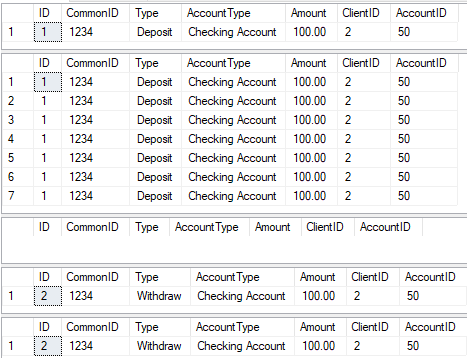
The union all statement in the above code can return all Withdraw data in the two tables:
   select * from @tmpTbl where Type='Withdraw'
    union all
    select * from TRANS where Type='Withdraw'
If you have any question, please feel free to let me know.
If the response is helpful, please click "Accept Answer" and upvote it.
Best Regards
Echo
If the answer is helpful, please click "Accept Answer" and upvote it.
Note: Please follow the steps in our documentation to enable e-mail notifications if you want to receive the related email notification for this thread.
The picture is the result of executing five select statements in the code.
In addition, if the same Withdraw rows exist in the two tables, but you don't want to return all the same rows, then you only need to replace union all with union. The union keyword implies distinct, which can filter out duplicate rows.
Echo
If only the column Type has the different values between both rows in Trans or @tmpTbl, try this:
SELECT
    tr.ID,
    tr.CommonID,
    IIF (tr.Type = 'Withdraw', tr.Type, tt.Type) AS Type,
    tr.AccountType,
    tr.Amount,
    tr.ClientID,
    tr.AccountID
FROM TRANS AS tr
INNER JOIN @tmpTbl AS tt
ON tr.CommonID = tt.CommonID AND (tr.Type = 'Withdraw' OR tt.Type = 'Withdraw');
GO
If other columns may have the different values between two rows, you need to use IIF on all columns.