Note
Access to this page requires authorization. You can try signing in or changing directories.
Access to this page requires authorization. You can try changing directories.
Azure Event Hubs Dedicated tier is a single-tenant solution designed to meet the needs of enterprise-scale, mission-critical event streaming workloads. This article provides an overview of the Dedicated tier, highlighting its key features, benefits, and use cases, showing how it supports high-performance, low-latency applications using Event Hubs SDK or Apache Kafka APIs.
Benefits of dedicated clusters
The Dedicated tier of Event Hubs offers several benefits to customers who need to run mission-critical workloads at enterprise-level capacity.
Low-latency event streaming
These clusters are optimized for low end-to-end latency and high performance. These clusters enable businesses to handle high-velocity and high-volume data streaming.
Stream large volumes of data
Dedicated clusters can stream events at the scale of gigabytes per second or millions of events per second for most of the use cases. You can also scale these clusters to accommodate changes in event streaming volume.
Guaranteed consistent performance
Event Hubs dedicated clusters minimize the latency jitter and ensure consistent performance with guaranteed capacity.
Zero interference
Event Hubs dedicated clusters operate on a single-tenant architecture. This architecture ensures that the allocated resources aren't being shared with any other tenants. Unlike with other tiers, you don't see any cross-tenant interference in a dedicated cluster.
Self-serve scaling
The dedicated cluster offers self-serve scaling capabilities that allow you to adjust the capacity of the cluster according to dynamic loads and to facilitate business operations. You can scale out during spikes in usage and scale in when the usage is low.
High-end features and generous quotas
Dedicated clusters include all features of the Premium tier and more. The service also manages load balancing, operating system updates, security patches, and partitioning. You can spend less time on infrastructure maintenance and more time on building your event streaming applications.
Supports streaming large messages
In most streaming scenarios, data is lightweight, typically less than 1 MB, and requires high throughput. There are instances where messages can't be divided into smaller segments. Self-serve dedicated clusters can accommodate events up to 20 MB of size at no extra cost. This capability allows Event Hubs to handle a wide range of message sizes to ensure uninterrupted business operations. For more information, see Send and receive large messages with Azure Event Hubs.
Capacity units
Dedicated clusters are provisioned and billed by capacity units (CUs), which is a preallocated amount of CPU and memory resources.
How much you can ingest and stream per CU depends on factors such as the:
- Number of producers and consumers.
- Number of partitions.
- Producer and consumer configuration.
- Payload size.
- Egress rate.
To determine the necessary number of CUs, you should carry out your anticipated event streaming workload on an Event Hubs dedicated cluster while you observe the cluster's resource utilization. For more information, see When should I scale my dedicated cluster.
Cluster provisioning and scaling
When you create a dedicated cluster through the Azure portal or Azure Resource Manager templates (ARM templates), you get a self-serve scalable cluster that you can scale the number of CUs allocated to the cluster. To learn how to scale your dedicated cluster, see Scale a dedicated cluster.
Approximately one CU provides ingress capacity ranging from 100 MB/sec to 200 MB/sec, although actual throughput might fluctuate depending on various factors.
You can purchase up to 10 CUs for a cluster in the Azure portal. You can scale clusters incrementally with CUs ranging from 1 to 10. If you need a cluster larger than 10 CUs, you can submit a support request to scale up your cluster after its creation.
Important
To enable availability zones on an Event Hubs dedicated cluster, you must provision the cluster with three or more CUs. Availability zone support is only available in Azure regions with availability zones. You can't currently create zone-redundant dedicated clusters through the Azure portal or ARM templates, so submit a support request to create one.
Quotas and limits
The Event Hubs Dedicated offering is billed at a fixed monthly price with a minimum of four hours of usage. The Dedicated tier offers all the features of the Premium plan, but with enterprise-scale capacity and limits for customers with demanding workloads.
For more information about quotas and limits, see Event Hubs quotas and limits.
FAQs
Can I scale up or scale down my cluster?
Use the self-serve experience to scale out and scale in your dedicated cluster, as needed. You can scale up to 10 CUs. The performance of dedicated clusters depends on factors such as resource allocation, number of partitions, and storage. Test with a real workload to determine the required number of CUs.
If you need more than 10 CUs for your dedicated cluster, submit a support request to scale out your cluster.
Warning
You won't be able to delete the cluster for at least four hours after you create it. You're charged for a minimum of four hours of usage of the cluster. For more information on pricing, see Event Hubs pricing.
When should I scale my dedicated cluster?
CPU consumption is the key indicator of the resource consumption of your dedicated cluster. When the overall CPU consumption begins to reach 70% (without observing any abnormal conditions, such as a high number of server errors or a low number of successful requests), that means your cluster is moving toward its maximum capacity. You can use this information as an indicator to consider whether you need to scale up your dedicated cluster or not.
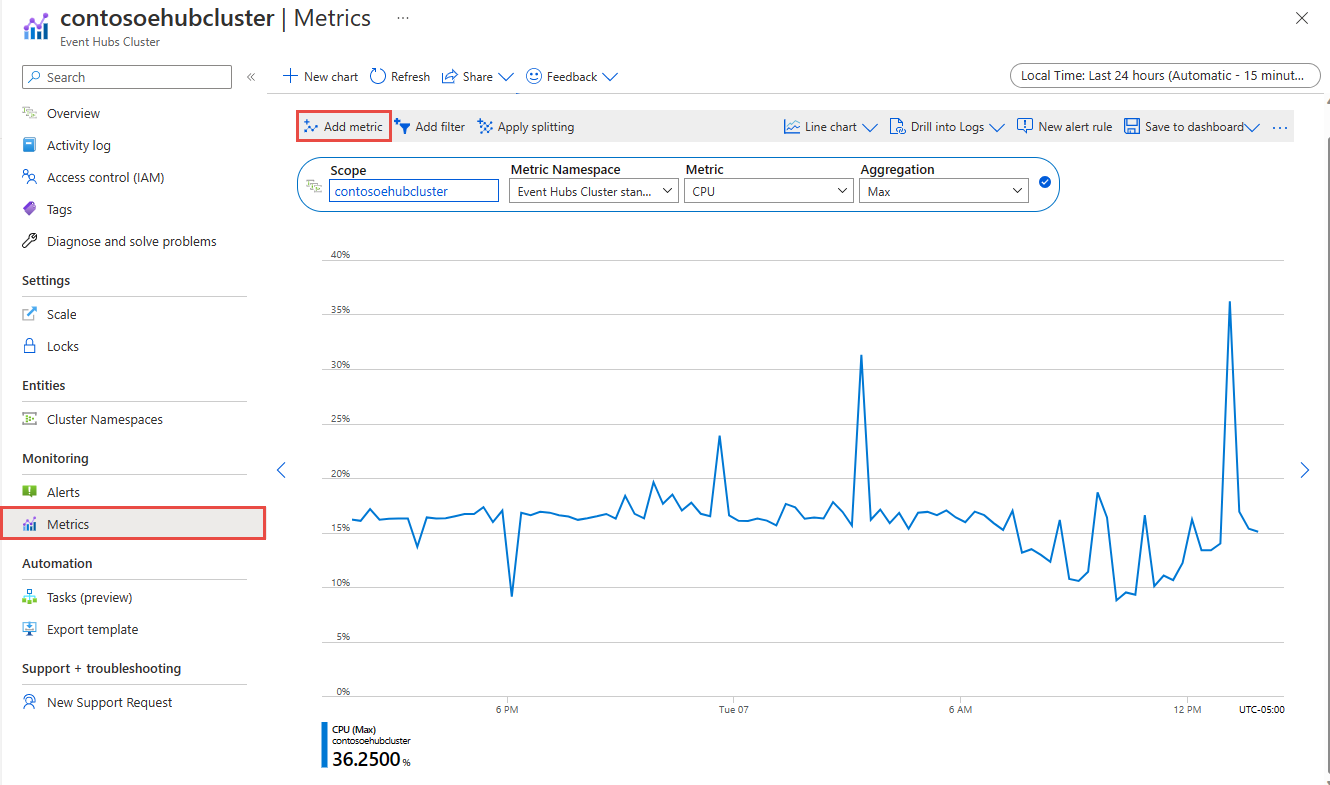
To monitor the CPU usage of the dedicated cluster, follow these steps:
On the Metrics page of your Event Hubs dedicated cluster, select Add metric.
Select CPU as the metric and use Max as the aggregation.
Select Add filter and add a filter for the Property type Role. Use the equal operator and select all the values (Backend and Gateway) from the dropdown list.
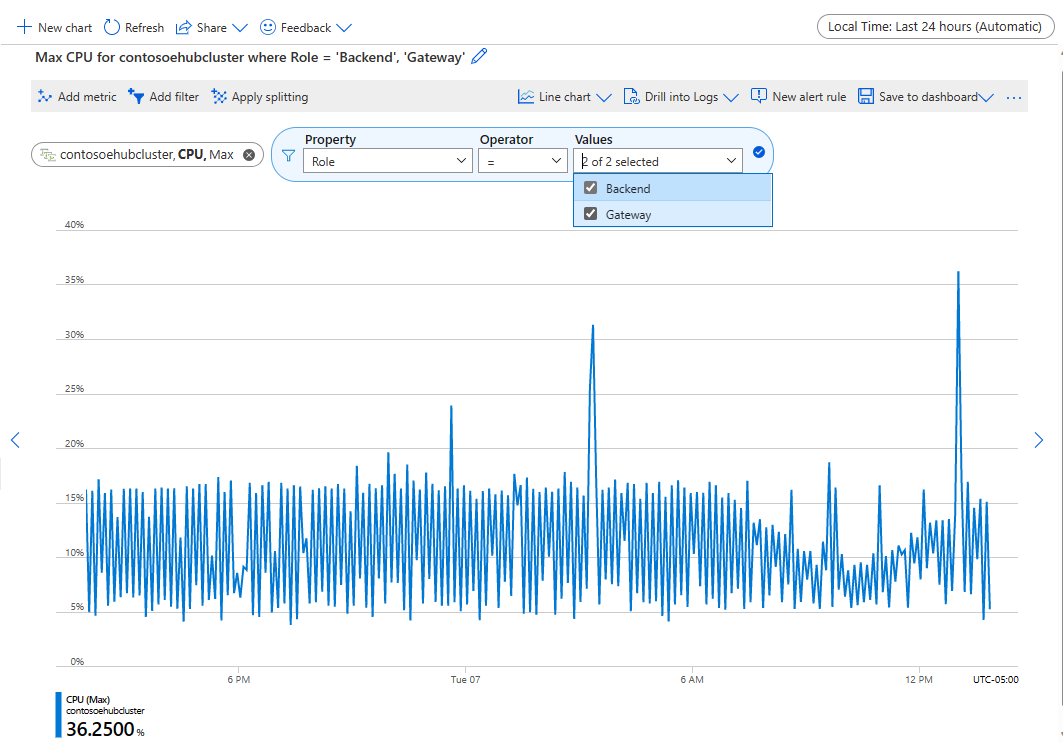
Then you can monitor this metric to determine when you should scale your dedicated cluster. You can also set up alerts against this metric to get notified when CPU usage reaches the thresholds you set.
How does geo-disaster recovery work with my cluster?
You can geo-pair a namespace under a Dedicated-tier cluster with another namespace under a Dedicated-tier cluster. We don't encourage pairing a Dedicated-tier namespace with a namespace in the Standard offering because the throughput limit is incompatible and results in errors.
Can I migrate my Standard or Premium namespaces to a Dedicated-tier cluster?
We don't currently support an automated migration process for migrating your Event Hubs data from a Standard or Premium namespace to a dedicated one.
How do I create a zone-redundant dedicated cluster?
To provide zone redundancy for the Dedicated offering, all compute resources must have replicas across three datacenters in the same region.
You can't currently create zone-redundant dedicated clusters through the Azure portal or ARM templates. Submit a support request to create one. Once a zone-redundant cluster is created, you can't scale it below 3 CUs.
Related content
Explore more about Event Hubs Dedicated:
- Create an Event Hubs cluster through the Azure portal.
- Event Hubs Dedicated pricing: Learn about pricing tiers and capacity options.
- Event Hubs FAQ: Find answers to frequently asked questions about Event Hubs.