Note
Access to this page requires authorization. You can try signing in or changing directories.
Access to this page requires authorization. You can try changing directories.
Azure Cosmos DB
Azure SQL Database
Azure API Management
Solution ideas
This article describes a solution idea. Your cloud architect can use this guidance to help visualize the major components for a typical implementation of this architecture. Use this article as a starting point to design a well-architected solution that aligns with your workload's specific requirements.
Applications often handle diverse data workloads that have different characteristics. Structured, transactional data requires relational integrity and complex queries. Semistructured, rapidly changing, or high-volume data requires flexible schemas and horizontal scalability. Databases like Azure SQL Database and Azure Cosmos DB can support diverse workloads and multimodel requirements. However, in specific scenarios, organizations can achieve better outcomes by pairing SQL Database and Azure Cosmos DB in a polyglot persistence architecture.
Some workloads need the strict transactional guarantees and complex relational queries of a relational database, while other workloads need the flexible schemas and horizontal scalability of a NoSQL database. A polyglot approach assigns each workload to the platform designed for its dominant access pattern, rather than forcing a single platform to handle requirements it isn't optimized for. For more information, see Data considerations for microservices.
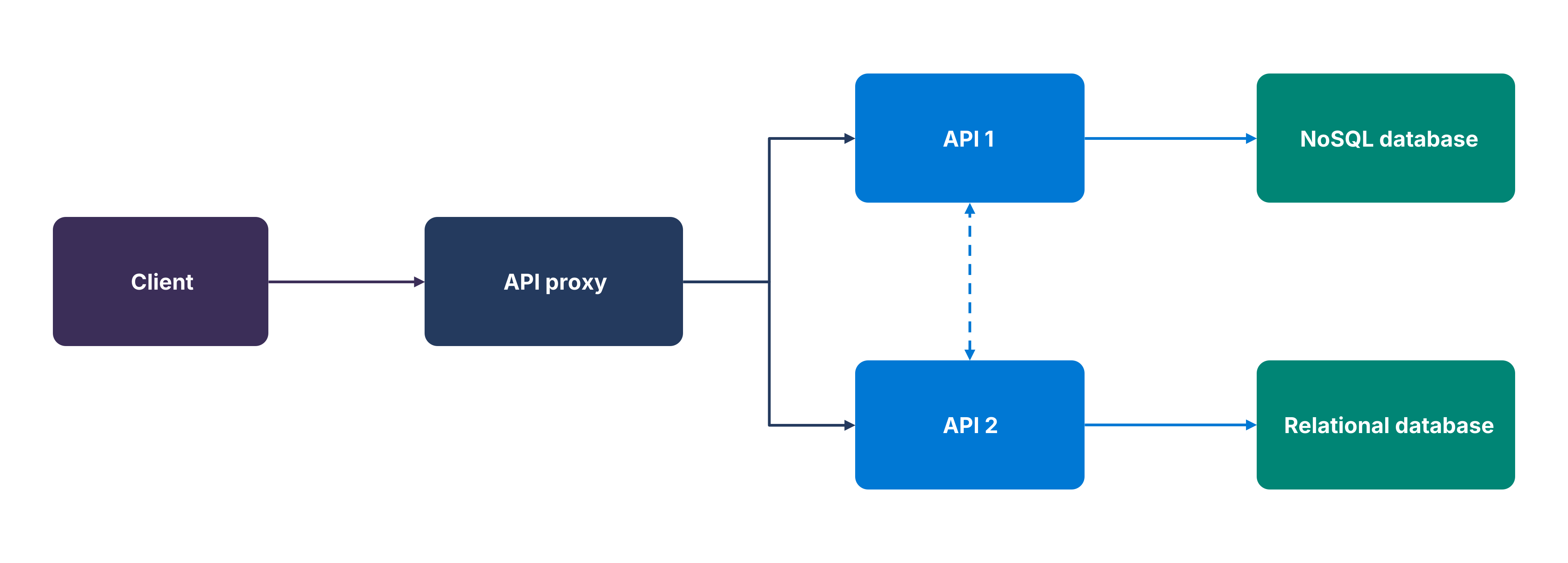
This article describes a polyglot persistence approach that pairs SQL Database with Azure Cosmos DB so that you can configure each workload to use the database that best suits its requirements:
SQL Database manages data that benefits from complex queries, relational integrity, and atomicity, consistency, isolation, and durability (ACID) transactions. SQL Database also supports multimodel capabilities like JSON, graph, spatial, and vector data, along with analytical workloads through columnstore indexes. Financial transaction records are well-suited to this database because they require consistent multiple-table transactions that span line items, inventory, and accounts.
Azure Cosmos DB handles high-volume, schema-flexible, or globally distributed data that requires low-latency access and elastic scalability. E-commerce catalogs are well-suited to this database because their schemas evolve frequently and shoppers expect submillisecond reads regardless of region.
With a domain-driven microservices approach, each service uses the database that fits its data characteristics. Each microservice owns its private data store. This design prevents unintentional coupling between services and supports independent updates and deployments without coordinating changes across the system.
Architecture
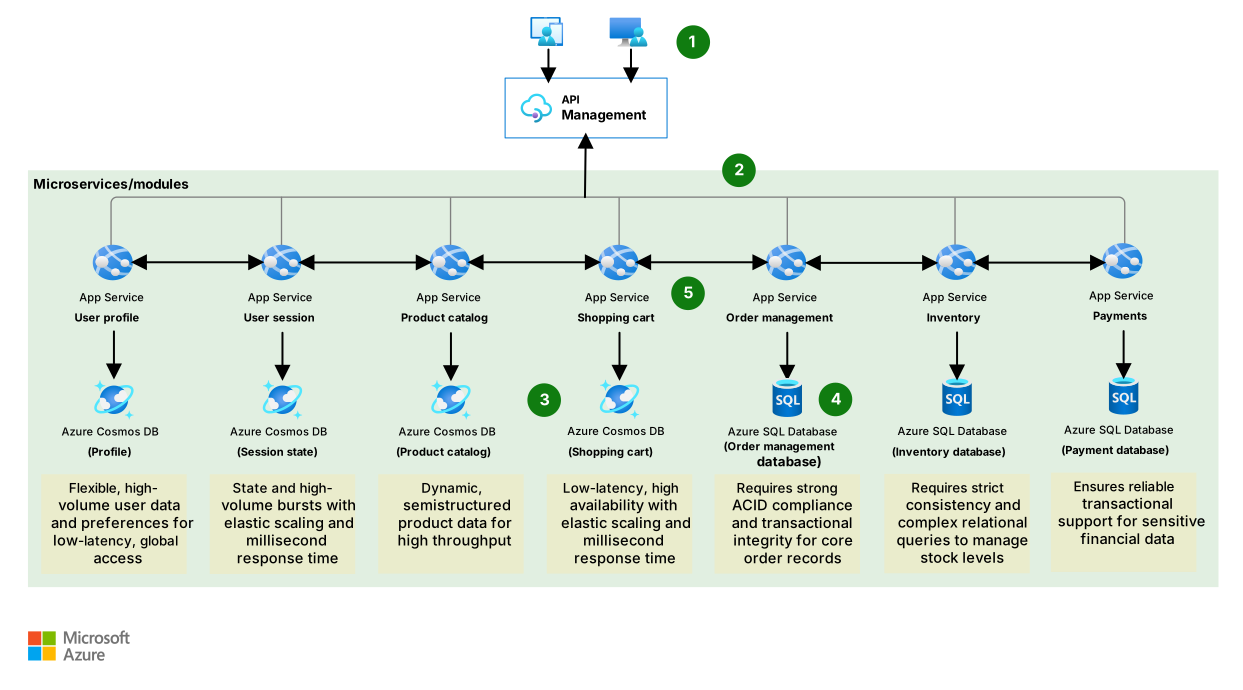
Download a Visio file of this architecture.
Data flow
The following data flow corresponds to the previous diagram:
Users and client applications connect to the system through Azure API Management, which provides a unified gateway for all back-end microservices.
API Management routes requests to the appropriate domain-driven microservices. Each microservice owns its data store independently.
Microservices that handle flexible-schema, high-volume, or globally distributed workloads, like user profiles, session state, product catalogs, and shopping carts, use Azure Cosmos DB. Azure Cosmos DB stores this data as JSON documents, provides single-digit millisecond response times, and scales horizontally.
Microservices that handle structured, transactional workloads, like order management, inventory, and payments, use SQL Database. SQL Database provides full ACID compliance, complex query support, and relational integrity for these operations.
Some microservices communicate with each other to fulfill cross-domain data requirements. For example, the shopping cart service queries the user session service for session context, and both the inventory and order management services interact with the product catalog service for product information. These calls between microservices use service APIs rather than directly accessing another service's database, which preserves data ownership boundaries.
Components
API Management is a management platform and gateway for APIs that routes client requests to APIs, applies rate limits and caches responses, and handles authentication. In this architecture, it provides a unified entry point that routes client requests to the appropriate domain microservices.
Azure Cosmos DB is a globally distributed, multimodel database that enables applications to elastically and independently scale throughput and storage. In this architecture, it stores data for workloads that require flexible schemas, low-latency access, horizontal scalability, or global distribution. Examples include user profiles, session state, product catalogs, and shopping carts.
SQL Database is a fully managed, cloud-first relational database engine that typically includes capabilities before they're available in the latest public version of SQL Server. Beyond relational data, it supports multimodel workloads, including JSON, graph, spatial, and vector data within the same database. In this architecture, it handles workloads that require ACID compliance, relational integrity, and complex query support. Examples include order management, inventory tracking, and payment processing.
Scenario details
Applications often combine transactional operations with high-volume or rapidly evolving data. Structured, transactional data requires relational integrity and complex queries. Semistructured, rapidly evolving, or high-volume data requires flexible schemas and horizontal scalability. With a polyglot persistence approach, you can assign each workload to the database technology that best matches its requirements.
Domain-driven microservices enforce clear data-ownership boundaries, so each service manages its own data store independently. This approach introduces challenges like data redundancy across stores and eventual consistency between services. A polyglot architecture also increases operational complexity compared to a single database platform. Your team must develop and maintain expertise across both database technologies, which increases training and operational overhead.
The following advantages help offset those challenges:
Independent scalability: Each database scales according to its workload. Azure Cosmos DB handles read/write bursts of millions of operations per second with guaranteed low latency. SQL Database provides both provisioned compute for steady workloads and serverless autoscaling, with scale-to-zero capabilities for unpredictable workloads.
Appropriate data modeling: SQL Database provides relational schemas, foreign keys, and joins for data that has well-defined relationships. Azure Cosmos DB provides schema-agnostic storage with automatic indexing for data that evolves frequently.
Global data distribution: Azure Cosmos DB provides automatic multiregion replication with a 99.999% read availability service-level agreement (SLA) for workloads that require low-latency data access worldwide. SQL Database provides geo-replication for multiregion read scenarios, and Hyperscale named replicas for read scale within a region.
Optimized cost allocation: Each service uses its own pricing model. SQL Database provides predictable pricing for steady transactional workloads. Azure Cosmos DB provides pay-per-request throughput for highly dynamic or spiky workloads. Segregating tasks avoids overprovisioning a single system.
Shared capacity for multitenant workloads: Both services support shared capacity deployment models. SQL Database provides elastic pools for consolidating databases across tenants. Azure Cosmos DB provides fleet pools for efficient multitenant resource sharing. These options maintain isolation while reducing per-tenant costs.
When to use each service
SQL Database and Azure Cosmos DB have overlapping capabilities. Both services can store JSON and deliver low-latency responses when configured appropriately. The decision depends on which service's primary design strengths align with your workload's dominant access patterns:
Choose Azure Cosmos DB when your workload primarily requires schema-flexible document storage, automatic multiregion distribution with guaranteed single-digit millisecond reads, or elastic horizontal scaling across partitions. These characteristics are native strengths of Azure Cosmos DB and represent its optimized path.
Choose SQL Database when your workload primarily requires enforced relational integrity across tables, multistatement ACID transactions, or complex joins and aggregations. These characteristics are native strengths of SQL Database and represent its optimized path.
When a workload's requirements don't clearly favor one service, evaluate the dominant access pattern rather than secondary capabilities. For example, SQL Database supports JSON storage, but a workload that consists primarily of schema-flexible JSON documents with high-write throughput better suits Azure Cosmos DB. For detailed selection criteria, see Prepare to choose a data store in Azure.
Potential use cases
This architecture suits applications that handle multiple data workload types that have different consistency, scalability, and schema requirements:
E-commerce and retail: Applications that use SQL Database for customer accounts, orders, and inventory, and Azure Cosmos DB for product catalogs, personalization, and real-time session data.
Software as a service (SaaS) platforms: Multitenant applications that store per-tenant relational data in SQL Database and shared, globally replicated metadata or user session content in Azure Cosmos DB.
Healthcare and Internet of Things (IoT): Systems that store aggregated results, reference data, or final reports in SQL Database and ingest high-volume metrics or sensor data into Azure Cosmos DB.
Financial services: Payment and trading platforms that use SQL Database for transactional integrity over financial records and Azure Cosmos DB for globally distributed, low-latency access to portfolio or operational data.
AI-enhanced applications: Solutions that use SQL Database for relational records of transactions and agreements, and Azure Cosmos DB for storing AI-generated metadata, chat sessions, or contextual artifacts that require flexible schema and fast access.
Cost Optimization
Cost Optimization focuses on ways to reduce unnecessary expenses and improve operational efficiencies. For more information, see Design review checklist for Cost Optimization.
Avoid overprovisioning by separating workloads based on data characteristics. Placing high-volume NoSQL reads in Azure Cosmos DB and complex transactional queries in SQL Database lets each service operate within its optimal cost profile.
SQL Database provides provisioned and serverless compute tiers. Use provisioned compute for steady transactional workloads. Serverless can reduce costs for intermittent or unpredictable workloads, but cold-start latency can affect response times after periods of inactivity.
Azure Cosmos DB provides provisioned throughput and serverless modes. Use provisioned throughput in autoscale mode for production workloads that have variable demand. Serverless can reduce costs for development and low-traffic workloads, but cold-start latency can affect response times after periods of inactivity.
Tip
To estimate the cost of the Azure resources for this solution idea, use the preconfigured estimate in the Azure pricing calculator.