Note
Access to this page requires authorization. You can try signing in or changing directories.
Access to this page requires authorization. You can try changing directories.
Use Azure Firewall to access a storage account container through SFTP. Use Azure PowerShell to deploy a firewall in a virtual network and configure it with DNAT rules to translate the SFTP traffic to the storage account container. Configure the storage account container with a private endpoint to allow access from the firewall. To connect to the container, use the firewall public IP address and the storage account container name.
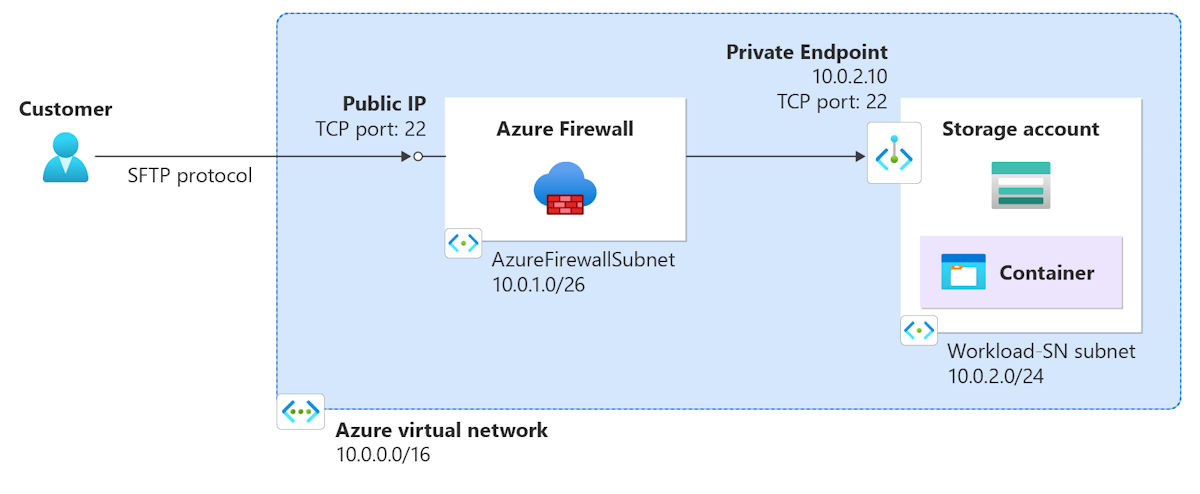
In this article, you:
- Deploy the network infrastructure.
- Create a firewall policy with the appropriate DNAT rule.
- Deploy the firewall.
- Create a storage account and container.
- Configure SFTP access to the storage account container.
- Create a private endpoint for the storage account container.
- Test the connection to the storage account container.
If you don't have an Azure subscription, create a free account before you begin.
Note
We recommend that you use the Azure Az PowerShell module to interact with Azure. To get started, see Install Azure PowerShell. To learn how to migrate to the Az PowerShell module, see Migrate Azure PowerShell from AzureRM to Az.
This article requires the latest Azure PowerShell modules. Run Get-Module -ListAvailable Az to find the version. If you need to upgrade, see Install Azure PowerShell module. If you're running PowerShell locally, you also need to run Connect-AzAccount to create a connection with Azure.
Deploy the network infrastructure
First, set up some variables to use in the deployment. Replace the values with your own.
Tip
You can use Microsoft Entra ID to find your user principal name.
$rg = "<resource-group-name>"
$location = "<location>"
$storageaccountname = "<storage-account-name>"
$staticEP = "10.0.2.10"
$SubscriptionName = "<your Azure subscription name>"
$UserPrincipalName = "<your AD user principal name>"
$ContainerName = "<container-name>"
Create the network infrastructure. This step includes creating a virtual network, subnets, and a public IP address for the firewall.
# Create a new resource group
New-AzResourceGroup `
    -Name $rg `
    -Location $location

# Create new subnets for the firewall
$FWsub = New-AzVirtualNetworkSubnetConfig `
    -Name AzureFirewallSubnet `
    -AddressPrefix 10.0.1.0/26
$Worksub = New-AzVirtualNetworkSubnetConfig `
    -Name Workload-SN `
    -AddressPrefix 10.0.2.0/24

# Create a new VNet
$testVnet = New-AzVirtualNetwork `
    -Name test-fw-vn `
    -ResourceGroupName $rg `
    -Location $location `
    -AddressPrefix 10.0.0.0/16 `
    -Subnet $FWsub, $Worksub

# Create a public IP address for the firewall
$pip = New-AzPublicIpAddress `
    -ResourceGroupName $rg `
    -Location $location `
    -AllocationMethod Static `
    -Sku Standard `
    -Name fw-pip
Create and configure the firewall policy
# Create a new firewall policy
$policy = New-AzFirewallPolicy `
    -Name "fw-pol" `
    -ResourceGroupName $rg `
    -Location $location

# Define new rules to add
$newrule1 = New-AzFirewallPolicyNatRule `
    -Name "dnat-rule1" `
    -Protocol "TCP", "UDP" `
    -SourceAddress "*" `
    -DestinationAddress $pip.IpAddress `
    -DestinationPort "22" `
    -TranslatedAddress $staticEP `
    -TranslatedPort "22"

# Add the new rules to the local rule collection object
$natrulecollection = New-AzFirewallPolicyNatRuleCollection `
    -Name "NATRuleCollection" `
    -Priority 100 `
    -ActionType "Dnat" `
    -Rule $newrule1

# Create a new rule collection group
$natrulecollectiongroup = New-AzFirewallPolicyRuleCollectionGroup `
    -Name "rcg-01" `
    -ResourceGroupName $rg `
    -FirewallPolicyName "fw-pol" `
    -Priority 100

# Add the new NAT rule collection to the rule collection group
$natrulecollectiongroup.Properties.RuleCollection = $natrulecollection

# Update the rule collection
Set-AzFirewallPolicyRuleCollectionGroup `
    -Name "rcg-01" `
    -FirewallPolicyObject $policy `
    -Priority 200 `
    -RuleCollection $natrulecollectiongroup.Properties.RuleCollection
Deploy the firewall
# Create the firewall
$firewall = New-AzFirewall `
    -Name fw-01 `
    -ResourceGroupName $rg `
    -Location $location `
    -VirtualNetwork $testVnet `
    -PublicIpAddress $pip `
    -FirewallPolicyId $policy.id
Create a storage account and container
New-AzStorageAccount `
    -ResourceGroupName $rg `
    -Name $StorageAccountName `
    -SkuName Standard_LRS `
    -Location $location `
    -EnableHierarchicalNamespace $true `
    -PublicNetworkAccess Enabled

# Get the subscription and user information
$subscriptionId = (Get-AzSubscription `
    -SubscriptionName $SubscriptionName).SubscriptionId
$user = Get-AzADUser `
    -UserPrincipalName $UserPrincipalName

# Give the user contributor role
New-AzRoleAssignment `
    -ObjectId $user.Id `
    -RoleDefinitionName "Storage Blob Data Contributor" `
    -Scope "/subscriptions/$subscriptionId/resourceGroups/$rg/providers/Microsoft.Storage/storageAccounts/$StorageAccountName"

# Create the container and then disable public network access
$ctx = New-AzStorageContext -StorageAccountName $StorageAccountName
New-AzStorageContainer `
    -Name $ContainerName `
    -Context $ctx
Set-AzStorageAccount `
    -ResourceGroupName $rg `
    -Name $StorageAccountName `
    -PublicNetworkAccess Disabled `
    -Force
Configure SFTP access to the storage account container
Set-AzStorageAccount `
    -ResourceGroupName $rg `
    -Name $StorageAccountName `
    -EnableSftp $true

$permissionScopeBlob = New-AzStorageLocalUserPermissionScope `
    -Permission rwdlc `
    -Service blob `
    -ResourceName $ContainerName

$localuser = Set-AzStorageLocalUser `
    -ResourceGroupName $rg `
    -AccountName $StorageAccountName `
    -UserName testuser `
    -PermissionScope $permissionScopeBlob

$localuserPassword = New-AzStorageLocalUserSshPassword `
    -ResourceGroupName $rg `
    -StorageAccountName $StorageAccountName `
    -UserName testuser

# Examine and manually save the password

$localuserPassword
Create a private endpoint for the storage account container
# Place the previously created storage account into a variable
$storage = Get-AzStorageAccount `
    -ResourceGroupName $rg `
    -Name $StorageAccountName

# Create the private endpoint connection
$pec = @{
    Name = 'Connection01'
    PrivateLinkServiceId = $storage.ID
    GroupID = 'blob'
}

$privateEndpointConnection = New-AzPrivateLinkServiceConnection @pec


# Create the static IP configuration
$ip = @{
    Name = 'myIPconfig'
    GroupId = 'blob'
    MemberName = 'blob'
    PrivateIPAddress = $staticEP
}

$ipconfig = New-AzPrivateEndpointIpConfiguration @ip

# Create the private endpoint
$pe = @{
    ResourceGroupName = $rg
    Name = 'StorageEP'
    Location = $location
    Subnet = $testVnet.Subnets[1]
    PrivateLinkServiceConnection = $privateEndpointConnection
    IpConfiguration = $ipconfig
}

New-AzPrivateEndpoint @pe
Test the SFTP connection
Now, test the connection to make sure you can connect to the storage account container by using SFTP. You can use any SFTP client to test the connection. In this example, use sftp from a command prompt.
For example, for a storage account named teststorageaccount, a container named testcontainer, a local account named testuser, and a firewall public IP address of 13.68.216.252, use the following command:
sftp teststorageaccount.testcontainer.testuser@13.68.216.252
Enter the password you saved earlier when prompted.
You see something similar to the following output:
> sftp vehstore101.container01.testuser@13.68.216.252
teststorageaccount.testcontainer.testuser@13.68.216.252's password:
Connected to 13.68.216.252.
sftp>
You're now connected to the storage account container by using SFTP. You can use put and get commands to upload and download files. Use ls to list the files in the container, and lls to list the files in the local directory.
Clean up resources
When you no longer need the resources, use the following command to remove the resource group, firewall, firewall policy, and all related resources.
Remove-AzResourceGroup -Name $rg -Force