Note
Access to this page requires authorization. You can try signing in or changing directories.
Access to this page requires authorization. You can try changing directories.
Microsoft Defender for open-source relational databases detects anomalous activities that indicate unusual and potentially harmful attempts to access or exploit databases. Defender for Cloud provides security alerts on anomalous activities so that you can detect potential threats and respond to them as they occur. When you enable this plan, Defender for Cloud provides alerts when it detects anomalous database access and query patterns and suspicious database activities.
These alerts appear in Defender for Cloud's security alerts page and include:
- Details of the suspicious activity that triggered them
- The associated MITRE
ATT&CKtactic - Recommended actions for how to investigate and mitigate the threat
- Options for continuing your investigations with Microsoft Sentinel
Microsoft Defender for Cloud and brute force attacks
A brute force attack is among the most common and fairly successful hacking methods, despite being one of the least sophisticated hacking methods. The theory behind such an attack is that if you take an infinite number of attempts to guess a password, you're bound to be right eventually. When Microsoft Defender for Cloud detects a brute force attack, it triggers an alert to bring you awareness that a brute force attack took place. It also can separate simple brute force attack from brute force attack on a valid user or a successful brute force attack.
Microsoft Defender for Cloud Security Posture Management (CSPM) Assessments
Microsoft Defender Security Posture Management assessments continuously evaluate the security posture of PostgreSQL servers. Defender scans server- and database-level configurations against PostgreSQL-specific security best practices to identify potential vulnerabilities and misconfigurations that could increase risk. Assessments provide actionable recommendations to help improve security posture, support compliance requirements, and reduce exposure to threats.
The following recommendations are now available for Azure Database for PostgreSQL flexible server as part of Defender CSPM, with additional assessments planned:
| Scope | Recommendation |
|---|---|
| server | Set logfiles.retention_days to greater than 3 for PostgreSQL Servers View file changes |
| server | Set pgaudit.log_statement to on for Azure Database for PostgreSQL Servers |
| server | Set pgaudit.log_statement_once to on for Azure Database for PostgreSQL Servers |
| server | Include role, ddl, and misc in pgaudit.log for Azure Database for PostgreSQL Servers |
| server | Set pgaudit.log_level to log for Azure Database for PostgreSQL Servers |
| server | Disable public IP access for Azure Database for PostgreSQL Servers |
| server | Configure private endpoint for Azure Database for PostgreSQL Servers |
| server | Disable 'Allow access to Azure services' for PostgreSQL Servers |
| server | Enable geo-redundant backups for PostgreSQL Servers |
| server | Set require_secure_transport to on for Azure Database for PostgreSQL Servers |
| server | Set connection_throttle to on for PostgreSQL Servers (preview) |
To get security alerts and recommendations from Microsoft Defender, first enable it as shown in the next section.
Enable enhanced security with Microsoft Defender for Cloud
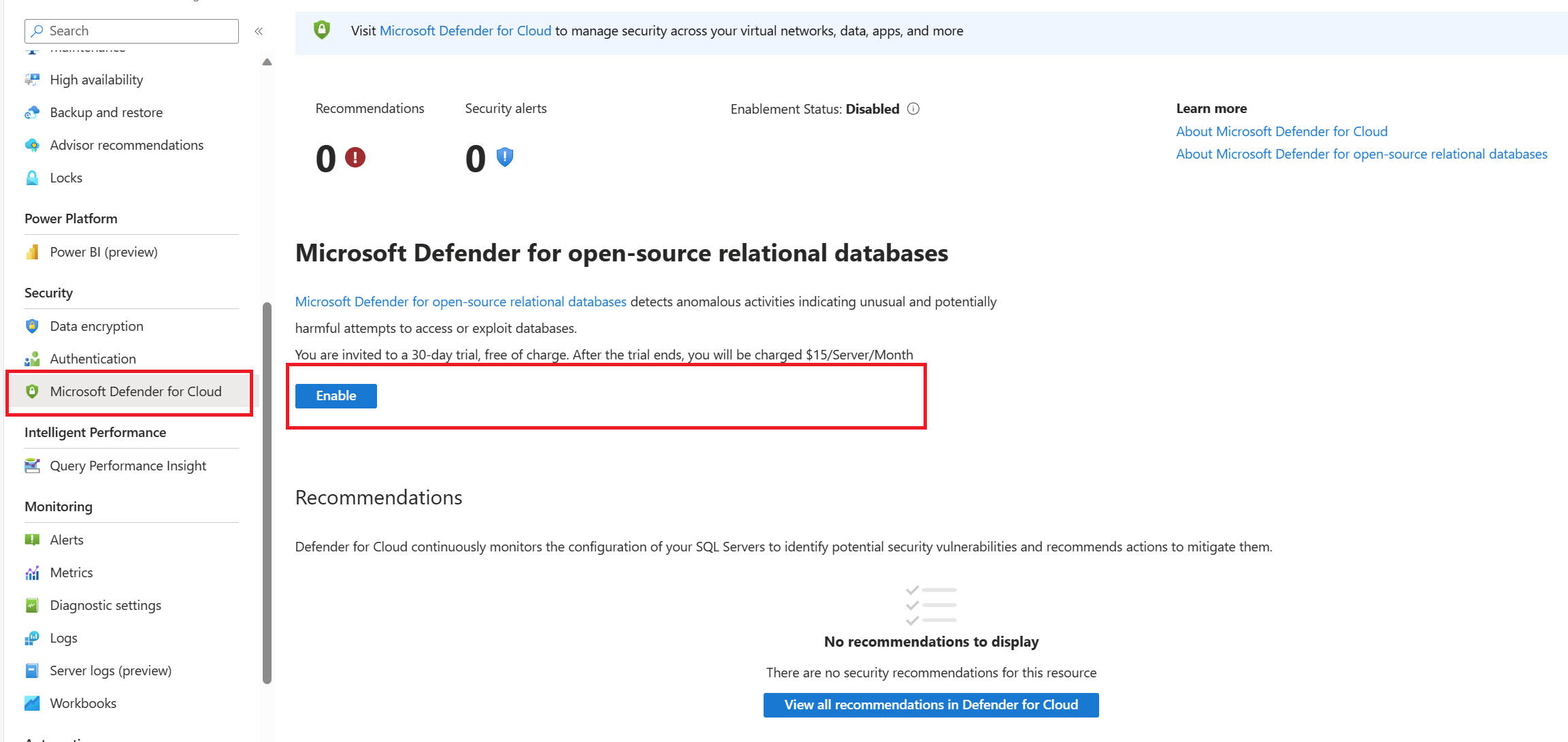
From the Azure portal, go to the Security menu in the left pane.
Select Microsoft Defender for Cloud.
Select Enable in the right pane.
Note
If you enable the open-source relational databases feature in your Microsoft Defender plan, you see that Microsoft Defender is automatically enabled by default for your Azure Database for PostgreSQL resource.