Note
Access to this page requires authorization. You can try signing in or changing directories.
Access to this page requires authorization. You can try changing directories.
In this tutorial, you enable Code Interpreter for your Azure SRE Agent and use it to analyze Azure data, generate visualizations, and create downloadable files directly from chat prompts.
Note
To learn more about Code Interpreter and the problems it solves, see Code Interpreter.
In this tutorial, you learn how to:
- Enable Code Interpreter through the agent settings
- Analyze Azure resource data using natural language prompts
- Download generated files from the conversation
- Create visualizations and PDF reports
Estimated time: 10 minutes
Prerequisites
Before you begin, make sure you have the following:
- An Azure SRE Agent. For more information, see Create an agent.
- Access to the SRE Agent portal.
Enable Code Interpreter
Turn on Code Interpreter through the Early access settings.
- Open the SRE Agent portal and select your agent.
- Select Settings in the left navigation.
- Select Basics.
- Find Early access to features and set the toggle to On.
Tip
The Early access toggle should display as enabled (blue). Your agent now has access to Code Interpreter.
Ask a question that needs computation
Submit a data analysis query to trigger Code Interpreter.
Select New chat thread in the top left.
In the chat input, type a question that requires data analysis:
Analyze the Azure resource groups in my subscription and create a summary
table showing each resource group name and its region.
Select Send and observe your agent's process.
Your agent:
- Queries Azure for resource group data
- Writes Python code to process the results
- Executes the code in a secure sandbox
- Returns a formatted table
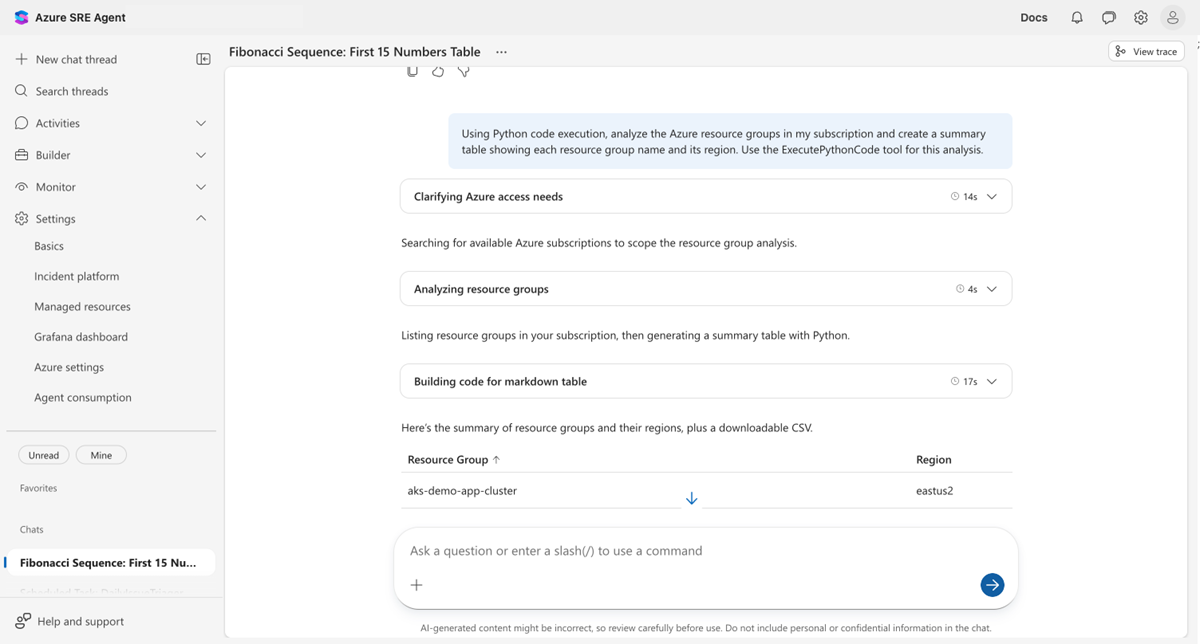
You should see your agent's reasoning steps (for example, "Clarifying Azure access needs," "Analyzing resource groups," "Building code for markdown table") followed by a formatted table of your resource groups.
Download a generated file
Scroll to the bottom of your agent's response to find a download link for a CSV file.
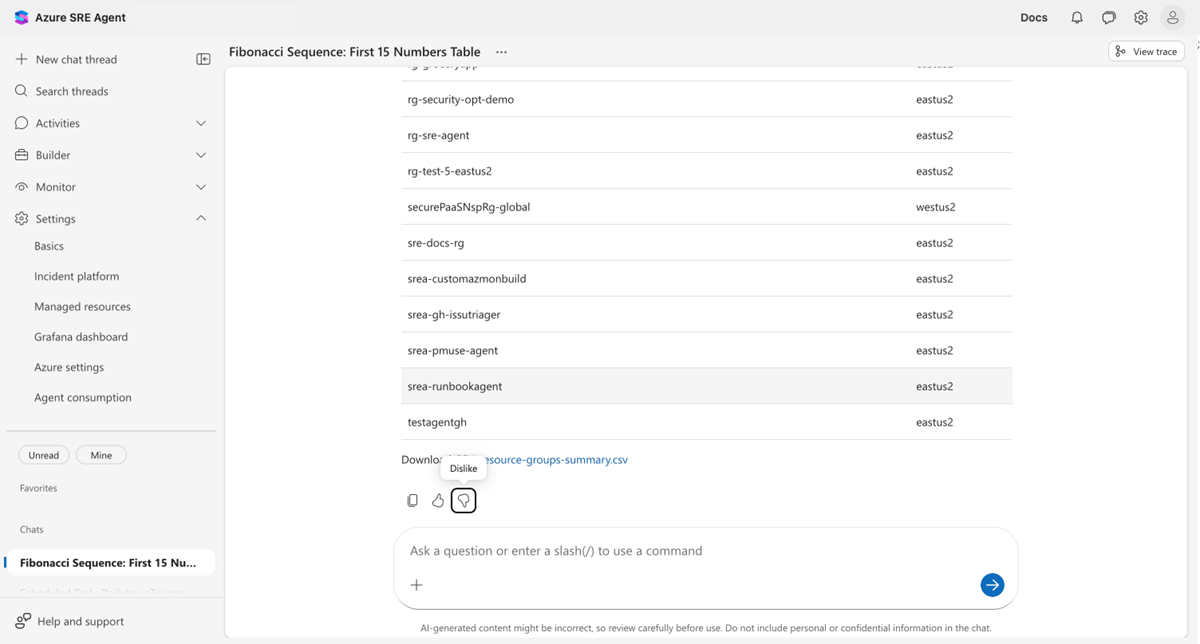
Select the link to download the CSV file and verify it contains the resource group data. This confirms that Code Interpreter can generate files you can use outside the conversation.
Generate a visualization
Ask your agent for a chart:
Create a bar chart showing how many resource groups I have in each Azure region.
Include a title and axis labels.
Your agent writes matplotlib code, executes it, and displays the chart inline in the conversation. An image should appear inline in the chat showing a bar chart of resource groups by region.
Create a PDF report
Ask your agent to create a formatted report:
Create a PDF report titled "Azure Resource Group Summary" that includes:
- A summary of total resource groups and regions used
- The table of all resource groups and regions
- The bar chart from the previous step
Save it as resource-group-report.pdf
Your agent combines the data, table, and chart into a formatted PDF and returns a download link. Download the file to verify it contains the summary, table, and chart. This demonstrates the full pipeline: Azure data to analysis to formatted report.
Troubleshooting
Use the following information to resolve common issues.
Agent says "I can only assist with Microsoft Azure topics"
Code Interpreter works within the context of Azure SRE tasks. Frame your prompts around your Azure environment. For example, instead of "Calculate the Fibonacci sequence," try "Analyze the deployment frequency across my Azure resource groups."
Code execution seems slow
Code execution typically takes 15 to 30 seconds depending on complexity. The agent needs time to write code, provision a sandbox session, execute, and return results. Wait for the full response before retrying.
Early access toggle doesn't appear
Verify you have the correct permissions on the agent. You need at least Contributor access to the agent resource to modify settings.
Code execution returns an error
Your agent handles most errors automatically by retrying with corrected code. If errors persist, try the following:
- Simplify your request into smaller steps.
- Be more specific about the desired output format.
- Start a new chat thread to reset the sandbox session.