Note
Access to this page requires authorization. You can try signing in or changing directories.
Access to this page requires authorization. You can try changing directories.
Note
Community interest groups have now moved from Yammer to Microsoft Viva Engage. To join a Viva Engage community and take part in the latest discussions, fill out the Request access to Finance and Operations Viva Engage Community form and choose the community you want to join.
The SalesPurchLine and SalesPurchTable table maps expose a set of common fields and methods that a variety of product features use. Refactor the mapping of fields and the implementation of methods into a class hierarchy. Some of these changes include:
- Move methods on the table maps to the class hierarchy.
- Expose fields through parm-methods on the class hierarchy.
- Keep the table map, and keep tables implementing the mapping to the table map, but make the fields on the table map obsolete, and remove field mapping.
- Make the methods on the table map obsolete.
SalesPurchTableInterface hierarchy
The new SalesPurchTableInterface class is the abstract base class for the ApplicationSuite functionality that the refactoring of the SalesPurchTable table map introduces. The class contains abstract methods for fields and methods, which must exist for each table implementing the interface. It also contains the default logic in methods, which is common across all implementations. Each table that implements the SalesPurchTable table map must be represented as a derived class in the SalesPurchTableInterface class hierarchy. Decorate each derived class with a SalesPurchTableInterfaceFactory attribute class. Use the attribute to associate the derived class with the table, so that you can instantiate a class of the correct type depending on a SalesPurchTable record.

Even though the table map methods are obsolete, the corresponding methods still exist on the implementing tables. Refactor the logic in these methods from delegating calls to the method on the table map, to the corresponding method on the base class of the hierarchy.
Extension scenario
In this example, if you want your ISVModule2 model to extend the interface class hierarchy and the tables that implement the SalesPurchTable table map, complete the following steps:
- Add fields and methods through table extension to the necessary tables that implement the SalesPurchTable table map.
- Create a new interface class hierarchy that exposes the new fields as parm-methods and other additional methods. The base class of the class hierarchy must be concrete and not abstract.
- Create derived classes for each table that you extended.
- Decorate each derived class with the SalesPurchTableInterfaceFactory attribute class to associate the class with the correct table.
- Create a static factory method on the base class of the new class hierarchy. The factory method should instantiate the proper derived class that leverages the SalesPurchTableInterfaceFactory attribute. If no derived class is found, the factory method returns an instance of the base class.
- Create an extension class of the SalesPurchTableInterface class. The class augments the SalesPurchTableInterface class with a method that creates an instance from the new class hierarchy by calling the factory method on the new class hierarchy.
The following diagram shows the preceding classes and extensions.
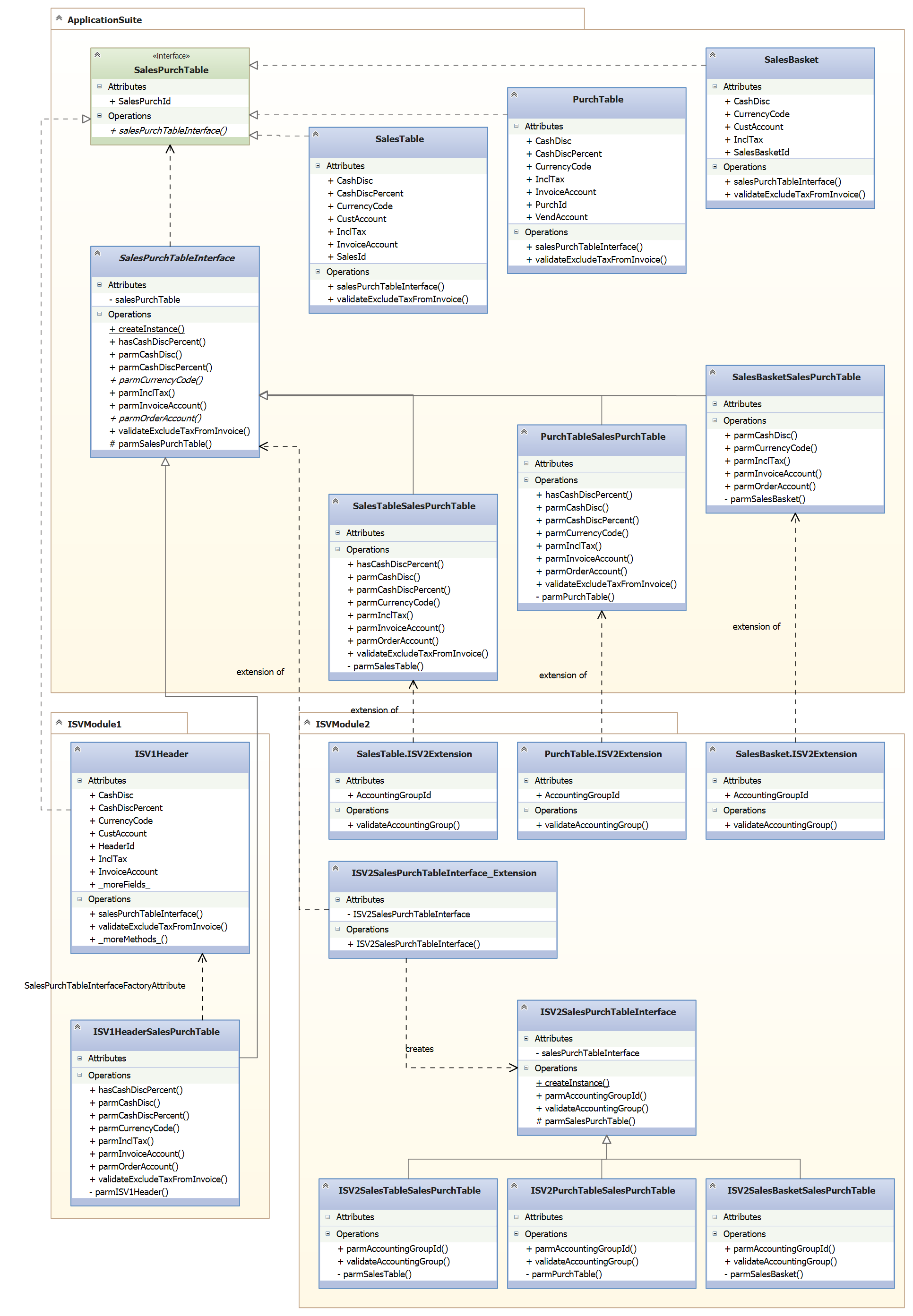
The diagram contains an ISVModule1 model, which includes the ISV1Header table that implements the SalesPurchTable table map and contains its own SalesPurchTableInterface derived class. The model is independent of the ISVModule2, so when logic in the ISVModule2 creates an instance from the ISV2SalesPurchTableInterface class hierarchy, the instance of the base class is returned when the SalesPurchTable record is of type ISV1Header. If the methods on the base class return a reasonable result for unknown tables, the two ISV models co-exist within the same installation.
Code example
The following code example demonstrates a way to extend table maps.
[ExtensionOf(classStr(SalesPurchTableInterface))]
final public class ISV2SalesPurchTableInterface_Extension
{
    private ISV2SalesPurchTableInterface ISV2SalesPurchTableInterface;

    public ISV2SalesPurchTableInterface ISV2SalesPurchTableInterface()
    {
        if (!ISV2SalesPurchTableInterface)
        {
            ISV2SalesPurchTableInterface = ISV2SalesPurchTableInterface::createInstance(this);
        }

        return ISV2SalesPurchTableInterface;
    }

}

public class ISV2SalesPurchTableInterface
{

    SalesPurchTableInterface salesPurchTableInterface;

    private void initializeSalesPurchTableInterface(SalesPurchTableInterface _salesPurchTableInterface)
    {
        salesPurchTableInterface = _salesPurchTableInterface;
    }

    public SalesPurchTable parmSalesPurchTable()
    {
        return salesPurchTableInterface.parmSalesPurchTable();
    }

    protected void new()
    {
    }

    public static ISV2SalesPurchTableInterface createInstance(SalesPurchTableInterface _salesPurchTableInterface)
    {
        SalesPurchTableInterfaceFactoryAttribute attr =
  new SalesPurchTableInterfaceFactoryAttribute(
   tableId2Name(_salesPurchTableInterface.parmSalesPurchTable().tableId));

        ISV2SalesPurchTableInterface instance =
  SysExtensionAppClassFactory::getClassFromSysAttribute(classStr(ISV2SalesPurchTableInterface), attr)
  as ISV2SalesPurchTableInterface;

        instance.initializeSalesPurchTableInterface(_salesPurchTableInterface);

        return instance;
    }

    public AccountingGroupId parmAccountingGroupId()
    {
        return '';
    }

}
[SalesPurchTableInterfaceFactoryAttribute(tableStr(SalesTable))]
public class ISV2SalesTableSalesPurchTable extends ISV2SalesPurchTableInterface
{
    private SalesTable parmSalesTable()
    {
        return this.parmSalesPurchTable();
    }

    public AccountingGroupId parmAccountingGroupId()
    {
        return this.parmSalesTable().AccountingGroupId;
    }

}

[SalesPurchTableInterfaceFactoryAttribute(tableStr(PurchTable))]
public class ISV2PurchTableSalesPurchTable extends ISV2SalesPurchTableInterface
{

    private PurchTable parmPurchTable()
    {
        return this.parmSalesPurchTable();
    }

    public AccountingGroupId parmAccountingGroupId()
    {
        return this.parmPurchTable().AccountingGroupId;
    }

}