Note
Access to this page requires authorization. You can try signing in or changing directories.
Access to this page requires authorization. You can try changing directories.
Applies to: Dynamics 365 Finance, Azure Key Vault, Azure SQL Database, Azure Active Directory, Azure Service Bus, Azure Kubernetes, MECOMS 365
This solution combines Microsoft Dynamics 365 Finance with the MECOMS 365 energy and utilities solution platform and MEEP (MECOMS Enterprise Extensibility Platform) to support utility companies in end-to-end back-office processes for Customer Information System (CIS) and Meter Data Management (MDM), including billing, payments and collections, market interaction, and a broad integration landscape.
Architecture
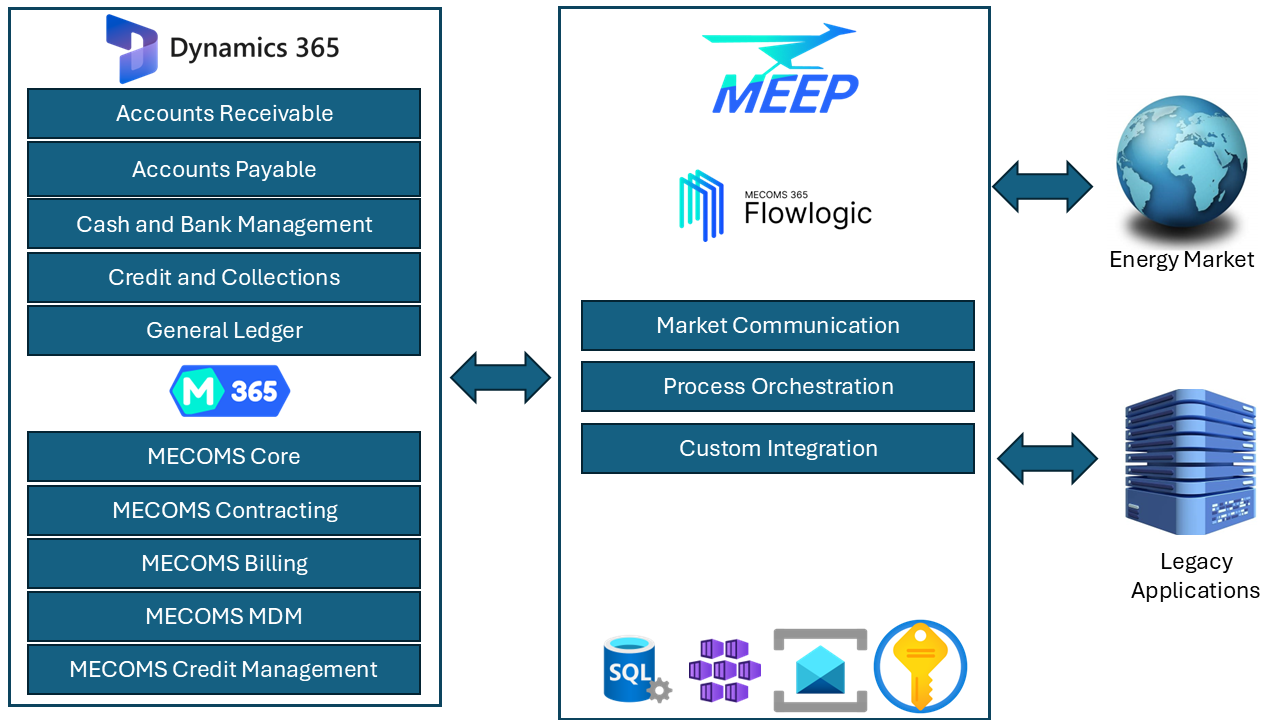
The following diagram illustrates the architecture for the solution.
Data flow
The solution uses a workflow-driven model that aligns with the MECOMS value chain and the integration and orchestration approach in MEEP. The typical end-to-end flow works as follows:
End customers are contracted through various channels. This can be through legacy applications, like websites or through the MECOMS contracting user interface.
Once the customer is contracted, the energy market should be notified. A process orchestration flow is started in MEEP which does the communication with the energy market parties.
Once the contract becomes active and accepted by the energy market, all needed master data is registered in MECOMS core module, this includes technical master data.
Meter data is collected from the energy market, through various MEEP processors.
Meter data is validated and stored in MECOMS MDM.
Once all meter data is received and checked for correctness, invoices can be generated by the Billing module, this includes scheduled and ad-hoc billing, including advances annual settlements, final bills and incidental invoices.
Invoices are validated in the Billing module.
Once invoices are correct, they can be sent to end customers, so that payments can be received.
Payment processing is done through direct debit generation, bank transfers and automatic matching rules for manual payments.
Financial postings and reporting is done in the general ledger in Dynamics 365 Finance.
Components
The reference architecture uses the following components:
Dynamics 365 Finance: core platform for financial and operational processing, batch execution, security.
MECOMS 365: A software solution specifically for the utility market, built as separate modules in Dynamics 365 Finance. Learn more at MECOMS 365 Customer Information System - Ferranti.
MEEP: An independent and cloud-centric integration and orchestration platform, using Azure Kubernetes, Azure SQL databases, Azure Service Bus, and Azure Key Vault. Learn more at MECOMS 365 Integration & orchestration - Ferranti.
Scenario details
This architecture supports the complex business processes that every utility business encounters. It brings the power of the cloud to utility companies by using a modular and standard approach with MECOMS 365.
Potential use cases
This solution was created specifically for a utility organization.
Considerations
These considerations help you implement a solution that includes Dynamics 365. Learn more at Dynamics 365 guidance documentation.
Key architectural considerations include scalability for high‑volume data, maintainability through modular design, auditability and compliance via time‑sliced data, operational efficiency through automation, and future‑proofing aligned with Microsoft’s One Version strategy.
Cost optimization
Cost optimization is about finding ways to reduce unnecessary expenses and improve operational efficiencies. Learn more at Overview of the cost optimization pillar.
The solution includes explicit cost and performance considerations for cloud operation at scale.
You can further support operational efficiency by using ‘manage by exception’ principles: automated processing is the default, and dedicated work lists, workspaces, and monitoring views help focus user effort on exceptions for meter data processing, payment matching, and other high-volume processes.