Note
Access to this page requires authorization. You can try signing in or changing directories.
Access to this page requires authorization. You can try changing directories.
A Citus cluster consists of a coordinator instance and multiple worker instances. The data is sharded on the workers while the coordinator stores metadata about these shards. A client can connect to the coordinator or, in MX mode, to any worker node, and submit queries there. The node that receives the query partitions it into smaller query fragments where each query fragment can run independently on a shard. That node assigns the query fragments to the workers that hold the relevant shards, oversees their execution, merges their results, and returns the final result to the client. The following diagram provides a brief description of the query processing architecture.
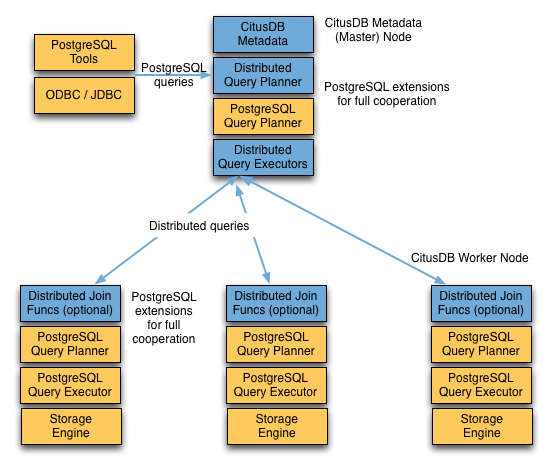
Citus's query processing pipeline involves two components:
- Distributed Query Planner and Executor
- PostgreSQL Planner and Executor
The following sections discuss these components in greater detail.
Query entry points and MX mode
In early versions of Citus, the coordinator was the only entry point for client queries. Starting with Citus 11, clients can also connect directly to any worker node and submit queries there. This capability is known as MX mode (multi-tenant or massively parallel extension), and it's enabled by default on managed Citus clusters.
MX mode addresses two scaling concerns:
- Coordinator hot-spotting. When every client connects to one node, that node's connection slots, CPU, and network become a bottleneck. Allowing workers to accept client connections spreads this load across the cluster.
- Latency for shard-local queries. When a client connects to the worker that already stores the relevant shard, Citus can plan and execute the query against the local shard table without extra network hops.
For MX mode to work, every node needs an up-to-date copy of the cluster metadata (the catalog of distributed tables and shard placements). Citus syncs this metadata to all nodes automatically; the citus.metadata_sync_mode setting controls how the sync runs.
When a worker receives a query, it plays the same role the coordinator plays in the classic topology:
- If the query touches shards on other workers, the receiving node opens connections to those workers, distributes the fragments, and merges results before returning them to the client.
- If the query targets a shard that lives on the receiving node, the node uses
citus.local_hostnameto reach itself and runs the fragment locally. The Delayed fast path planning (Citus 13.2) optimization builds on this case to reuse cached plans and skip deparse, parse, and plan steps for the shard query.
Writes to distributed and reference tables follow the same path: the receiving node applies the standard distributed transaction protocol regardless of whether it's the coordinator or a worker.
Distributed query planner
Citus's distributed query planner takes in a SQL query and plans it for distributed execution. The planner runs on the node that received the query: the coordinator in the classic topology, or any worker in MX mode.
For SELECT queries, the planner first creates a plan tree of the input query and transforms it into its commutative and associative form so it can be parallelized. It also applies several optimizations to ensure that the queries are executed in a scalable manner, and that network I/O is minimized.
Next, the planner breaks the query into two parts: the top-level query, which runs on the receiving node, and the worker query fragments, which run on individual shards on the workers. The planner then assigns the query fragments to the workers such that all their resources are used efficiently. After this step, the distributed query plan is passed on to the distributed executor for execution.
The planning process for key-value lookups on the distribution column or modification queries is slightly different as they hit exactly one shard. When the planner receives an incoming query, it decides the correct shard to which the query should be routed. It determines the right shard for the query by extracting the distribution column in the incoming row and looking up the metadata. Then, the planner rewrites the SQL of that command to reference the shard table instead of the original table. This rewritten plan is then passed to the distributed executor.
Delayed fast path planning (Citus 13.2)
In Citus 13.2, the planner delays building the fast-path placeholder plan until it identifies the shard. In MX mode, if the shard placement is local to the node that handles the client query, Citus can avoid deparse, parse, and plan steps for the shard query and reuse a cached plan. This approach improves throughput.
Eligibility:
- Query is
SELECTorUPDATEon a distributed table (schema or column-sharded) or Citus-managed local table. - No volatile functions.
- Shard can be determined at plan time and is local to the receiving node.
- Reference tables aren't currently supported.
Behavior:
- If the shard is local and safe, the executor replaces the distributed table OID with the shard OID, calls
standard_planner, and caches the plan in the task. - Otherwise, the executor falls back to the fast-path placeholder plan.
GUC:
citus.enable_local_fast_path_query_optimization(defaulton).
Distributed query executor
Citus's distributed executor runs distributed query plans and handles failures. The executor is well suited for getting fast responses to queries that involve filters, aggregations, and colocated joins. It's also good for running single-tenant queries with full SQL coverage. The executor runs on the receiving node and opens one connection per shard to the workers that hold those shards, sending all fragment queries to them. In MX mode, the receiving node might be a worker, and any shards it stores locally execute without a network hop. The executor then fetches the results from each fragment query, merges them, and returns the final results to the client.
Subquery and CTE push-pull execution
If necessary, Citus can gather results from subqueries and common table expressions (CTEs) into the receiving node and then push them back across workers for use by an outer query. This architecture allows Citus to support a greater variety of SQL constructs.
For example, having subqueries in a WHERE clause can't always execute inline at the same time as the main query, but must be done separately. Suppose a web analytics application maintains a page_views table partitioned by page_id. To query the number of visitor hosts on the top 20 most visited pages, use a subquery to find the list of pages, then an outer query to count the hosts.
SELECT page_id, count(distinct host_ip)
FROM page_views
WHERE page_id IN (
  SELECT page_id
  FROM page_views
  GROUP BY page_id
  ORDER BY count(*) DESC
  LIMIT 20
)
GROUP BY page_id;
The executor runs a fragment of this query against each shard by page_id, counts distinct host_ips, and combines the results on the coordinator. However, the LIMIT in the subquery means the subquery can't be executed as part of the fragment. By recursively planning the query Citus can run the subquery separately, push the results to all workers, run the main fragment query, and pull the results back to the coordinator. The push-pull design supports subqueries like the one in the previous example.
You can see this push-pull execution in action by reviewing the EXPLAIN output for this query.
GroupAggregate (cost=0.00..0.00 rows=0 width=0)
  Group Key: remote_scan.page_id
  -> Sort (cost=0.00..0.00 rows=0 width=0)
    Sort Key: remote_scan.page_id
    -> Custom Scan (Citus Adaptive) (cost=0.00..0.00 rows=0 width=0)
      -> Distributed Subplan 6_1
        -> Limit (cost=0.00..0.00 rows=0 width=0)
          -> Sort (cost=0.00..0.00 rows=0 width=0)
            Sort Key: COALESCE((pg_catalog.sum((COALESCE((pg_catalog.sum(remote_scan.worker_column_2))::bigint, '0'::bigint))))::bigint, '0'::bigint) DESC
            -> HashAggregate (cost=0.00..0.00 rows=0 width=0)
              Group Key: remote_scan.page_id
              -> Custom Scan (Citus Adaptive) (cost=0.00..0.00 rows=0 width=0)
                Task Count: 32
                Tasks Shown: One of 32
                -> Task
                  Node: host=localhost port=9701 dbname=postgres
                  -> HashAggregate (cost=54.70..56.70 rows=200 width=12)
                    Group Key: page_id
                    -> Seq Scan on page_views_102008 page_views (cost=0.00..43.47 rows=2247 width=4)
      Task Count: 32
      Tasks Shown: One of 32
      -> Task
        Node: host=localhost port=9701 dbname=postgres
        -> HashAggregate (cost=84.50..86.75 rows=225 width=36)
          Group Key: page_views.page_id, page_views.host_ip
          -> Hash Join (cost=17.00..78.88 rows=1124 width=36)
            Hash Cond: (page_views.page_id = intermediate_result.page_id)
            -> Seq Scan on page_views_102008 page_views (cost=0.00..43.47 rows=2247 width=36)
            -> Hash (cost=14.50..14.50 rows=200 width=4)
              -> HashAggregate (cost=12.50..14.50 rows=200 width=4)
                Group Key: intermediate_result.page_id
                -> Function Scan on read_intermediate_result intermediate_result (cost=0.00..10.00 rows=1000 width=4)
The process is fairly involved, so let's break it apart and examine each piece.
GroupAggregate (cost=0.00..0.00 rows=0 width=0)
  Group Key: remote_scan.page_id
  -> Sort (cost=0.00..0.00 rows=0 width=0)
    Sort Key: remote_scan.page_id
The root of the tree is what the coordinator node does with the results from the workers. In this case, it's grouping them, and GroupAggregate requires they be sorted first.
    -> Custom Scan (Citus Adaptive) (cost=0.00..0.00 rows=0 width=0)
      -> Distributed Subplan 6_1
The custom scan has two large subtrees, starting with a distributed subplan.
        -> Limit (cost=0.00..0.00 rows=0 width=0)
          -> Sort (cost=0.00..0.00 rows=0 width=0)
            Sort Key: COALESCE((pg_catalog.sum((COALESCE((pg_catalog.sum(remote_scan.worker_column_2))::bigint, '0'::bigint))))::bigint, '0'::bigint) DESC
            -> HashAggregate (cost=0.00..0.00 rows=0 width=0)
              Group Key: remote_scan.page_id
              -> Custom Scan (Citus Adaptive) (cost=0.00..0.00 rows=0 width=0)
                Task Count: 32
                Tasks Shown: One of 32
                -> Task
                  Node: host=localhost port=9701 dbname=postgres
                  -> HashAggregate (cost=54.70..56.70 rows=200 width=12)
                    Group Key: page_id
                    -> Seq Scan on page_views_102008 page_views (cost=0.00..43.47 rows=2247 width=4)
Worker nodes run this subplan for each of the 32 shards (Citus is choosing one representative for display). You can recognize all the pieces of the IN (...) subquery: the sorting, grouping, and limiting. When all workers complete this query, they send their output back to the coordinator, which puts it together as intermediate results.
      Task Count: 32
      Tasks Shown: One of 32
      -> Task
        Node: host=localhost port=9701 dbname=postgres
        -> HashAggregate (cost=84.50..86.75 rows=225 width=36)
          Group Key: page_views.page_id, page_views.host_ip
          -> Hash Join (cost=17.00..78.88 rows=1124 width=36)
            Hash Cond: (page_views.page_id = intermediate_result.page_id)
Citus starts another executor job in this second subtree. It's going to count distinct hosts in page_views. It uses a JOIN to connect with the intermediate results. The intermediate results help restrict it to the top 20 pages.
            -> Seq Scan on page_views_102008 page_views (cost=0.00..43.47 rows=2247 width=36)
            -> Hash (cost=14.50..14.50 rows=200 width=4)
              -> HashAggregate (cost=12.50..14.50 rows=200 width=4)
                Group Key: intermediate_result.page_id
                -> Function Scan on read_intermediate_result intermediate_result (cost=0.00..10.00 rows=1000 width=4)
The worker internally retrieves intermediate results by using a read_intermediate_result function, which loads data from a file that the coordinator node copied in.
This example showed how Citus executed the query in multiple steps with a distributed subplan, and how you can use EXPLAIN to learn about distributed query execution.
PostgreSQL planner and executor
After the distributed executor dispatches the query fragments, each worker processes its fragments like regular PostgreSQL queries. In MX mode, the receiving worker also runs fragments for any shards it stores locally. The PostgreSQL planner on each worker chooses the most optimal plan for executing the query locally on the corresponding shard table. The PostgreSQL executor runs the query and returns the query results back to the distributed executor. For more information about the PostgreSQL planner and executor, see the PostgreSQL manual. Finally, the distributed executor passes the results to the receiving node for final aggregation and returns them to the client.