Note
Access to this page requires authorization. You can try signing in or changing directories.
Access to this page requires authorization. You can try changing directories.
Managed availability provides robust capabilities to ensure continuous uptime, seamless failover, and enterprise-grade resilience for mission-critical applications and AI workloads. Built on Microsoft Azure, these features safeguard businesses against failures, outages, and disruptions, ensuring high availability without compromising performance.
What can you do with managed availability?
Managed availability is a suite of premium capabilities designed to ensure the resilience, responsiveness, and reliability of AI agents built with Microsoft Copilot Studio. It provides seamless failover, self-healing systems, and disaster-proof architecture, allowing businesses to run their intelligent automation workflows securely and at scale. By proactively mitigating disruptions and maintaining uninterrupted operations, managed availability empowers organizations to safeguard their AI-driven processes against a wide range of unforeseen events.
Increased resiliency with Azure availability zones
Managed availability uses Azure availability zones to replicate production environments across multiple datacenters within a region. These zones are physically separated and operate independently with distinct power, networking, and cooling systems.
Benefits of availability zones:
- Near zero data loss: Synchronous replication across zones. For example, two—and in some cases three—zones.
- Rapid failover: Recovery time objective (RTO) of typically less than five minutes.
- Minimal service disruption: Automatic redirection of traffic during zone-level failures.
A typical replication lag of up to 15 minutes (but often under 5 minutes) is observed. The platform is designed to complete failover in under 5 minutes for Dynamics 365 CE and under 30 minutes for F&O once initiated. Because customers retain control of when and whether to trigger a cross-region failover, Microsoft doesn't publish a contractual cross-region RTO. However, customers can monitor real-time replication lag directly in the Power Platform Admin Center (PPAC) to inform their own recovery decisions. It's also important to note that when Power Platform solutions connect to external systems - such as SQL Server, REST APIs, or other third-party services - the RTO and RPO of those integrations are governed by the availability and recovery capabilities of the respective target systems, and fall outside the scope of Power Platform's resiliency commitments.
Automated backups and self-serve disaster recovery
Environments with databases benefit from automated backups that you can restore to any system backup from the past seven days (extendable to 28 days for production managed environments).
Self-serve disaster recovery allows organizations to:
- Define and test cross-region failover strategies directly from the Power Platform admin center.
- Maintain a secondary environment copy in another region for business continuity.
- Activate emergency response modes for quick recovery during major outages.
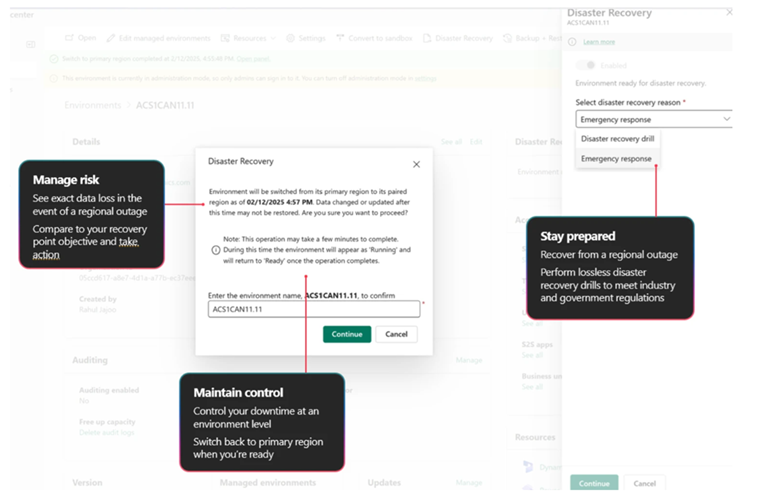
Self-serve disaster recovery also supports disaster recovery drills and failback capabilities that empower administrators to decide whether and when to switch back to the primary location after an outage.