Note
Access to this page requires authorization. You can try signing in or changing directories.
Access to this page requires authorization. You can try changing directories.
The Dataverse SDK for Python is a comprehensive toolkit that empowers professional developers and data scientists to unlock advanced analytics, automation, and innovation in Microsoft Dataverse. Developers can use the SDK to build scalable and secure business applications and orchestrate agentic workflows. Data scientists and analysts can use familiar Python tools—such as Pandas, Jupyter notebooks, and machine learning libraries—to create analysis models and simulation models and operationalize AI-driven insights. This SDK bridges the gap between enterprise-grade data management and the flexibility of Python, accelerating time-to-value and fostering a vibrant developer ecosystem.
Tip
This article provides an example scenario and architectural overview of how the Dataverse SDK for Python enables data-driven innovation. This solution is a generalized example that can be adapted to various industries and use cases.
Start by watching the introduction video on using the Dataverse SDK for Python with business data.
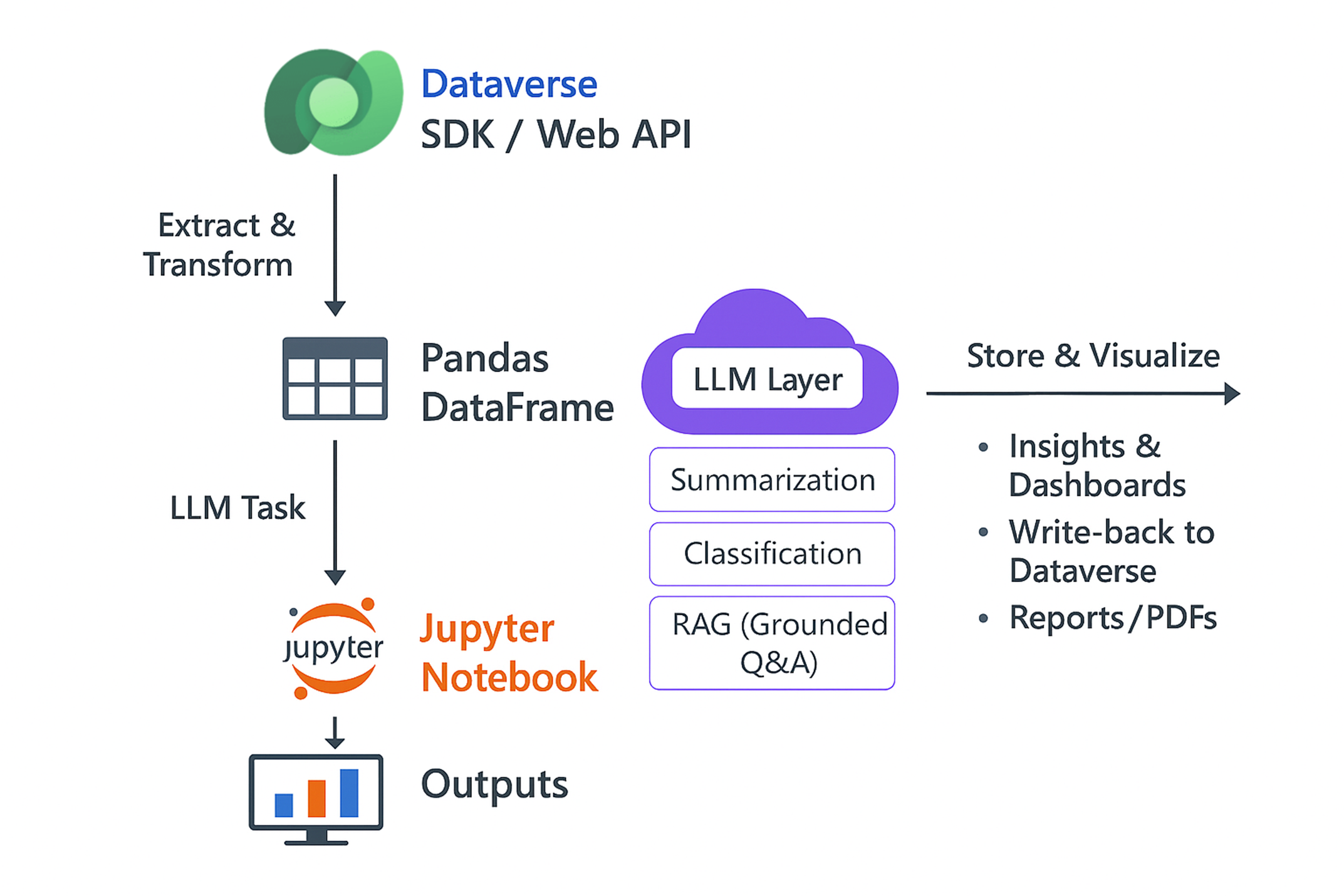
Architecture diagram
Workflow
The typical workflow for harnessing Dataverse business data by using Python includes:
- Connect to Dataverse: Securely access enterprise data by using the SDK.
- Extract and transform: Load tables into Pandas DataFrames for cleaning, feature engineering, and exploratory analysis.
- Assessment modeling: Apply machine learning algorithms (for example, classification, regression) to evaluate business scenarios, predict outcomes, and identify trends.
- Write-back to Dataverse: Post AI-generated assessments to Dataverse tables for dashboards and reporting.
- Governance: Ensure all workflows comply with enterprise security and governance standards.
Scenario details
This architecture supports a wide range of scenarios and use cases across industries.
Developer scenario
A Python developer builds an employee onboarding system for Fabrikam Enterprises by creating tables for employee details, department reference, and onboarding request status. By using the SDK, they define schemas, add columns and relationships, and use create, read, and update APIs to seed and modify records—all while upholding enterprise-level security and governance.
Data scientist scenario
A data scientist uses Python tools such as Jupyter notebooks and Visual Studio Code to extract business data from Dataverse and shape it into Pandas DataFrames. The data scientist uses the extracted business data with advanced analytics and machine learning models for risk assessment, service level agreement (SLA) monitoring, or compliance reporting. The data scientist visualizes and shares outputs to enable fast decision-making.
Generative AI use case
Use Python analytics and language models to summarize customer trends or classify segments, such as high-value or churn risk. Write the results back to Dataverse to enable operational dashboards and compliance workflows. This approach ensures that AI outputs are securely stored and governed within the enterprise data platform.
Prerequisites
- Access to a Power Platform environment with Dataverse
- Appropriate security roles
- Python 3.13 or later
- Network access to PyPI for SDK installation
In addition:
- Integration: Ensure compatibility with existing Extract, Transform, Load (ETL) pipelines, automation tools, and enterprise governance policies.
- Scalability: Design workflows to handle large datasets and concurrent analytics tasks.
Considerations
These considerations implement the pillars of Power Platform Well-Architected, a set of guiding tenets that improve the quality of a workload. Learn more in Microsoft Power Platform Well-Architected.
Reliability
Robust data access: Supports reliable Create, Read, Update, and Delete (CRUD) operations and schema management.
Automation: Enables repeatable, automated workflows for data extraction, transformation, and analysis.
Operational efficiency: Reduces manual effort and accelerates analytics modernization.
Security
Role-based access control: Enforces Dataverse security roles and policies for all data operations.
Data governance: Ensures compliance with enterprise standards for data privacy, audit logging, and encryption.
Next steps
- Download and install the SDK from PyPI. Explore the GitHub source repository for documentation, sample projects, and community contributions.
- Start building Python-powered analytics and AI workflows with Dataverse data.
- Share feedback and join the community to help shape the future of Dataverse for Python.
Contributors
Microsoft maintains this article. The following contributors wrote this article.
Principal authors:
- Paul Liew, Principal Product Manager
- Jeff Anderson, Partner Software Engineer
- Peter Hecke, Senior Developer Writer