Note
Access to this page requires authorization. You can try signing in or changing directories.
Access to this page requires authorization. You can try changing directories.
There are two classes involved in a ContentProvider interaction:
ContentProvider – Implements an API that exposes a set of data in a standard way. The main methods are Query, Insert, Update and Delete.
ContentResolver – A static proxy that communicates with a
ContentProviderto access its data, either from within the same application or from another application.
A content provider is normally backed by an SQLite database, but the
API means that consuming code does not need to know anything about the
underlying SQL. Queries are done via a Uri using constants to reference
column names (to reduce dependencies on the underlying data structure),
and an ICursor is returned for the consuming code to iterate over.
Consuming a ContentProvider
ContentProviders expose their functionality through a Uri that is
registered in the AndroidManifest.xml of the application that
publishes the data. There is a convention where the Uri and the data
columns that are exposed should be available as constants to make it
easy to bind to the data. Android's built-in ContentProviders all
provide convenience classes with constants that reference the data
structure in the
Android.Providers namespace.
Built-In Providers
Android offers access to a wide range of system and user data using ContentProviders:
Browser – bookmarks and browser history (requires permission
READ_HISTORY_BOOKMARKSand/orWRITE_HISTORY_BOOKMARKS).CallLog – recent calls made or received with the device.
Contacts – detailed information from the user's contact list, including people, phones, photos & groups.
MediaStore – contents of the user's device: audio (albums, artists, genres, playlists), images (including thumbnails) & video.
Settings – system-wide device settings and preferences.
UserDictionary – contents of the user-defined dictionary used for predictive text input.
Voicemail – history of voicemail messages.
Classes Overview
The primary classes used when working with a ContentProvider are
shown here:
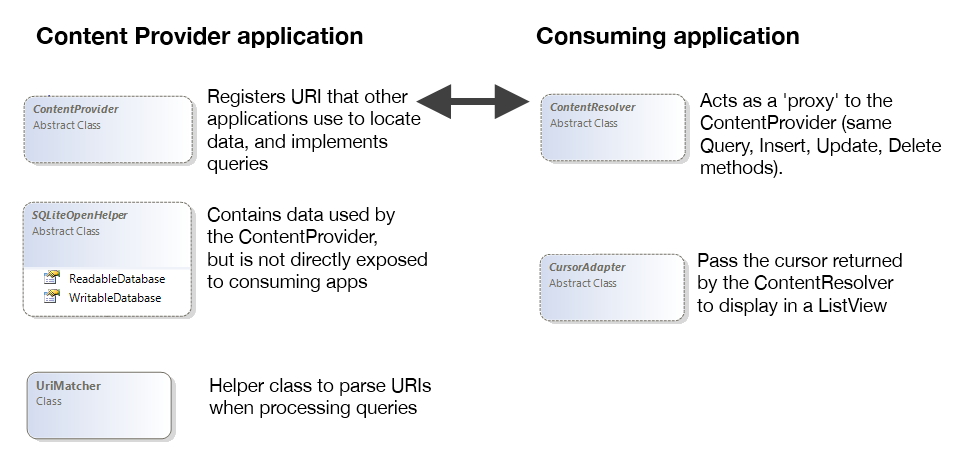
In this diagram, the ContentProvider implements queries and registers
URI's that other applications use to locate data. The ContentResolver
acts as a 'proxy' to the ContentProvider (Query, Insert, Update, and
Delete methods). The SQLiteOpenHelper contains data used by the
ContentProvider, but it is not directly exposed to consuming apps.
The CursorAdapter passes the cursor returned by the ContentResolver
to display in a ListView. The UriMatcher is a helper class that
parses URIs when processing queries.
The purpose of each class is described below:
ContentProvider – Implement this abstract class's methods to expose data. The API is made available to other classes and applications via the Uri attribute that is added to the class definition.
SQLiteOpenHelper – Helps implement the SQLite datastore that is exposed by the
ContentProvider.UriMatcher – Use
UriMatcherin yourContentProviderimplementation to help manage Uris that are used to query the content.ContentResolver – Consuming code uses a
ContentResolverto access aContentProviderinstance. The two classes together take care of the inter-process communication issues, allowing data to be easily shared between applications. Consuming code never creates aContentProviderclass explicity; instead, the data is accessed by creating a cursor based on a Uri exposed by theContentProviderapplication.CursorAdapter – Use
CursorAdapterorSimpleCursorAdapterto display data accessed via aContentProvider.
The ContentProvider API allows consumers to perform a variety of
operations on the data, such as:
- Query data to return lists or individual records.
- Modify individual records.
- Add new records.
- Delete records.
This document contains an example that uses a system-provided
ContentProvider, as well as a simple read-only example that
implements a custom ContentProvider.